Patrimoine immatériel
Bobbin Lace
Bobbin lace, a textile cushion art from the fishing communities of Vila do Conde and Peniche, with centuries of tradition and identity in Portugal.
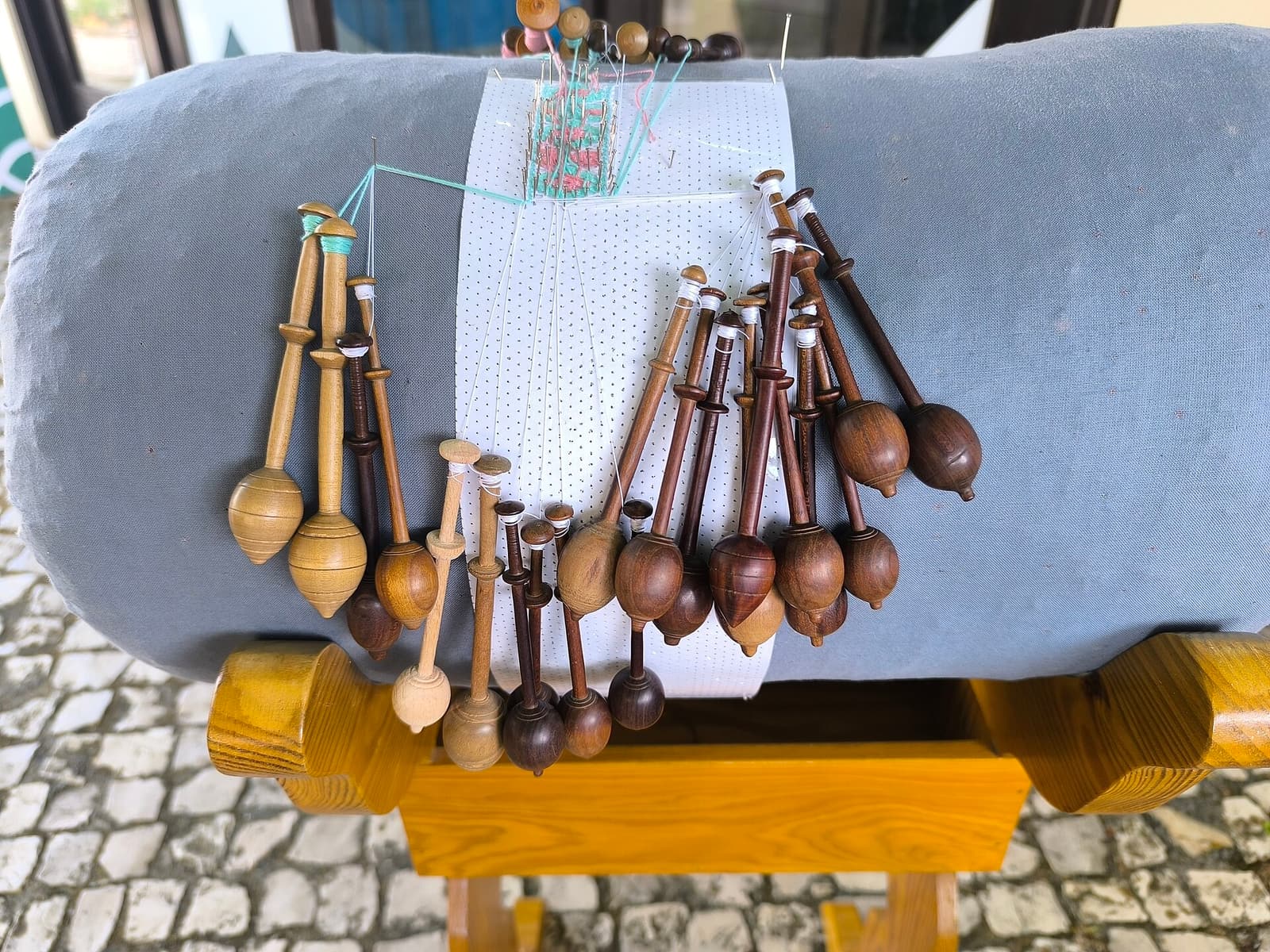
Bobbin lace is one of Portugal’s oldest and most refined textile arts, produced by successively interlacing threads on a cushion using small turned wooden pieces—the bobbins—and pins that secure the design. It is a pillow lace, distinct from needle lace, and deeply associated with the fishing communities along the coast, where for centuries it was the work and income of women while the men went to sea.
Technique and Materials
The craft relies on a small set of tools. A cylindrical cushion, sometimes called a ‘mundilho,’ holds the pricked card—traditionally saffron-colored—marked with the pattern to be executed. The threads, wound in pairs on bobbins, are crossed, twisted, and braided by the lacemaker, who pins the design points to hold the growing mesh. The rhythmic clatter of bobbins knocking together is inseparable from this art. The complexity of the pricked card and the number of bobbin pairs used determine the fineness of the result, ranging from simple borders to pieces of great figurative virtuosity.
Vila do Conde and Peniche
In Portugal, bobbin lace finds its two main hubs in Vila do Conde in the North and Peniche in the West. Vila do Conde’s tradition is documented as early as the 17th century in the town and surrounding parishes like Azurara and Árvore, and by the 19th century, it gained international recognition, featured in exhibitions with records of over a thousand active lacemakers. Vila do Conde lace is distinguished by elaborate floral, scroll, and figurative motifs.
In Peniche, the art is believed to have consolidated over centuries, reaching prominence by the mid-19th century when the town had nearly a thousand lacemakers. In 1887, the Industrial Drawing School founded by Maria Augusta Bordalo Pinheiro—later the Lace School—elevated the technical and artistic quality of production, passing the craft to new generations.
Bobbin lace is, above all, knowledge passed from hand to hand: what is learned is not just a pattern but a gesture, a rhythm, and a community.
Safeguarding and Recognition
Bobbin lace is part of the vast array of practices that make up Portugal’s intangible cultural heritage, alongside other textile traditions like Portuguese embroidery. In Peniche, the Bobbin Lace Museum, opened in 2016, is dedicated to preserving and promoting this art; the town’s specific tradition is detailed on the Peniche bobbin lace page.
More recently, Vila do Conde has been working to inscribe bobbin lace in the National Inventory of Intangible Cultural Heritage, seen as a decisive step toward a future UNESCO Representative List nomination. These efforts mark an important shift: from primarily an economic activity, bobbin lace is now valued as a cultural identity element to safeguard and pass on.
Questions fréquentes
- What is bobbin lace?
- It is a handmade textile lace created on a cylindrical cushion by interlacing threads wound around small wooden pieces called bobbins, with pins securing the design marked on a pricked card pattern.
- Where is bobbin lace made in Portugal?
- The two main centers are Vila do Conde in the North and Peniche in the West. The technique is also documented in other coastal areas like Póvoa de Varzim, Setúbal, Lagos, and Caminha, as well as inland in Nisa.
- What materials and tools are used?
- A cushion (or 'mundilho'), wooden bobbins that hold the thread, pins, and the pricked card ('picô')—the perforated pattern guide for executing the design.