Thèmes
Arraiolos Carpets
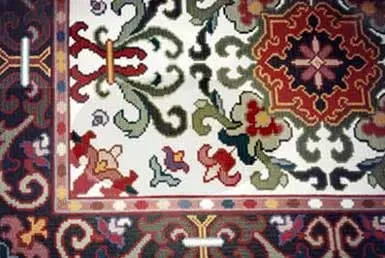
Wool-embroidered Arraiolos carpets, a traditional craft from the Alentejo village of Arraiolos documented since the 15th century.
- Lieu
- Arraiolos, Évora
Arraiolos carpets are wool-embroidered on counted canvas, executed with the distinctive Arraiolos stitch, which entirely covers the base and gives the piece a velvety density. Originating from the Alentejo village of Arraiolos, in the Évora district, they represent one of the most unique expressions of Portuguese decorative arts, differing from woven tapestries precisely because they are born from the needle rather than the loom.
Technique and Stitch
The Arraiolos stitch is an oblique cross-stitch, composed of two half-stitches of unequal length—one about twice as long as the other. Worked on counted-thread canvas, today mainly in jute, linen, or cotton, and embroidered with thick wool suitable for carpets, the stitch progresses diagonally and covers the entire surface, leaving no visible background. It is a slow and counted labor, where each stitch corresponds to a crossing of canvas threads, imposing a geometric and modular logic on the design similar to that of patterned tiles.
The strength of the Arraiolos carpet lies less in the loom’s dexterity than in the needle’s patience: it is an embroidery counted thread by thread, and it is from this counting that its ornamental precision arises.
Wool, once dyed with natural pigments, fixed sober chromatics—blues, ochres, earthy reds, greens—that still define the piece’s visual identity today.
Origins and Influences
The earliest references to the manufacture date back to the late 15th century. Tradition links its origins to the presence of Moorish families and contact with Oriental carpets that reached Portugal via Levantine routes. From the Oriental matrix, it inherited the compositional structure: two axes of symmetry, longitudinal and transversal, with a central field, medallion, and surrounding borders, following the scheme of Persian carpets.
Over the centuries, however, the repertoire became more Portuguese. In the second half of the 18th century, Persian motifs began to give way to ornaments of European taste—floral garlands, wreaths, a repertoire close to the Louis XVI style—and by the first third of the 19th century, Oriental motifs had practically disappeared, though the Persian-inspired symmetrical organization endured. Then emerged a more popular figurative universe: birds, deer, stylized flowers, and rural scenes that became emblematic.
Peak, Decline, and Revival
In the first half of the 18th century, Arraiolos already supplied carpets to other regions of the country and established itself as the main center of this embroidery, with flourishing domestic production. The industrialization of the 19th century and competition from factory-made carpets led to a sharp decline that nearly extinguished the practice.
The 20th century brought a revival, first through the scholarly copying of antique pieces and later through the reorganization of production in local workshops and ateliers. Today, carpet-making remains alive as a craft activity and as a reference of the village’s identity, alongside other Alentejo traditions inscribed in intangible cultural heritage—such as the neighboring clay figurines of Estremoz—which give the Alentejo one of the richest sets of artisanal knowledge in the country.
In 2021, the Arraiolos carpet-making process was inscribed in the National Inventory of Intangible Cultural Heritage, proposed by the Arraiolos municipality, a recognition that underscores the cultural value of a craft transmitted from generation to generation and inseparable from the land that gave it its name.
Questions fréquentes
- What is the Arraiolos stitch?
- It is an oblique cross-stitch, formed by two half-stitches of unequal length, embroidered in wool on counted canvas (jute, linen, or cotton), covering the entire fabric surface.
- Since when have Arraiolos carpets been made?
- The earliest documented references date back to the late 15th century; production peaked in the 18th century when Arraiolos supplied much of the country.
- Are Arraiolos carpets classified as heritage?
- In 2021, the Arraiolos carpet-making process was inscribed in the National Inventory of Intangible Cultural Heritage, an initiative by the Arraiolos municipality.