Intangible Heritage
Castelo Branco Embroidery
Castelo Branco Embroidery, the silk-on-linen bedspreads of the Beira Baixa, with the Tree of Life and the Castelo Branco stitch.
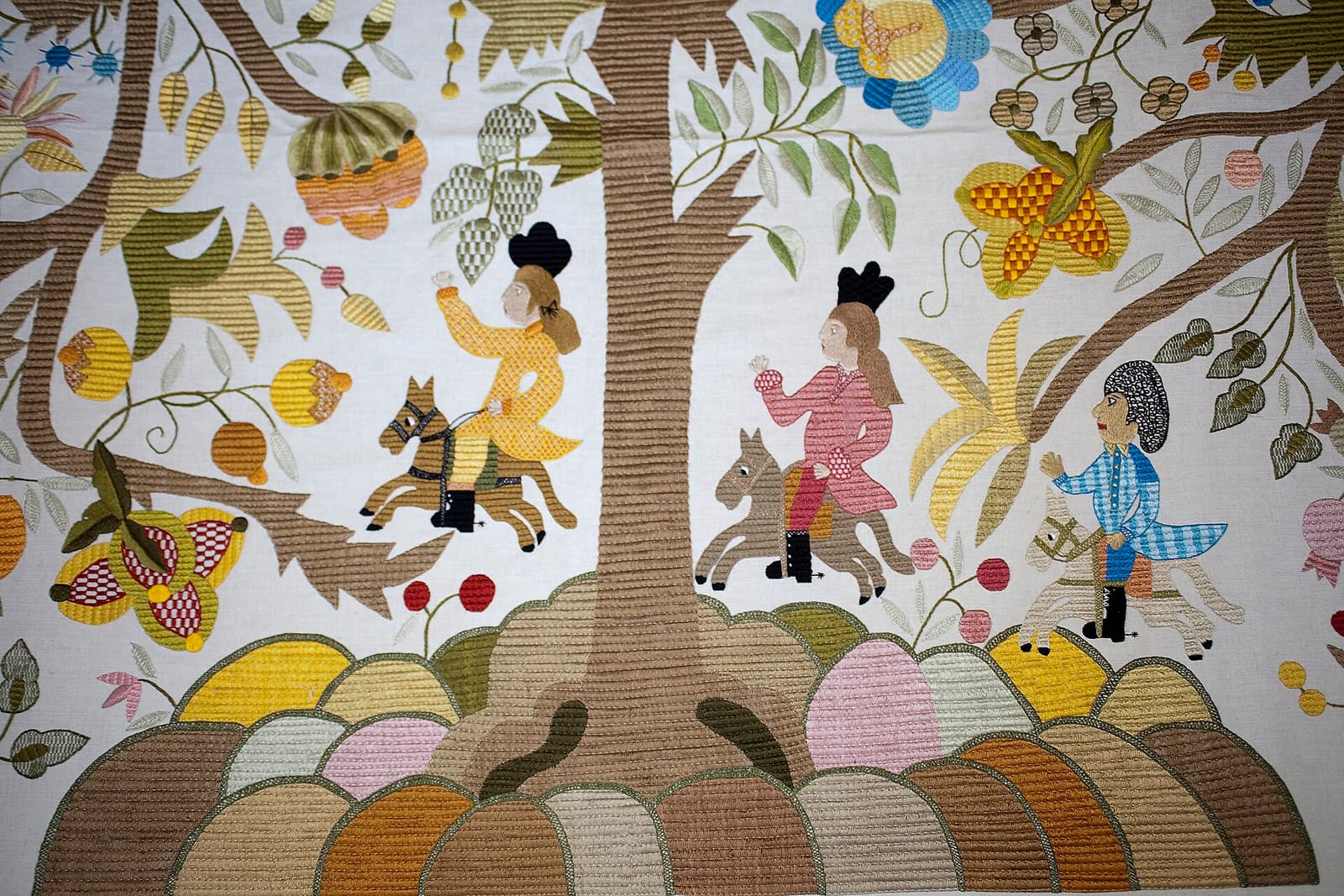
Castelo Branco Embroidery is one of the most distinctive of Portuguese textile traditions, recognisable by its linen bedspreads embroidered in natural silk thread, originating in the city of Castelo Branco and the region of the Beira Baixa. Its hallmark is the so-called Tree of Life, the central motif that organises dense and luminous compositions, peopled with flowers, birds and hearts. More than mere ornament, each bedspread condenses a symbolic vocabulary that, over the centuries, lent dignity to the trousseaux of the brides of Castelo Branco, whether of humble or noble origin.
Origin and influences
The embroidery is thought to have gained prominence from the mid-sixteenth century, becoming firmly established in the seventeenth and eighteenth centuries. Its decorative repertoire owes much to oriental bedspreads and to Indo-Portuguese trade: flowering vases, tendrils, lilies and stylised animals reveal an aesthetic of Asian inspiration reinterpreted by the hands of the Beira region. This circulation of exotic models, integrated into a local craft, brings it close to other national textile traditions, as can be seen in the broader panorama of traditional Portuguese embroidery and in its island counterpart, Madeira embroidery.
The technique that sets it apart is the Castelo Branco stitch, formerly known as bordado a frouxo. Worked with loosely twisted silk, it allows large surfaces to be filled with soft gradations and intense lustre, producing an almost pictorial effect on the raw linen.
A language of symbols
Few folk arts are so legible. Carnations represent man and roses woman; hearts speak of love and tendrils of friendship; lilies evoke virtue and paired birds the betrothed.
To embroider a bedspread was, in effect, to write a declaration: the bride and her family composed, stitch by stitch, a message about love, faith and the continuity of the household.
At the centre, the Tree of Life links the home to the divine and foretells descendants. This iconographic programme transforms a domestic object into an affective and religious document, making each piece an unrepeatable testimony.
Transmission and recognition
The safeguarding of the embroidery owes much to the Museu Francisco Tavares Proença Júnior in Castelo Branco, where, in the 1970s, the Oficina-Escola de Bordados Regionais (Workshop-School of Regional Embroidery) was founded — a unit for production, teaching and research that fixed technical standards and trained new embroiderers. Today, a number of certified workshops and craftswomen ensure the continuity of the craft, in a delicate balance between fidelity to the historical model and economic sustainability.
Institutional recognition culminated in the inscription of Castelo Branco Embroidery on the National Inventory of Intangible Cultural Heritage, by order of Património Cultural, I.P., signed on 31 January 2025, following an application promoted by the municipality. This classification integrates the embroidery into the safeguarding system defined by the national inventory of intangible cultural heritage and reinforces its place among the emblematic expressions of Portuguese intangible culture.
Inseparable from the identity of the Beira region, the embroidery shares territory and memory with other traditions of the Beira Baixa, such as the adufe and the region’s music, composing a living portrait of a culture that continues to be passed down from generation to generation.
Frequently asked questions
- What materials is Castelo Branco Embroidery made from?
- Traditionally, natural silk thread is embroidered onto homespun linen fabric using the technique known as the Castelo Branco stitch, formerly called bordado a frouxo (loose-thread embroidery).
- What does the Tree of Life on the bedspreads represent?
- The Tree of Life is the central motif of many bedspreads and symbolises the continuity of the generations and the bond between the earth and the sacred, surrounded by carnations, roses, birds and hearts of symbolic meaning.
- Is Castelo Branco Embroidery part of the Intangible Cultural Heritage?
- Yes. It was inscribed on the National Inventory of Intangible Cultural Heritage by order of Património Cultural, I.P., signed on 31 January 2025.