Intangible Heritage
Gondomar Filigree
The gold and silver wirework of Gondomar, in the district of Porto, inscribed in 2023 on the National Inventory of Intangible Cultural Heritage.
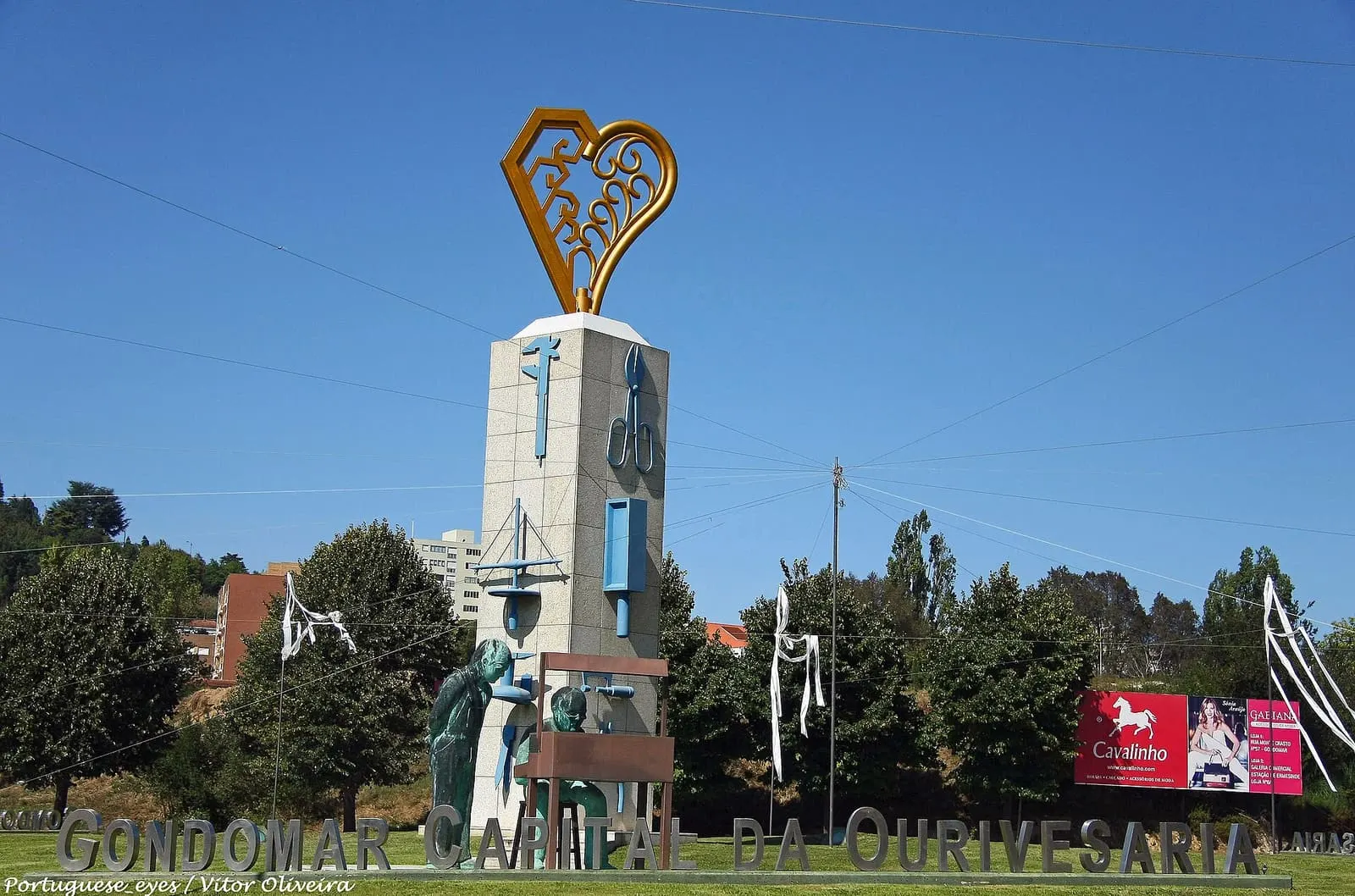
- Location
- Gondomar, Porto
- Built
- 18th–21st centuries
Gondomar filigree is one of the most refined expressions of traditional Portuguese goldsmithing. The term filigree — from the Latin filum (thread) and granum (grain) — describes the technique with precision: two extremely fine metal wires, of gold or silver and, more rarely, of copper or brass, are twisted one over the other and then rolled flat in a cylinder, acquiring a granular texture. Soldered onto a frame, these wires trace openwork compositions of extraordinary lightness, in which the metal seems almost like lace. Practised in the municipality of Gondomar, in the district of Porto, this art transformed a land of mining tradition into the largest goldsmithing centre in Portugal.
An art with ancient roots
Wire goldsmithing has roots in the region that go back to the Castro culture and the Roman period, drawn by the deposits of precious metals in the hills of the Douro valley. Filigree, in the form we know today, took hold above all from the 18th century onwards, when it ceased to be a luxury reserved for the nobility and became democratised among the populations of the North. It was in the 19th and 20th centuries that it asserted itself as a true identity of Gondomar, with workshops spread across several parishes — with the greatest concentration in São Cosme — and a knowledge passed from master to apprentice, generation after generation.
This collective, workshop-based dimension brings filigree close to other manifestations of Portuguese intangible cultural heritage, in which knowledge lives in the gesture and in practice, rather than in manuals. Each piece is the result of hours of meticulous work, at the limit of patience and manual dexterity.
Filigree is perhaps the clearest Portuguese case of a craft in which the boundary between handicraft and art dissolves: from the same thread are born the peasant woman’s Sunday jewel and the collector’s piece, without ever ceasing to be made by hand.
The Viana heart and the Gondomar repertoire
The most celebrated motif of this goldsmithing is the Viana heart, an affective symbol associated with the costume of the peasant women of the Minho, but the repertoire is vast: «queen-style» earrings, drop earrings (arrecadas), beads, crosses and bows. The importance of the art for the municipality was enshrined in 1940, when the filigree heart was incorporated into the very coat of arms of Gondomar. To learn the broader history of this technique and its regional variants, see the page devoted to Portuguese filigree, as well as the more general framing of Portuguese goldsmithing and of traditional jewellery.
Alongside Gondomar, Póvoa de Lanhoso is the other great centre of this production, but it is in Gondomar that the largest share of national goldsmithing is concentrated, sustained by a fabric of small family workshops and by a school of know-how that continues to train new craftspeople.
Recognition and safeguarding
On 7 September 2023, «Gondomar Filigree» was inscribed on the National Inventory of Intangible Cultural Heritage, following an application submitted by the Municipality of Gondomar and approved by the Directorate-General for Cultural Heritage. The classification recognises not only the aesthetic value of the pieces, but the body of knowledge, gestures and instruments that give substance to the technique — an intangible capital whose transmission is considered essential to safeguard.
National recognition was accompanied by local promotion initiatives, such as the Municipal Filigree Museum, opened in 2022 in the Casa Branca de Gramido, in Valbom, and the Filigree Route, which opens the workshops to the public. More than a tourist product, these structures seek to ensure that Gondomar’s golden thread continues to pass from hand to hand.
Frequently asked questions
- What is Gondomar filigree?
- It is an ancient goldsmithing technique practised in the municipality of Gondomar, in the district of Porto, which consists of twisting together two very fine metal wires — of gold, silver and, more rarely, copper or brass — then rolled flat and soldered to form delicate, openwork designs. Gondomar is today the country's largest goldsmithing centre.
- Is Gondomar filigree a UNESCO World Heritage item?
- No. In 2023 «Gondomar Filigree» was inscribed on the National Inventory of Intangible Cultural Heritage, managed by the Directorate-General for Cultural Heritage. It is a national classification; Portuguese filigree has been put forward as a possible candidate for the UNESCO list, but such international recognition has not yet been granted.
- What is the most emblematic filigree piece?
- The Viana heart is the most recognisable motif, but the repertoire includes «queen-style» earrings, beads, drop earrings (arrecadas) and crosses. In Gondomar, the filigree heart was incorporated into the municipal coat of arms in 1940, a symbol of the economic and identitary weight of this art.