Themen
Portuguese Primitives
The Portuguese Primitives: late Gothic and 16th-century painting by Nuno Gonçalves, Grão Vasco, and the Lisbon workshop, between 1450 and 1550.
- Errichtet
- c. 1450–1550
- Stil
- Tardo-gótico e Renascimento, com influência flamenga
The term Portuguese Primitives, by analogy with the Flemish and Italian primitives, refers to the body of painting produced in Portugal between the mid-15th and mid-16th centuries—roughly from 1450 to 1550. These works were primarily executed on wood panels, using tempera and oil for altarpieces and devotional images, during a transitional period where the legacy of late Gothic intersected with the early influences of the Renaissance. This cohesive cycle, with its distinct visual language, has been increasingly recognized by art historians as one of the most remarkable periods in Portuguese art.
The Century of Nuno Gonçalves
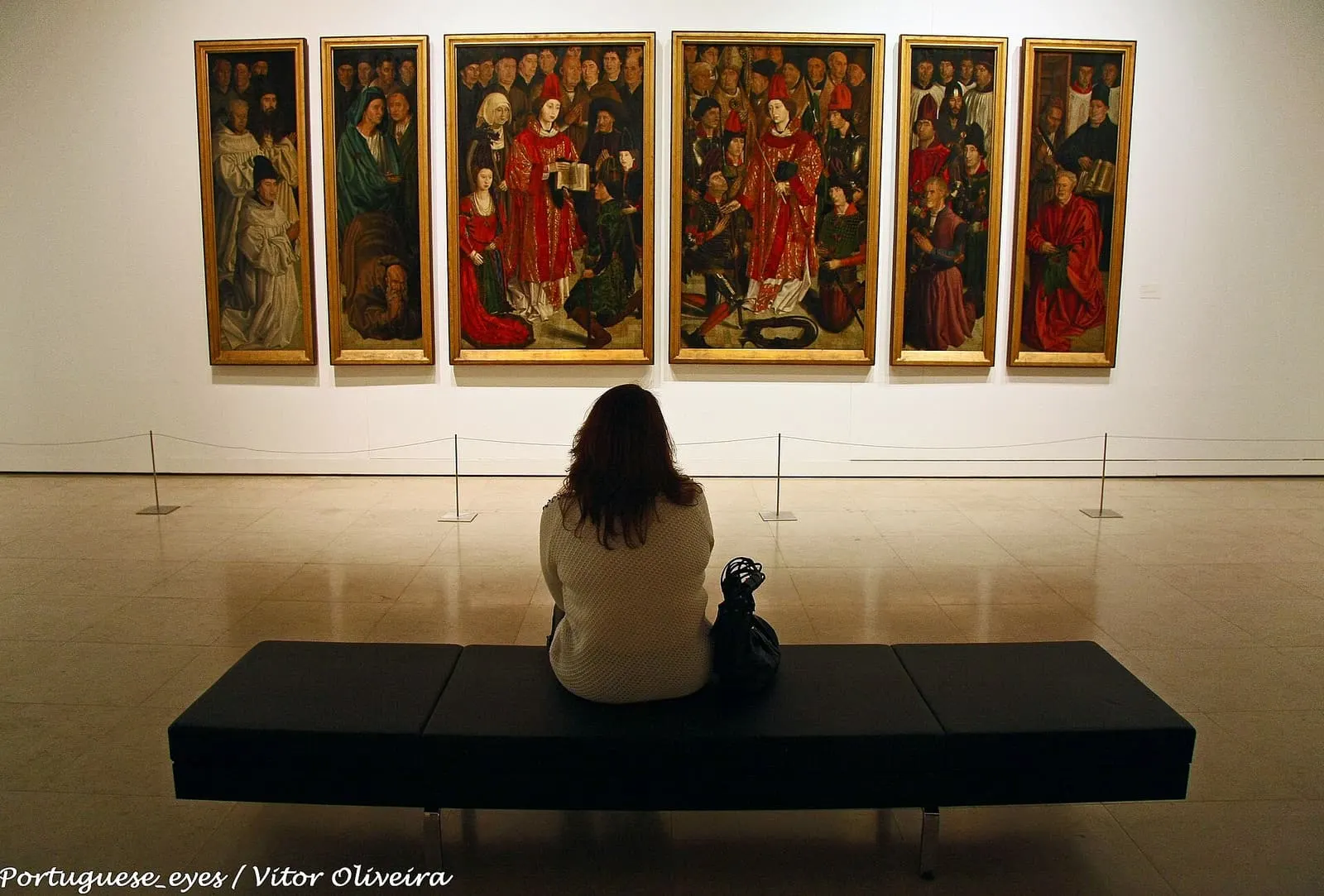
The conventional starting point of this cycle is the work of Nuno Gonçalves, a painter documented in the court of King Afonso V between 1450 and 1471. He is attributed with the famous Saint Vincent Panels, rediscovered and identified in the early 20th century and now a centerpiece of the National Museum of Ancient Art. The six panels depict fifty-eight figures gathered around a double representation of Saint Vincent, forming a solemn assembly that portrays the Portuguese court and various social strata of 15th-century society. The precision of the portraiture, the monumentality of the figures, and the absence of illusionistic scenery make this ensemble one of the most unique—and debated—works of European painting of its time.
The strength of the Portuguese Primitives lies less in narrative and more in the face: individualized, observed faces that lend Portuguese painting an early penchant for portraiture.
The 16th-Century Workshops
After Nuno Gonçalves, the cycle continued and consolidated in the first half of the 16th century, now fully embracing Flemish painting and, later, Italian influences. The main production center was Lisbon, benefiting from its status as a mercantile hub and the capital of Portugal’s overseas expansion. There, the royal workshop was organized around Jorge Afonso, collaborating with Flemish painters like Francisco Henriques and Frei Carlos, as well as Portuguese masters such as Cristóvão de Figueiredo, Garcia Fernandes, and Gregório Lopes. These artists worked for the court, religious orders, and major monasteries, during a period when artistic commissions closely followed the architecture of the Manueline style.
Alongside Lisbon, regional centers of high quality emerged. In Viseu, Vasco Fernandes, known as Grão Vasco (c. 1475–1542), became the leading painter of the 16th-century interior, creating altarpieces for the Cathedral of Viseu and Lamego. Most of his works are now preserved at the Grão Vasco National Museum in Viseu. Another notable figure was the Master of Lourinhã, an unidentified artist responsible for a set of remarkably refined panels.
Character and Legacy
What sets the Portuguese Primitives apart is their synthesis: the precision of drawing and the miniaturist detail of Flemish influence are applied to a distinct sensibility, attentive to portraiture and the dignity of figures. Gilded backgrounds give way to landscapes and architectural settings, and color gains material depth. This production directly dialogues with Portuguese sculpture and the sacred art treasures of the same period, integrating into the devotional programs of major monastic ensembles.
The transition from late Gothic to Renaissance classicism, initiated here, paved the way for Portuguese Renaissance painting in the latter half of the 16th century. Far from being a provincial chapter in European art, the Portuguese Primitives form a coherent and original body of work, whose rediscovery in the 20th century was decisive in affirming a national artistic identity.
Häufige Fragen
- What is meant by Portuguese Primitives?
- The term refers to Portuguese painting from around 1450 to 1550, executed on wood panels, marked by the transition from late Gothic to Renaissance and strong Flemish influence.
- Who were the main painters of this period?
- Notable figures include Nuno Gonçalves in the 15th century and, in the 16th century, Vasco Fernandes (Grão Vasco), Jorge Afonso, Cristóvão de Figueiredo, Garcia Fernandes, Gregório Lopes, and Frei Carlos.
- Where can works by the Portuguese Primitives be seen?
- Primarily at the National Museum of Ancient Art in Lisbon, which houses the Saint Vincent Panels, and the Grão Vasco National Museum in Viseu.