Periods & Styles
Suevic Art and Architecture
Suevic art and architecture in the north-west of the Iberian Peninsula (409-585): the first autonomous Germanic kingdom of Gallaecia, with its capital at Braga.
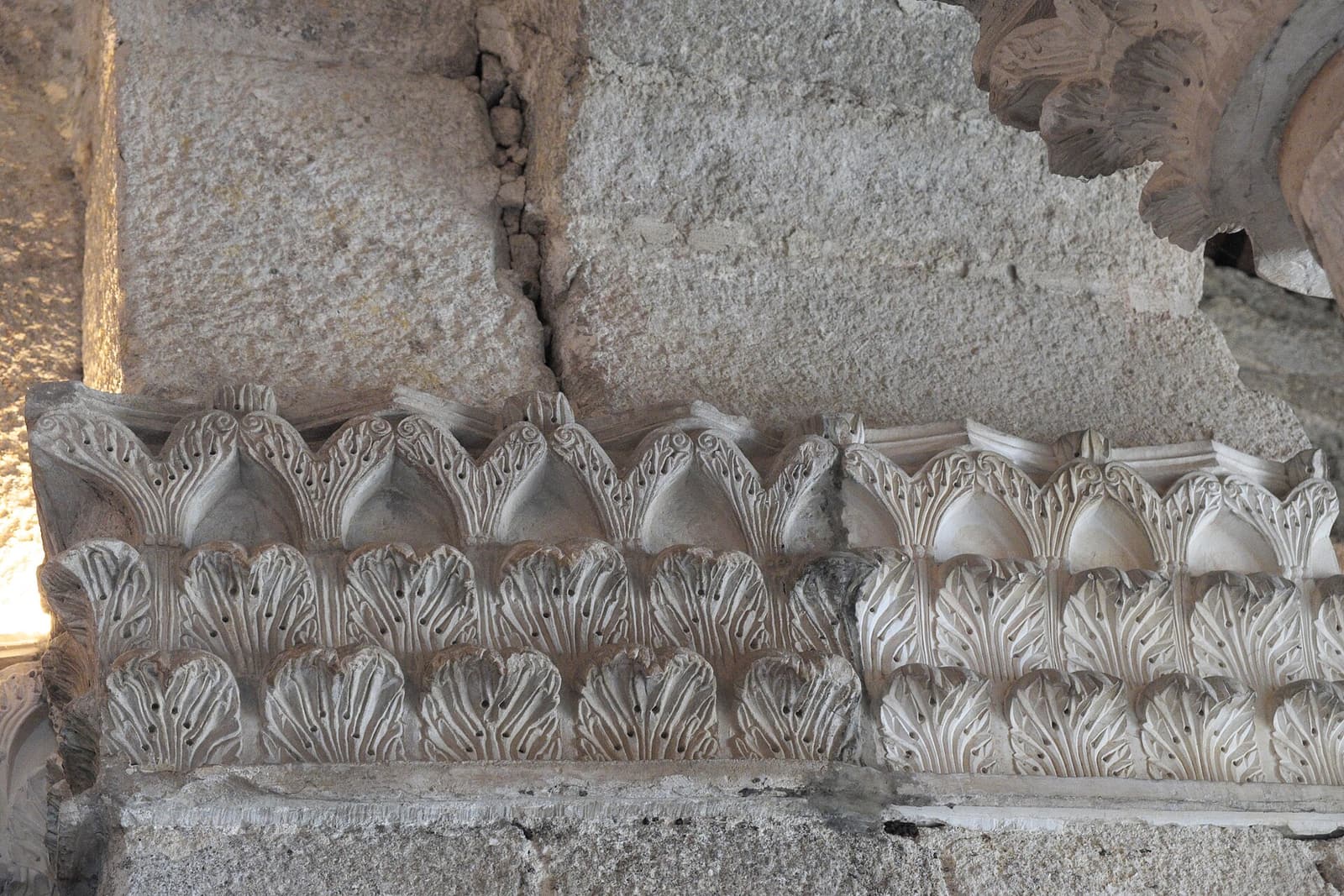
- Built
- 409-585
- Style
- Suevo-visigótico (pré-românico)
Suevic art and architecture correspond to the cultural production of the Suebian Kingdom, the Germanic entity that settled in the north-west of the Iberian Peninsula between 409 and 585. Founded in the former Roman province of Gallaecia — which encompassed present-day Galicia and northern Portugal — this kingdom is often singled out as the first autonomous and long-lasting Germanic state of the medieval West. Its capital was established at Bracara Augusta, Roman Braga, which thus retained the central role it had held under imperial administration.
A kingdom between Rome and Christianity
When the Suebi crossed the Pyrenees, they inherited a deeply Romanised territory, with cities, roads and an already consolidated ecclesiastical structure. Their material production therefore does not break with the Late Antique tradition: it prolongs and reinterprets it. The scarcity of monumental remains — explained by the continued use of Roman techniques and by the later Visigothic absorption — makes each surviving testimony particularly valuable for understanding the transition between Roman Antiquity and the Early Middle Ages.
The religious dimension was decisive. Pagans and, later, Arians, the Suebi gradually converted to Catholicism from the mid-sixth century onwards. This movement became inseparably linked to Saint Martin of Dume (Saint Martin of Braga), a bishop of Pannonian origin who promoted ecclesiastical reform, fought rural superstitions and organised the councils of Braga, making the city one of the great centres of cultural radiation of the period.
The rarity of Suevic remains does not reflect artistic poverty, but rather the discretion of a culture that preferred to prolong Roman models rather than invent an entirely new language.
The architectural testimonies
The monument par excellence of this cycle is the Chapel of São Frutuoso de Montélios, in Real, on the outskirts of Braga, built in the second half of the seventh century at the initiative of Bishop Frutuoso. With a cruciform plan of roughly equal arms, a barrel-vaulted roof and horseshoe-arched apses, it reveals a clear inspiration in Byzantine mausolea — often compared to the Mausoleum of Galla Placidia in Ravenna. Classified as a National Monument in 1944, it is regarded as a unique example of the architecture of the Galician Early Middle Ages.
Associated with it is the basilica of São Martinho de Dume, ordered to be built in the mid-sixth century by King Chararic next to the ancient Bracaran urbs. With granite walls, a cross-shaped plan oriented from west to east and a triple chevet, this basilica constitutes one of the first great Christian buildings in Portuguese territory and the centre of the Dumian bishopric. Excavations at the site of Dume have also revealed burials and structures that document the continuity of occupation over centuries.
Style, affiliations and legacy
Stylistically, one speaks of a Suevo-Visigothic manner, in which the Roman building heritage, the Christian decorative repertoire and Mediterranean influences arriving by continental routes (Ravenna, Milan, Tours) and maritime ones (southern Italy and North Africa) intersect. This language precedes and prepares the ground for the Visigothic art that followed it, as well as for the later developments of Asturian and pre-Romanesque art in the Iberian north-west.
The Suevic legacy is not confined to stone. It survives in the toponymy and rural vocabulary of Galicia and northern Portugal, in the ecclesiastical memory of Braga and its Cathedral and in the very idea of an early Galician identity. Set within the long sequence of periods and styles of Portuguese heritage, Suevic art thus represents the discreet but fundamental link between the Roman world and the Christian Middle Ages.
Frequently asked questions
- What was the Suebian Kingdom?
- It was the political entity founded by the Suebi in the former Roman province of Gallaecia in 409-411, with its capital at Bracara Augusta (Braga). It is often regarded as the first autonomous and stable Germanic kingdom in the West, lasting until 585, when it was annexed by the Visigoths.
- Which monuments survive from this period?
- The most celebrated testimony is the Chapel of São Frutuoso de Montélios, in Real (Braga), with a cruciform plan inspired by Byzantine mausolea. Associated with it is the basilica of São Martinho de Dume, ordered to be built by King Chararic in the mid-sixth century.
- What was the religion of the Suebi?
- Initially pagans and later Arians, the Suebi converted to Catholicism from the mid-sixth century onwards, a process linked to the work of Saint Martin of Dume (of Braga).