Monuments
Braga Cathedral
Braga Cathedral, in Braga, is the oldest cathedral in Portugal, the primatial see of the Spains, with overlapping Romanesque, Gothic, and Baroque layers.
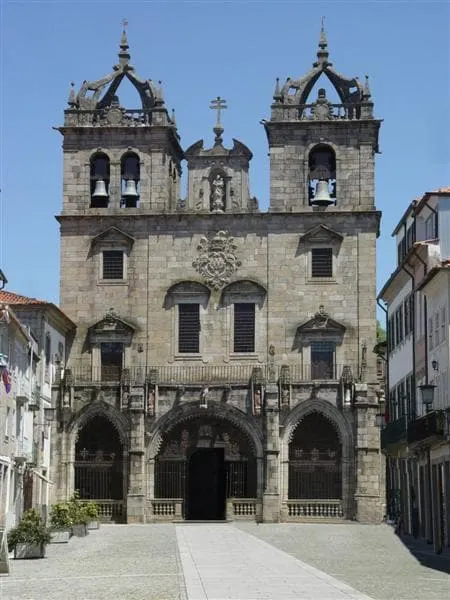
- Location
- Braga, Braga
- Built
- 1070–séc. XIII
- Style
- Românico, gótico, manuelino e barroco
Braga Cathedral, dedicated to Saint Mary, is the oldest of Portugal’s cathedrals and one of the country’s most densely stratified monuments. Built in the heart of the city that claims the title of Primate of the Spains, its history is intertwined with that of the kingdom itself: it was consecrated on August 28, 1089, half a century before Afonso Henriques proclaimed himself king. Those who walk through it today read, in stone, almost a thousand years of successive transformations—from the foundational Romanesque to the gold of Minho Baroque. Classified as a National Monument in 1910, it is a centerpiece among Portugal’s cathedrals and sees.
From Roman origins to the Reconquista
The Diocese of Braga is among the oldest in the Iberian Peninsula, with documented roots dating back to the 3rd century, when Bracara Augusta was an important Roman center. After Suebi and Visigothic rule and the long interruption of Islamic presence, the episcopal see was restored around 1071, during the Christian Reconquista. Bishop D. Pedro was tasked with initiating the construction of the new cathedral, over remnants of earlier buildings, giving it a basilica plan with three naves, a transept, and an apse flanked by smaller apses.
The Romanesque campaign continued under Archbishop D. Paio Mendes in the second quarter of the 12th century, a time when Braga was asserting itself as an ecclesiastical metropolis—it had been elevated to an archdiocese in 1107. The inspiration came from Burgundian Romanesque, following the great abbey church of Cluny, and is still clearly recognizable in the southern portal, the archivolts, and the historiated capitals.
Braga Cathedral is not a monument of a single era: it is a palimpsest where each archbishop sought to leave their mark, overlaying their taste onto that of their predecessors without ever completely erasing what they inherited.
Layers of Gothic, Manueline, and Baroque
From the 14th century onward, Gothic introduced new chapels and vaults. The most famous is the Chapel of the Kings, built around 1374 over the burial site of Count Henry and Teresa, parents of the first king. Their tombs were replaced in the early 16th century with new recumbent statues, turning the chapel into a true foundational pantheon of the kingdom. Nearby also lies the memory of Archbishop D. Diogo de Sousa, a great patron who, at the dawn of the 16th century, commissioned the redesign of the façade and the opening of the Manueline portal.
The most transformative intervention, however, came with the Baroque. Between the 17th and 18th centuries, gilded woodwork invaded the interior: two imposing Joanine-style pipe organs, the high choir, chapels lined with azulejos, and exuberant altarpieces gave the cathedral the scenographic atmosphere that still distinguishes it today. This predilection for ornamentation would link Braga to its most emblematic monument of this period, the Bom Jesus do Monte Sanctuary, and to the art of azulejo that covers so many Minho temples.
Treasury and monumental context
Added to the built ensemble is the Cathedral Treasure Museum, one of the richest collections of sacred art in the country, with goldsmithing, vestments, ivories, and the famous chalice attributed to Saint Gerald. The cathedral is part of a network of great monuments in the North worth exploring in dialogue: the nearby Porto Cathedral, also of fortified Romanesque origin, and the Tibães Monastery, the Benedictine motherhouse whose woodcarving workshop greatly influenced Braga’s Baroque.
Visiting Braga Cathedral is, thus, simultaneously traversing the history of Portuguese religious architecture and the genesis of the country itself. Each nave, each chapel, and each organ tells a distinct chapter, and it is from this accumulation—and not from an impossible stylistic unity—that its singular grandeur arises.
Frequently asked questions
- Why is it considered the oldest cathedral in Portugal?
- Its construction began around 1070 and was consecrated on August 28, 1089, before the foundation of the Kingdom of Portugal, making it the first cathedral built in the territory.
- Who is buried in Braga Cathedral?
- In the Chapel of the Kings rest Count Henry and Teresa, parents of Afonso Henriques, the first king of Portugal, in tombs with recumbent statues.
- What architectural styles can be seen in Braga Cathedral?
- The building preserves the original Romanesque structure and has accumulated Gothic, Manueline, and especially exuberant Baroque decorations.
Sources
Keep exploring
Heritage nearby
More places to discover from here. Approximate straight-line distances, within 50 km.