Intangible Heritage
Arte Xávega
The arte xávega, a traditional beach-seine fishery using crescent-moon boats along the central coast of Portugal, from Espinho to Vieira de Leiria.
- Location
- Mira, Aveiro
The arte xávega is one of the oldest and most spectacular forms of traditional fishing on the Portuguese coast. It is a beach seine: an encircling net, extended by long cables fitted with floats, is cast into the sea from a boat that braves the surf, leaving one of its ends anchored on land; once the shoal has been surrounded, the boat returns to the sand and the net is slowly hauled ashore until the catch is unloaded. The name derives from the Arabic xábaka, “net”, a testament to the Mediterranean and North African roots of this technique, which has parallels in the Andalusian jábega and in similar practices in Morocco.
The work and the crescent-moon boats
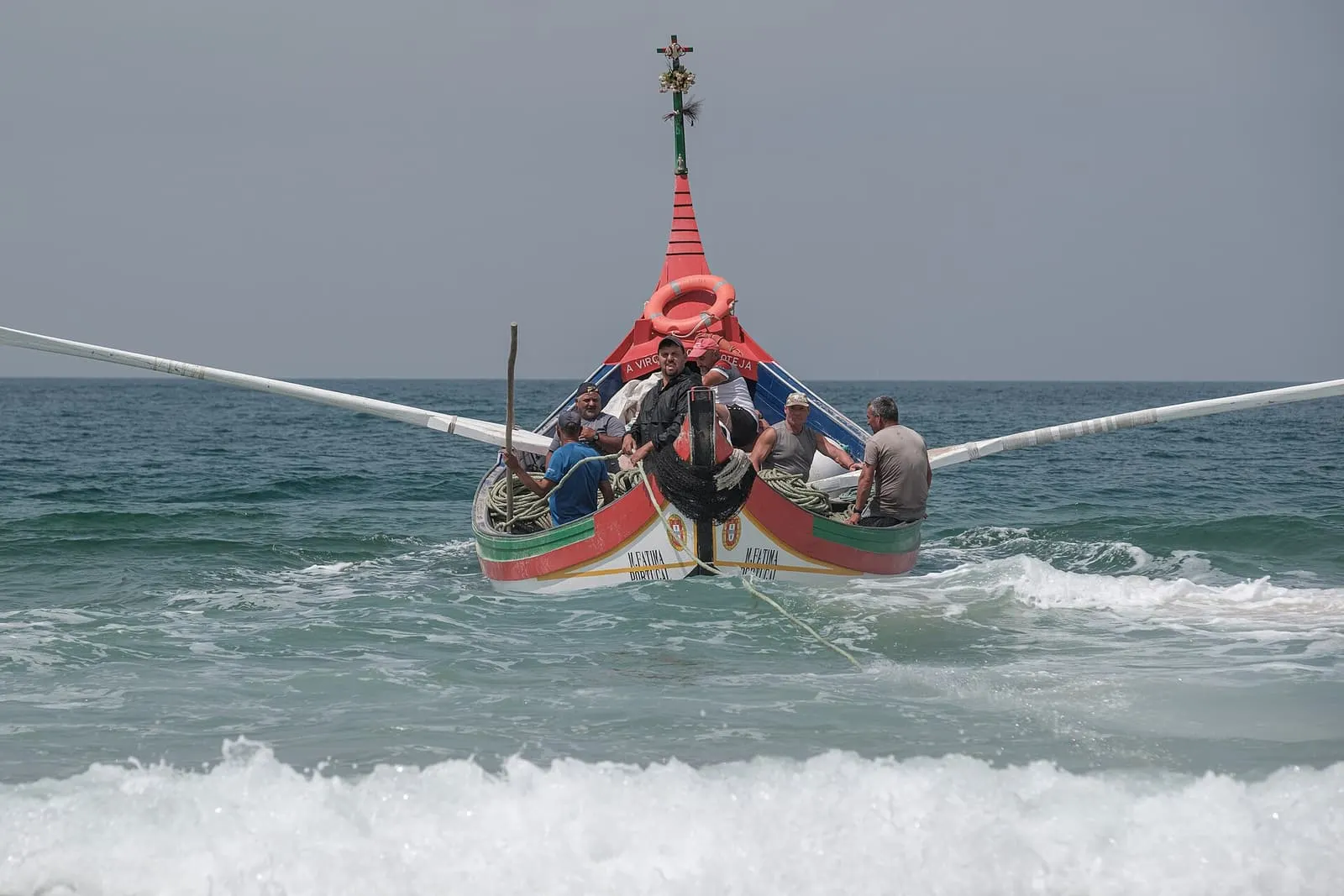
The most recognisable feature of the xávega is its flat-bottomed boat with a high prow arched into the shape of a crescent moon, painted in vivid colours. This silhouette is not merely decorative: on an open coast with no sheltered harbour, the raised prow allows the boat to pierce the waves both on departure and on return, beaching directly on the sand. On board, the crew casts the xalavar — the conical bag of the net — while paying out cable, closing the circle around the shoal.
The xávega sums up centuries of human adaptation to a coast without shelter: where there was no harbour, the beach itself was made into a quay.
For generations, the cables were hauled by teams of oxen, capable of dragging the loaded nets across the wet sand. From the mid-twentieth century, and especially in the 1970s and 1980s, tractors gradually replaced the animals, positioning themselves at the two ends of the cables to draw in the net. The targeted catch is above all sardine, horse mackerel and other pelagic species that approach the coast in shoals.
Geography of a tradition
The history of the xávega is bound up with the settlement of the sandy stretches of the Portuguese Atlantic seaboard, in particular the long dune belt that extends from Espinho to Vieira de Leiria. Beaches such as Torreira, Costa Nova, Vagueira, Praia de Mira, Tocha, Pedrógão and Praia da Vieira keep this work alive, with differing degrees of vitality. Further south, the Costa da Caparica also preserved its own version of the art, although manual and animal hauling ceased there around the 1980s.
These fishing communities left distinctive marks on the landscape, of which the wooden stilt houses of the coast are the most emblematic example. The xávega is thus part of a body of knowledge linked to the sea and to traditional navigation that includes the traditional Portuguese boats and the know-how of traditional naval craftsmanship responsible for building and repairing these vessels.
Recognition and safeguarding
Faced with the ageing of its crews, competition from industrial fishing and tourist pressure on the beaches, the arte xávega has been the subject of classification processes as intangible cultural heritage. Several municipalities have promoted the inscription of their local variants on the National Inventory of Intangible Cultural Heritage managed by the Directorate-General for Cultural Heritage, with a view to ethnographic documentation and the transmission of this knowledge to new generations. These efforts form part of the broader valorisation of the intangible cultural heritage of Portugal, which recognises in the living practices of communities a heritage value equivalent to that of monuments.
Today, the xávega survives between genuine fishing and cultural demonstration. On several central beaches, the launching of the boats and the hauling of the net continue to bring together fishermen and visitors, keeping alive a collective choreography that binds the sea, the sand and the memory of the coastal people.
Frequently asked questions
- What is the arte xávega?
- It is a traditional beach-seine fishing technique in which an encircling net is cast into the sea from a boat and then hauled ashore by two cables, gathering the catch up onto the sand.
- Where is the arte xávega practised in Portugal?
- It survives above all along the central and northern coast, on sandy beaches between Espinho and Vieira de Leiria, including Torreira, Mira, Tocha, Vagueira and Praia da Vieira, as well as the Costa da Caparica, south of Lisbon.
- Why do the xávega boats have a crescent-moon shape?
- The high, arched crescent-moon prow allows the boat to pierce the surf and face the waves when leaving and returning to the beach, along a coast with no sheltered harbour.