Denkmäler
Paço dos Duques de Bragança (Guimarães)
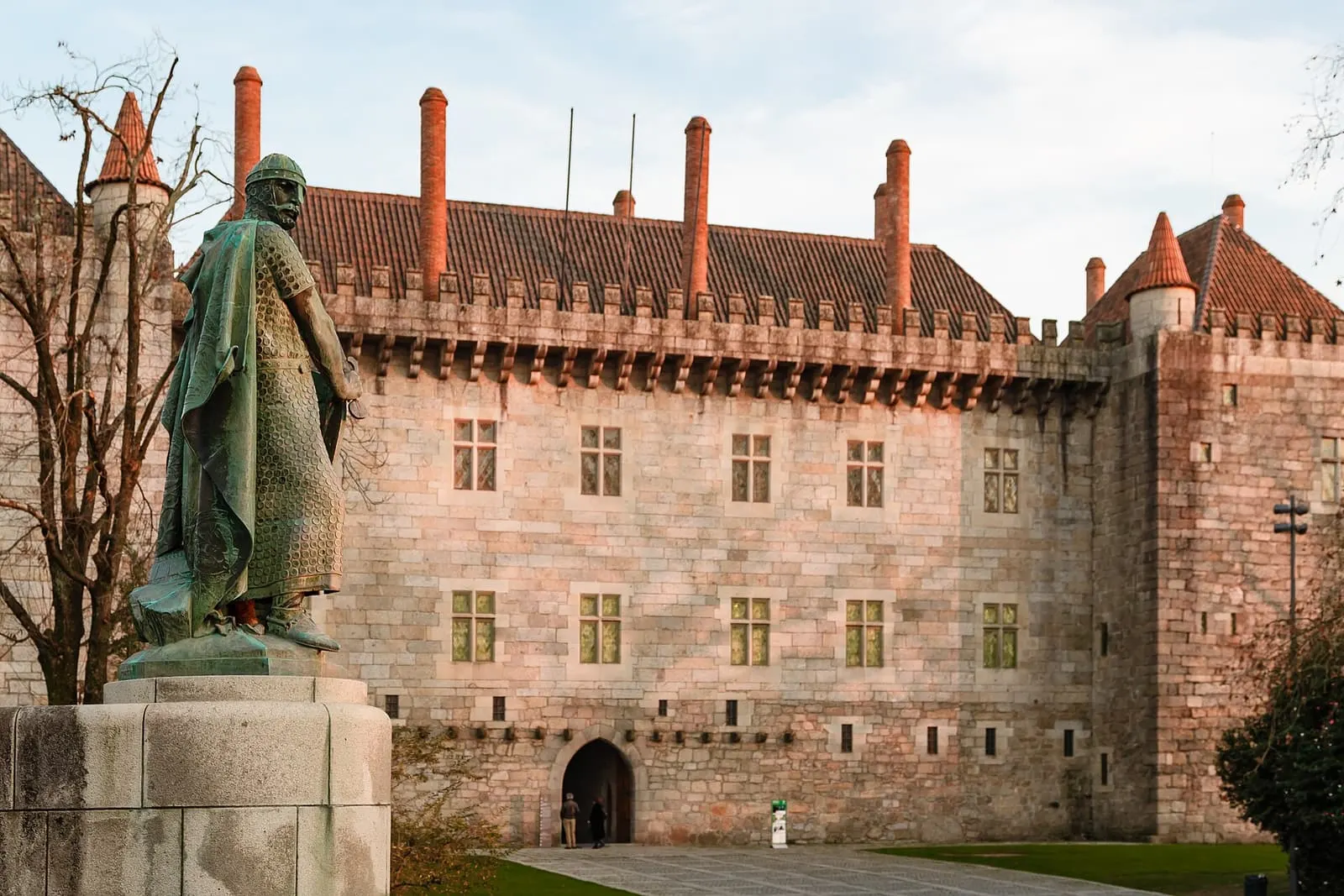
Paço dos Duques de Bragança, in Guimarães: a 15th-century Burgundian-inspired noble palace, National Monument and museum in the heart of the birthplace city.
- Lage
- Guimarães, Braga
- Errichtet
- 1420–1433
- Stil
- Gótico senhorial de inspiração borgonhesa
At the top of the Sacred Hill, next to the Castle of Guimarães and the Chapel of São Miguel, stands the Paço dos Duques de Bragança, the most unique late-medieval noble palace surviving in Portugal. Its dense silhouette of steep roofs and dozens of cylindrical chimneys immediately sets it apart from any other noble residence in the Iberian Peninsula, marking the landscape of the birthplace of the nation.
A palace of Burgundian inspiration
The palace was commissioned by D. Afonso, the illegitimate son of D. João I and the first Duke of Bragança, between 1420 and 1433, on the occasion of his second marriage to D. Constança de Noronha. The building’s design reflects the duke’s acquired tastes from his travels across Europe: the steep roofs, four corner towers, and numerous tubular chimneys evoke the noble architecture of northern Europe, particularly the Burgundian style then in vogue in European courts.
It is a fortified house of vast dimensions, organized around a central courtyard, with galleries and grand reception halls. The result is a practically unique example in the Iberian context, where noble residential traditions followed distinct architectural paths.
More than a fortress, the palace was conceived as a stage for prestige: a noble court that displayed, in stone and chimneys, the connection of the House of Bragança to the circles of European nobility.
Abandonment and reconstruction
Mainly inhabited in the 15th century, the palace declined when the House of Bragança transferred its main residence to the Ducal Palace of Vila Viçosa, in Alentejo. Over the following centuries, it progressively deteriorated, reaching the 20th century in an advanced state of ruin and even serving as a military barracks for some time.
Its recovery was one of the most ambitious and controversial heritage restoration projects in Portugal. Between 1937 and 1959, a comprehensive reconstruction took place, based on a project by architect Rogério de Azevedo, as part of the Estado Novo’s monument policy. The work rebuilt much of the lost structures and gave the palace a representative function, transforming it into the official residence of the head of state in the northern region—a role it still partially maintains.
Museum and National Monument
Classified as a National Monument since 1910, the palace now houses a museum with collections including Flemish and French tapestries, oriental carpets, furniture, Chinese porcelain, arms, and paintings, with highlights of works associated with the House of Bragança. The restored rooms recreate the atmosphere of an aristocratic residence, while the noble floor retains its function as a space for official receptions.
Just a few steps from the castle and the historic center, the palace is part of the monumental ensemble that earned Guimarães its inscription on the UNESCO World Heritage list. Visiting it means traversing, in one place, the memory of the foundation of the Portuguese monarchy and the cosmopolitan tastes of one of the kingdom’s most powerful noble houses. To contextualize this monument within the typology of royal palaces and residences, it is worth comparing it with the palaces that extended this tradition of noble dwellings in later periods.
Häufige Fragen
- Who ordered the construction of the Paço dos Duques de Bragança?
- It was commissioned by D. Afonso, the first Duke of Bragança and illegitimate son of D. João I, around the time of his second marriage to D. Constança de Noronha, between 1420 and 1433.
- Can the Paço dos Duques be visited?
- Yes. The palace functions as a museum, with collections of tapestries, furniture, ceramics, and paintings. Part of the building also serves as the official residence of the Presidency of the Republic in the northern region.
- Why does the palace have such distinctive cylindrical chimneys?
- The steep roofs and numerous cylindrical chimneys reflect the influence of northern European noble architecture, a rare model in the Iberian Peninsula.
Quellen
Weiter entdecken
Kulturerbe in der Nähe
Weitere Orte in der Umgebung entdecken. Ungefähre Entfernungen als Luftlinie, im Umkreis von 50 km.