Intangible Heritage
Portuguese Equestrian Art
Portuguese Equestrian Art, the classical riding of the Lusitano horse and heir to the Royal Picaria, was inscribed by UNESCO as Intangible Cultural Heritage of…
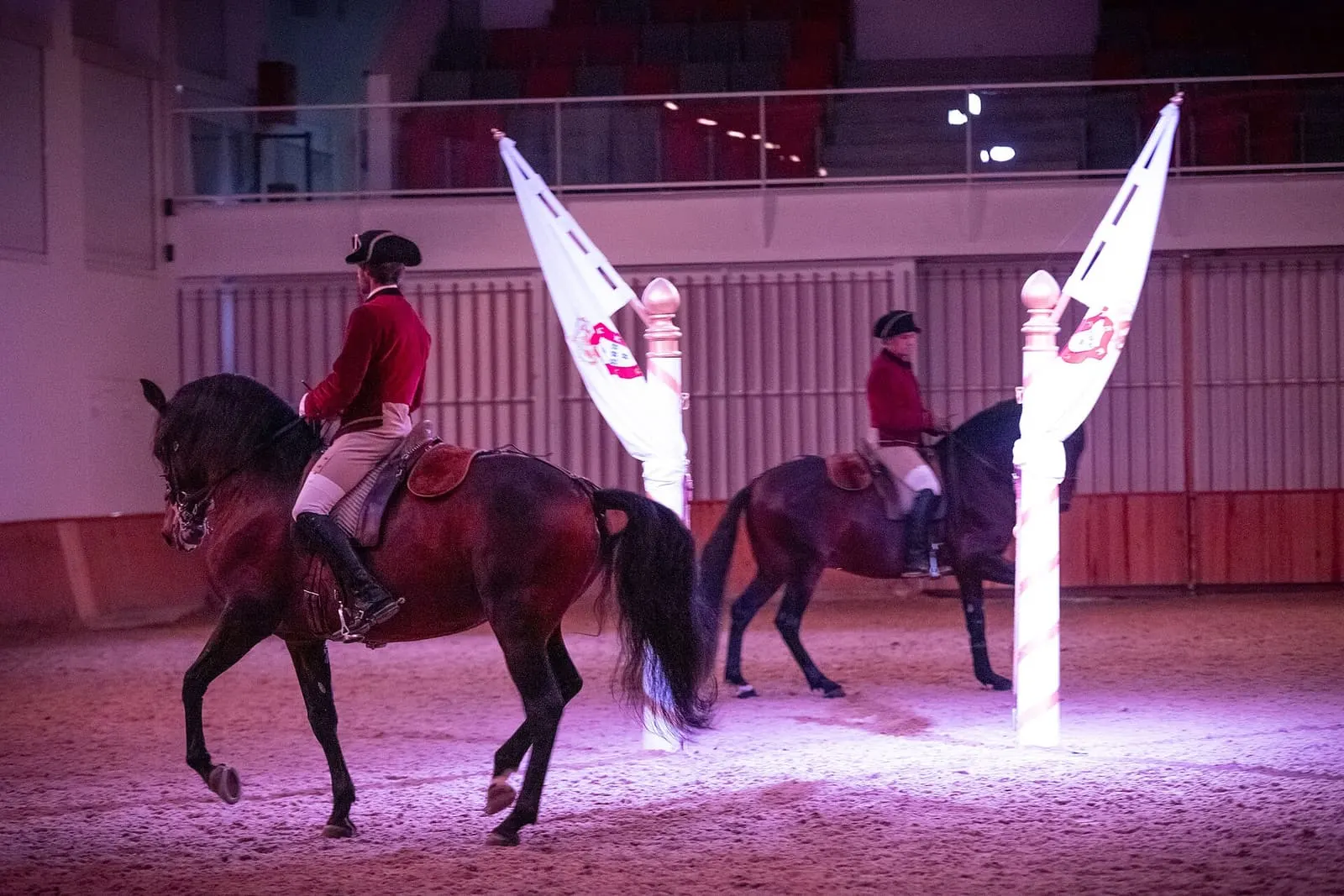
Portuguese Equestrian Art is a form of classical riding that combines functionality and aesthetics, grounded in a relationship of harmony and deep respect between the rider and the horse, conducted without recourse to force and centred on the animal’s well-being. It is distinguished by the rider’s characteristic seat in the saddle, by its traditional harnesses and costumes, and by a repertoire of movements inherited from court riding. On 4 December 2024, it was inscribed on UNESCO’s Representative List of the Intangible Cultural Heritage of Humanity (reference 02079), becoming the eleventh Portuguese element recognised under the 2003 Convention, alongside Fado and Cante Alentejano.
From the Royal Picaria to academic riding
The roots of this practice plunge into centuries of Portuguese equestrian tradition. Its learned core is academic riding, cultivated at the Royal Picaria, the equestrian academy of the Portuguese court in the eighteenth and early nineteenth centuries. Closed in the nineteenth century, it left as its inheritance a body of haute-école knowledge that survived in the stud farms, the bullrings and the traditions of mounted bullfighting.
That legacy is today preserved above all by the Portuguese School of Equestrian Art (EPAE), founded in 1979 and housed since 1996 at the Queluz National Palace, where it gives public performances in the historic riding arenas and gardens. The school deliberately maintains the same type of horse, the same embroidered harnesses and the same eighteenth-century costumes of the Royal Picaria, functioning as a living guardian of an aesthetic and a technique that date back to the Ancien Régime.
The art lies in achieving the utmost elegance and precision with the least constraint: the rider does not impose the movements, he suggests them, and the horse performs them as if they arose from its own will.
The Lusitano horse and the territories of tradition
At the heart of this art is the Purebred Lusitano horse, a supple, agile and docile breed, particularly able to follow the rider’s subtle indications. The lineage of the Alter Stud, founded in 1748 in Alter do Chão, in the Alto Alentejo, supplies the horses that the EPAE links directly to the court’s legacy. The breeding and selection of the breed are therefore an inseparable part of the heritage element.
The practice is not confined, however, to the learned riding arenas. It also lives on in fairs, pilgrimages and popular festivities — most notably the National Horse Fair in Golegã — in equestrian centres and stud farms scattered across the country, and in the side-saddle riding discipline practised by women. This simultaneously courtly and popular dimension makes riding an element of collective identity, transmitted in academies, schools and equestrian centres, both in Portugal and abroad.
A recognition built in stages
The UNESCO inscription was the outcome of a process begun in 2015 and conducted jointly by the Portuguese Association of Purebred Lusitano Breeders, by Parques de Sintra — Monte da Lua, which manages the EPAE, and by the municipality of Golegã. Before international recognition, the practice was entered in the National Inventory of Intangible Cultural Heritage in 2021, a stage required by Portuguese legislation for any candidacy to the 2003 Convention.
The recognition integrates Portuguese Equestrian Art into the broader body of national equestrian traditions, addressed in equestrian art in Portugal, and reinforces its safeguarding as an expression of the wider Portuguese intangible cultural heritage. More than a spectacle, the distinction honours a know-how transmitted between generations, in which technique, animal breeding and historical memory remain inseparable.
Frequently asked questions
- When was Portuguese Equestrian Art recognised by UNESCO?
- It was inscribed on the Representative List of the Intangible Cultural Heritage of Humanity in December 2024, during the 19th session of the Intergovernmental Committee, held in Asunción, Paraguay (reference 02079). It became the 11th Portuguese element recognised under the 2003 UNESCO Convention.
- Which horse is associated with Portuguese Equestrian Art?
- The Purebred Lusitano horse, in particular the lineage of the Alter Stud, in Alter do Chão. Its docility, agility and willingness to cooperate with the rider make it especially suited to academic riding.
- What is the Royal Picaria?
- It was the equestrian academy of the Portuguese court in the eighteenth and early nineteenth centuries. The Portuguese School of Equestrian Art, founded in 1979, continues its legacy, preserving the same type of horse, the same harnesses and the same costumes.