Intangible Heritage
Portuguese Pavement (Calçada Portuguesa)
Portuguese pavement and the craft of the cobbler (calceteiro): the art of paving in limestone and basalt, a symbol of the streets and squares of Lisbon and of…
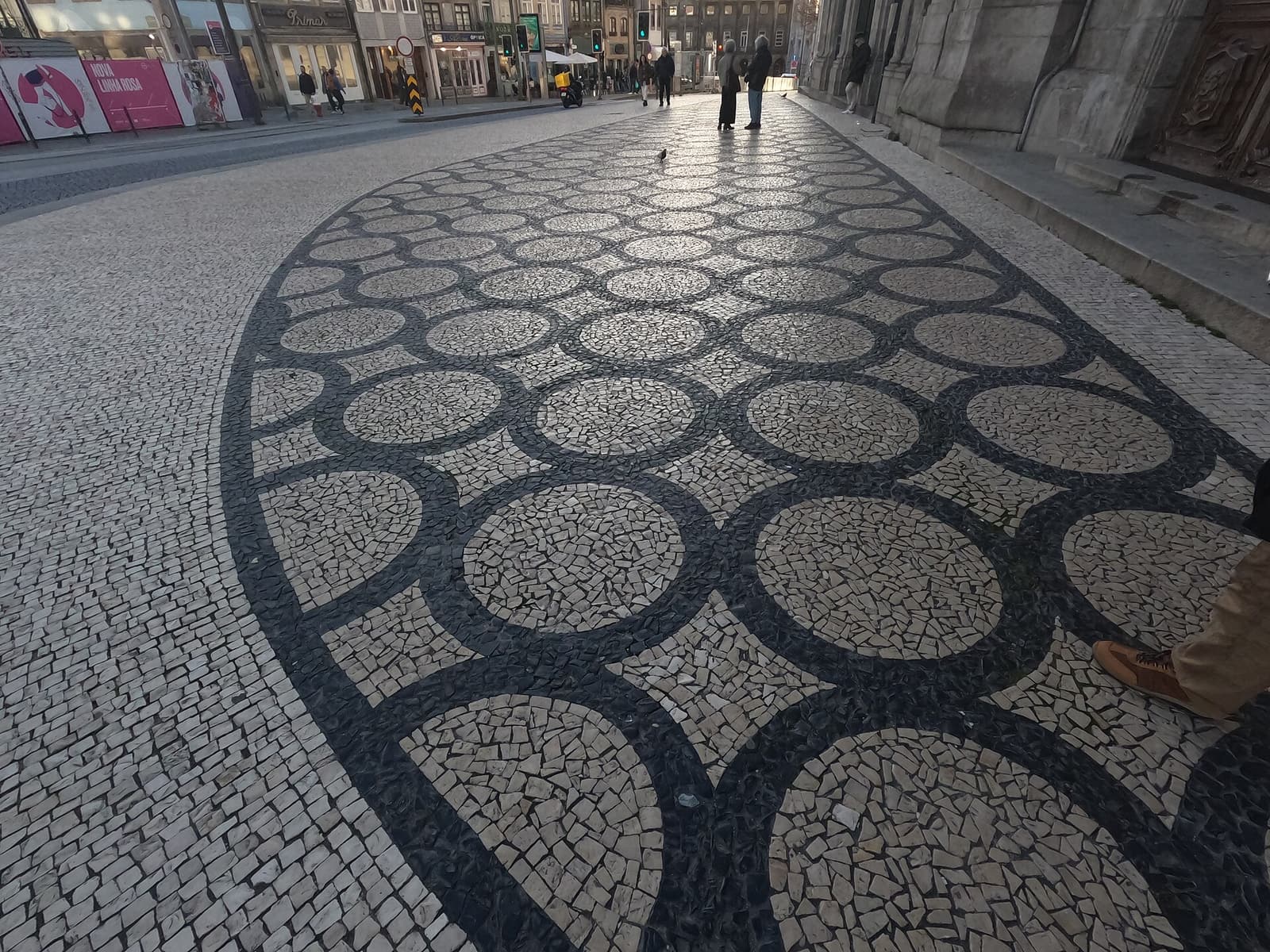
Portuguese pavement (calçada portuguesa) is a decorative paving made by hand, in which thousands of small stone cubes — usually white limestone and black basalt — are laid in geometric, ornamental or figurative patterns. More than a covering for streets and squares, it has become one of the most recognisable features of the Portuguese urban landscape, exported across the country and to the former overseas territories. Its making depends entirely on the calceteiro, the craftsman who cuts each stone with a broad-mouthed hammer and fits it into a bed of sand, without mortar, adjusting it to the natural fractures of the rock.
Origins and the “Mar Largo” of the Rossio
The first artistic pavements in light and dark stone appeared in Lisbon in the mid-nineteenth century. A pioneering role is attributed to Eusébio Pinheiro Furtado, then governor of the Castle of São Jorge, who in 1842 had part of the castle precinct paved with limestone in a pattern — at that time the castle was used as a prison, and the first labour is said to have been that of the inmates.
The decisive leap took place in the Praça do Rossio (now Praça de D. Pedro IV). From August 1848, and over the course of about a year, a vast pavement of roughly 8,700 square metres was laid, with a wavy pattern of white and black stone that became known as “Mar Largo” (“Wide Sea”). The waves evoked the ocean and the memory of the Discoveries, and the visual effect — vibrant and almost dizzying — became so celebrated that the motif spread throughout Lisbon, the rest of the country and cities such as Rio de Janeiro and Macau.
The genius of the pavement lies in a radical economy: there is no colour, only the contrast of light and dark and the geometry. Everything else — movement, rhythm, depth — is born from the hand of the cobbler.
The craft of the calceteiro
The cobbler’s work is at once manual and highly precise. From blocks of limestone or basalt, the craftsman produces the cubes by exploiting the diaclases, the natural fracture lines of the stone, breaking it with calculated blows until pieces of a few centimetres are obtained. He then lays them in a single position, one by one, tapping them level and following the line of the design.
There are various techniques and formats — from the more rustic irregular pavement, to malhete paving (interlocking polygonal pieces), and to composite designs that require mastery of symmetries and patterns whose sophistication mathematicians have studied. It is a knowledge transmitted chiefly through practice, on the worksite, from master to apprentice. Recognising the fragility of this chain of transmission, the Lisbon City Council created a school of cobblers in 1986 to train new professionals.
Recognition and challenges
In 2021, the craft of the cobbler and the art of Portuguese pavement were inscribed in the National Inventory of Intangible Cultural Heritage, forming part of the broader effort to safeguard Portuguese intangible cultural heritage. The measure underscores the value of the pavement as an expression of the arts of design and stonework, alongside other decorative manifestations such as the azulejo and the body of Portuguese decorative arts, with which it shares a taste for pattern and the ornamented surface.
The future of the pavement nevertheless faces real tensions. The scarcity of cobblers, the cost of labour, and concerns over accessibility and safety — especially on surfaces polished by use or by rain — have led, in some cities, to the replacement of the pavement with industrial materials. Its continuity therefore depends as much on the training of new craftsmen as on technical solutions that reconcile tradition with the demands of contemporary mobility. In Lisbon, where its most monumental expression was born, the pavement remains an emblem of identity whose preservation is today regarded as a heritage responsibility.
Frequently asked questions
- What is Portuguese pavement?
- It is a type of decorative paving made by hand with small cubes of limestone and basalt, laid in geometric or figurative patterns. It is executed by the calceteiro (cobbler), who cuts and adjusts each stone individually.
- Where did Portuguese pavement originate?
- The first artistic pavements in light and dark stone appeared in Lisbon in the mid-nineteenth century. The major landmark was the paving of the Rossio, laid from 1848 under the direction of Eusébio Pinheiro Furtado.
- Is Portuguese pavement a recognised heritage?
- Yes. In 2021 the craft of the cobbler and the art of Portuguese pavement were inscribed in the National Inventory of Intangible Cultural Heritage, recognising their artistic and technical value.