Intangible Heritage
Estremoz Figures – Clay Figurines
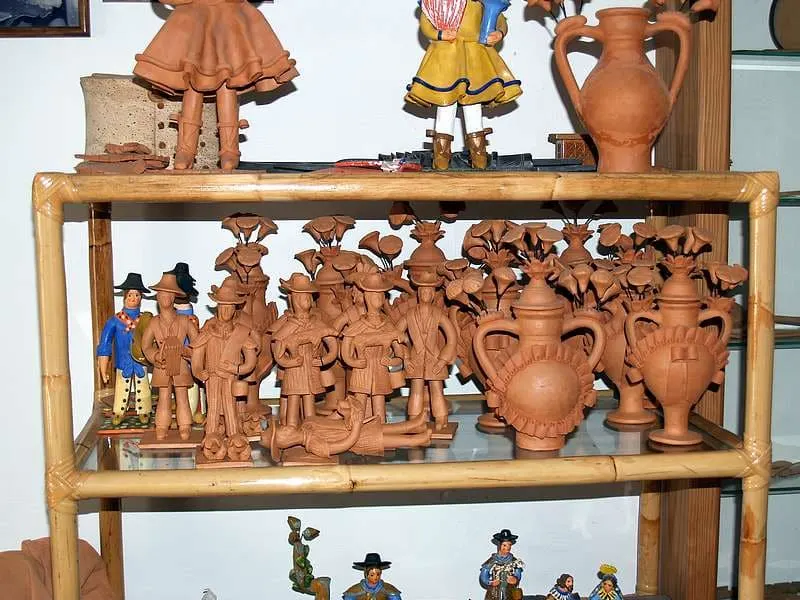
The Estremoz Figures, clay figurines from the Alentejo, were inscribed by UNESCO as Intangible Cultural Heritage of Humanity in 2017.
- Location
- Estremoz, Évora
- Built
- séc. XVII–presente
- UNESCO
- Intangible Heritage · since 2017
The Estremoz Figures are hand-modelled, polychrome clay figurines produced in the Alentejo town of Estremoz, in the district of Évora. On 7 December 2017, UNESCO inscribed the know-how associated with Estremoz figurines on the Representative List of the Intangible Cultural Heritage of Humanity — the first clay figurines in the world to receive this distinction. The nomination had been preceded, in 2014, by the inscription of the practice in the National Inventory of Intangible Cultural Heritage.
A tradition more than three centuries old
The production of figurines in Estremoz dates back at least to the 17th century and is documented by 18th-century records — among them a 1770 inventory that already mentioned clay figures. For a long time the activity was carried on by women, the boniqueiras, who sold the pieces at the region’s fairs and pilgrimages. In the early 20th century the tradition almost died out, with the death of potters such as Gertrudes Rosa Marques, surviving in the memory of artisans such as Ana das Peles.
Its continuity was owed above all to Mariano da Conceição and his sister Sabina Santos, who passed the technique on to new generations, and to the role of the School of Arts and Crafts, founded in 1924, in recovering the old models. It is this unbroken chain of oral and gestural transmission that sustains the practice today.
What UNESCO honoured was not an object but a living know-how: the transmission, from master to apprentice, of a grammar of forms, colours and themes that has remained recognisable for generations.
Technique and aesthetics
Estremoz figurines are born from the local clay, modelled by hand using three fundamental techniques — the ball, the slab and the coil. After being dried for several days, the piece is fired at around 800 °C and then painted with diluted pigments of mineral origin, finally being protected with varnish. The palette of bright colours and the rounded contours make these figures instantly identifiable.
The themes reflect the life and imagination of the Alentejo: scenes of rural work and crafts, Nativity scenes, religious figures such as Spring (Primavera) or Love is Blind (Amor é Cego), and the procession of popular characters. This connection to Alentejo culture brings the figurines close to other expressions of the region, such as the Cante Alentejano, also recognised by UNESCO.
Place in Portuguese intangible heritage
The Estremoz Figures form part of a broad set of expressions that make up the internationally recognised Portuguese intangible heritage, alongside other Portuguese inscriptions on the Representative List. As an art of clay, they also dialogue with the wider tradition of Portuguese decorative arts, in which popular ceramics holds a prominent place.
Today, only a small number of potters keep the production going, which makes the safeguarding and transmission of the knowledge as essential as the creation itself. The inscription on the UNESCO list, part of the broader recognition of Portugal’s world and intangible heritage, has reinforced the commitment to preserve one of the oldest and most singular traditions of clay figurines in Europe.
Frequently asked questions
- When were the Estremoz Figures recognised by UNESCO?
- The art of the Estremoz clay figures was inscribed on UNESCO's Representative List of the Intangible Cultural Heritage of Humanity on 7 December 2017, during the 12th session of the Intergovernmental Committee.
- Where are the Estremoz Figures produced?
- They are produced in the town of Estremoz, in the district of Évora, in the Alentejo, where a small number of potters keep the traditional technique and models alive.
- How are the Estremoz Figures made?
- The figure is modelled by hand using three techniques — the ball, the slab and the coil —, dried for several days, fired at around 800 °C and then painted with pigments and protected with varnish.