Intangible Heritage
The Pig Slaughter (Matança do Porco)
The pig slaughter, a communal ritual of the Portuguese rural winter: practices, cured sausages, sarrabulho and its place in the intangible cultural heritage.
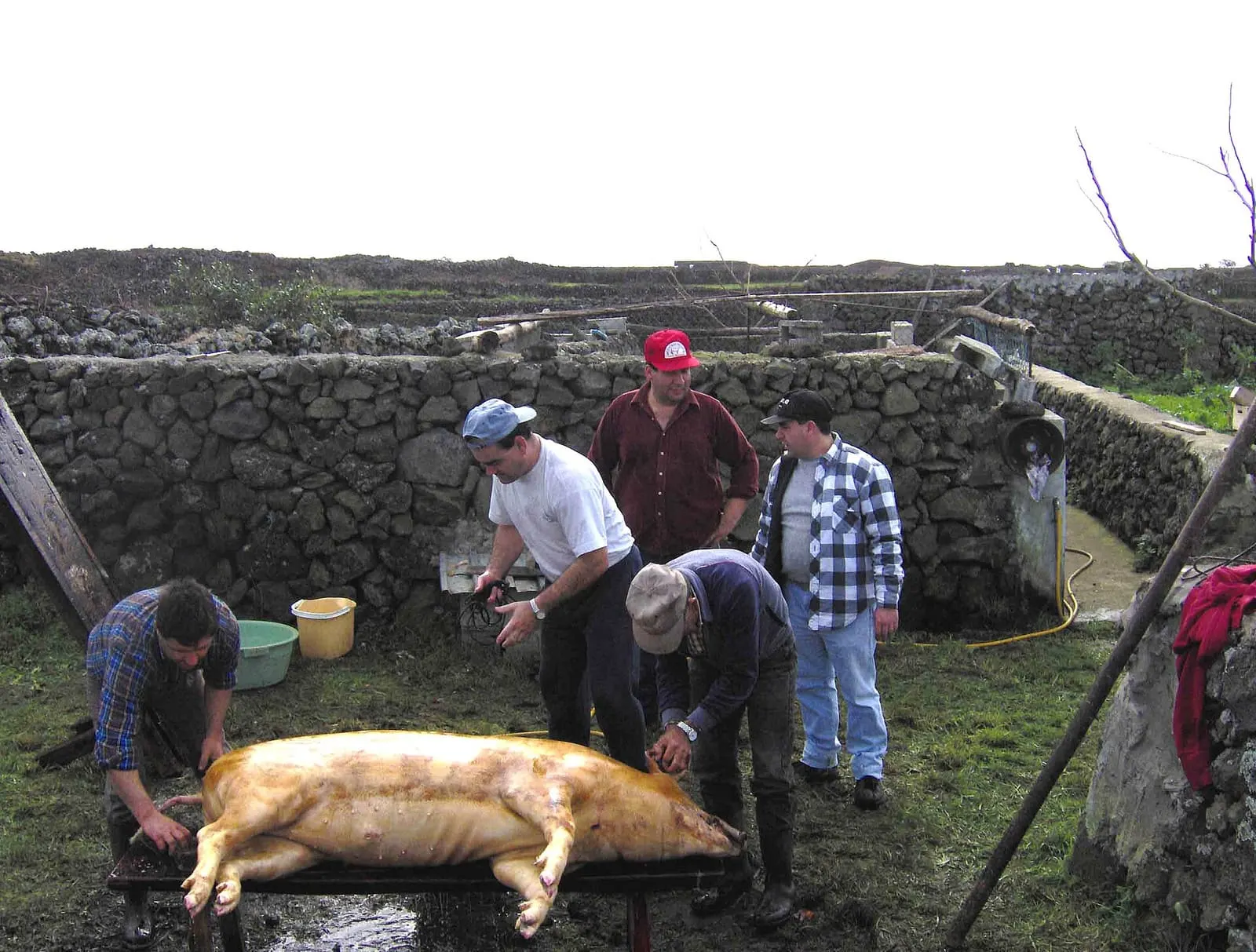
The pig slaughter (matança do porco) is one of the most deeply rooted rituals of the Portuguese rural calendar. For centuries it represented, for the great majority of peasant families, the main reserve of animal protein for the whole year: from the pig “everything was used”, in a subsistence economy in which little went to waste. More than an act of slaughter, it was a social event that brought together relatives, neighbours and friends around shared labour and the celebration that accompanied it.
Calendar and practices
The slaughter is concentrated in the cold months, above all between November and January, because the low temperature is essential for preserving the meat and curing the sausages without their spoiling. The day is organised according to a well-known sequence: the slaughter at daybreak, the collection of the blood, the scalding and scraping of the bristles, the opening of the carcass and the butchering. Each gesture has its own person responsible for it, and the knowledge is passed on orally, from generation to generation, in the very act of doing.
The butchering gives rise to a chain of transformations that stretches over weeks. The meat is salted, seasoned and stuffed into casings to produce the smoked range: chouriças, salpicões, paios and, in certain regions, the alheira. The pieces then go to the smoking chamber, where slow smoking — historically indispensable for preservation — gives them their characteristic aroma. Dishes for immediate consumption, such as sarrabulho prepared with the cooked blood, mark the communal meal that closes the day’s work.
Communal and symbolic dimension
More than a supply operation, the slaughter was a moment of fellowship and of strengthening the bonds of mutual aid. The collective presence, the division of tasks and the sharing of the first delicacies set it within a festive cycle of the rural winter, close to other manifestations of Portuguese intangible cultural heritage. In many villages the calendar linked it to the winter festivities that punctuate the north-east of Trás-os-Montes and the inland Beira.
Cured sausages and pork are, moreover, a pillar of the traditional diet of the interior, in dialogue with the values of sharing, seasonality and full use that shape the Mediterranean diet. It is also within the material universe of pastoralism and rural life — to which belongs, for example, the making of cowbells — that the slaughter finds its broadest cultural context.
Heritage and preservation
The domestic practice has gone into steep decline in recent decades, as a result of the rural exodus, changes in ways of life and health regulation. Portuguese law continues to authorise the slaughter for self-consumption, within limits and rules of sanitation, as well as its performance at public events of a cultural and gastronomic character.
In response to this decline, municipalities, brotherhoods and associations have promoted re-enactments and pig-slaughter festivals, above all in Trás-os-Montes, the Minho and the Beiras, which seek to fix in collective memory the gestures, the know-how and the flavours associated with the ritual. These efforts form part of the work of inventorying and safeguarding the intangible heritage, recognising in the pig slaughter not merely a technique of food production, but a cultural complex that brings together labour, festivity, gastronomy and the identity of Portuguese rural communities.
Frequently asked questions
- At what time of year does the pig slaughter take place?
- It is held above all between November and January, in the depths of winter, because the low temperatures make it easier to preserve the meat and cure the sausages.
- Is slaughtering a pig for one's own consumption permitted in Portugal?
- Yes. Portuguese law authorises the domestic slaughter of pigs for self-consumption, subject to health rules; public events featuring the traditional slaughter are likewise permitted for cultural and gastronomic purposes.
- What products come out of the slaughter?
- Fresh meat, bacon fat and lard, and a wide range of smoked cured sausages such as chouriça, salpicão and alheira, as well as immediate dishes such as sarrabulho.