Monuments
Ducal Palace of Vila Viçosa
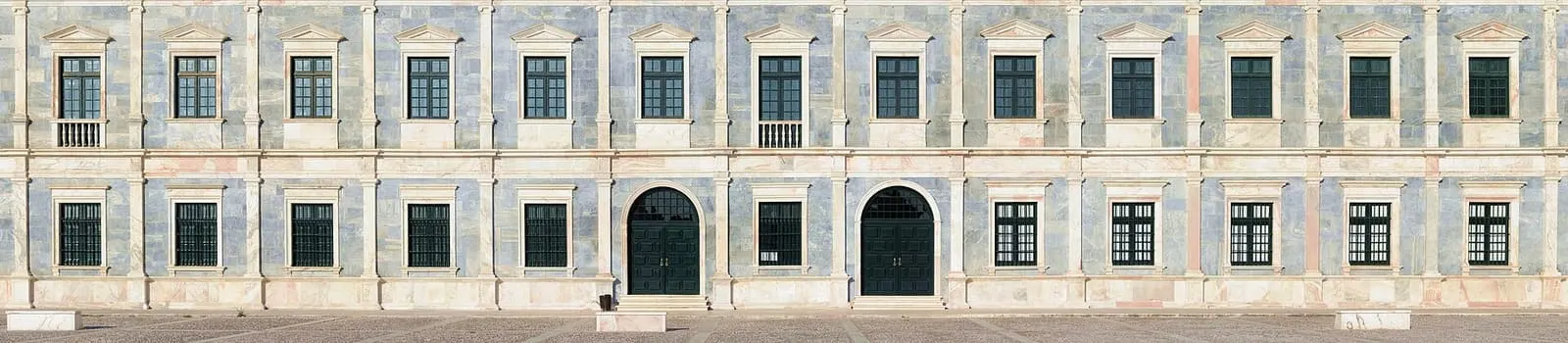
Ducal Palace of Vila Viçosa in Alentejo: residence of the Dukes of Braganza with a 110-meter marble facade and rich art collections.
- Location
- Vila Viçosa, Évora
- Built
- 1501–1640
- Style
- Renascimento
The Ducal Palace of Vila Viçosa rises in the heart of the Alentejo town that bears its name, dominating the vast Terreiro do Paço with an extensive marble facade that has become one of its most recognizable emblems. For centuries, it was the favored residence of the Dukes of Braganza, the most powerful noble house in the kingdom, and its history is intertwined with that of the country itself. When, in 1640, the 8th Duke was acclaimed king as Dom João IV, the palace became part of the royal family’s heritage, a status it retained until the monarchy’s abolition.
Origins and Construction
Construction began in 1501 under the orders of Dom Jaime, 4th Duke of Braganza, who moved the ducal seat to Vila Viçosa from the Palace of the Dukes of Braganza in Guimarães. The building was expanded and enriched throughout the 16th and 17th centuries, a process that gave it the monumental scale we see today. The main facade, executed from 1537 in the Italian Renaissance style, grew through successive campaigns until it reached approximately 110 meters in length, clad in marble extracted from local quarries—the same white and pink stone that brought the region international fame.
The choice of marble was not merely aesthetic: by displaying the territory’s wealth on the palace walls, the Braganzas visually asserted the power of a house that, unbeknownst to them, would later ascend to the throne.
From Ducal Residence to Museum
After 1640, with the Braganzas’ rise to the throne, Vila Viçosa lost its status as a permanent residence and became primarily a hunting retreat and royal lodging, benefiting from the nearby game reserve and woodland. The palace followed the monarchy’s vicissitudes until its end: after the Republic was established in 1910, the assets of the House of Braganza remained in the possession of Dom Manuel II, as they were family property rather than state property.
It was through the will of Portugal’s last king that the House of Braganza Foundation was established, responsible for opening the palace to the public as a museum. Today, visitors explore the royal apartments, chapels, tiled and fabric-lined halls, and admire collections of painting, goldsmithing, tapestries, and arms, as well as a remarkable carriage section. The building has been classified as a National Monument since 1970.
Significance and Context
The Vila Viçosa complex—palace, castle, squares, and woodland—constitutes one of the most coherent testimonies of Portuguese noble architecture in the Early Modern period, integrated into the heritage wealth of the Alentejo. Its value led to the site’s inclusion on the Portuguese Tentative List for World Heritage, a nomination that highlights the relationship between the town, marble stone, and dynastic memory.
As the foremost example of royal palaces and residences in the country, the Ducal Palace of Vila Viçosa cannot be understood in isolation: it dialogues with the urban and retreat palaces scattered across the national territory and helps explain how a provincial aristocratic lineage evolved, over centuries, into the dynasty that ruled Portugal until 1910.
Frequently asked questions
- Who commissioned the construction of the Ducal Palace of Vila Viçosa?
- Construction began in 1501 under the orders of Dom Jaime, 4th Duke of Braganza, and continued throughout the 16th and 17th centuries, when the marble facade achieved its current grandeur.
- Can the Ducal Palace be visited?
- Yes. Since the establishment of the House of Braganza Foundation, the palace has operated as a museum, displaying royal apartments, art collections, furniture, and a carriage section.
- Why is the House of Braganza significant in this palace?
- Vila Viçosa was for centuries the seat of the Dukes of Braganza, who ascended to the Portuguese throne in 1640 with Dom João IV, linking the palace's history to that of the monarchy itself.
Sources
Keep exploring
Heritage nearby
More places to discover from here. Approximate straight-line distances, within 50 km.