Resources
National Palaces of Portugal
The national palaces of Portugal — Ajuda, Pena, Sintra, Mafra and Queluz — former royal residences under state guardianship, their history and management.
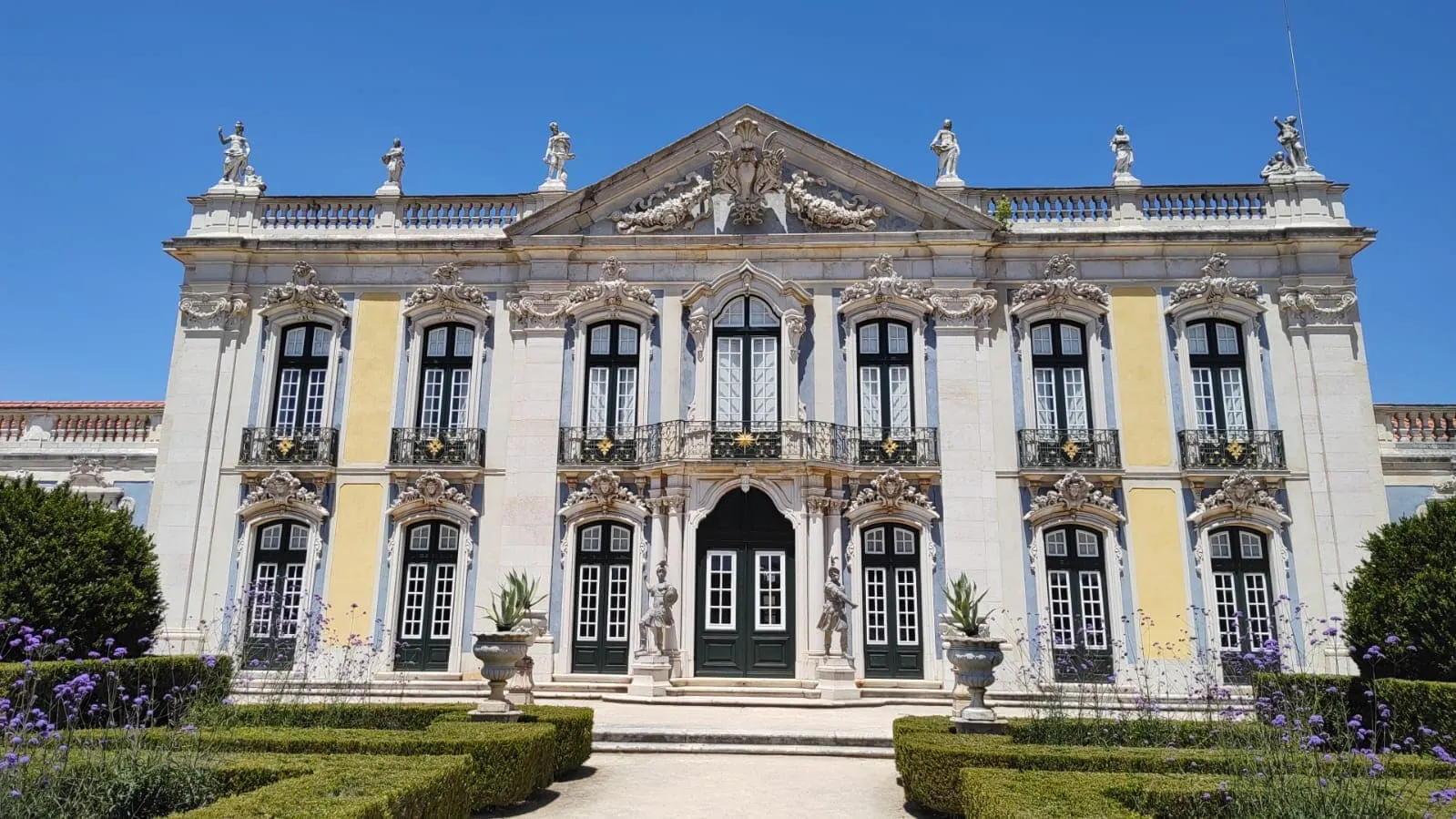
The designation national palaces identifies the group of former Portuguese royal residences that, following the establishment of the Republic in 1910 and the consequent dissolution of the Royal Household, passed into state ownership and guardianship. Traditionally there are five: the National Palaces of Sintra, Queluz, Mafra, Ajuda and Pena. Though distinct in period, style and function, they share a common origin as spaces of royal habitation and representation, and a convergent institutional trajectory as public assets open for cultural enjoyment.
The five palaces
The oldest is the Sintra National Palace, whose construction dates back to the 15th century and combines medieval, Manueline, Renaissance and Romantic campaigns, being the only Portuguese medieval palace to survive relatively intact to the present day. Next comes the Baroque complex of Mafra, commissioned by King João V from 1717, which integrates royal palace, basilica, convent and hunting park as one of the grandest undertakings of Joanine Baroque. The Queluz National Palace, begun in 1747 to designs by Mateus Vicente de Oliveira, is one of Europe’s last great Rococo exemplars, conceived as a summer retreat.
The Ajuda National Palace, started in 1795 following the Neoclassical designs of José da Costa e Silva and Francisco Xavier Fabri, remained unfinished but became the monarchy’s official residence from 1861. The most recent is the Pena National Palace, created in the mid-19th century by King Fernando II atop an ancient Hieronymite monastery, the foremost icon of Romantic revivalism in Portugal. Each monument has its own dedicated page — see /palacio-nacional-de-sintra/, /palacio-nacional-de-mafra/ and /palacio-nacional-da-ajuda/.
Guardianship and management
Management of the national palaces is not centralized under a single entity. Since 2012, the Sintra and Queluz National Palaces have been overseen by the publicly owned company Parques de Sintra-Monte da Lua, established in 2000 following Sintra’s designation as a World Heritage Cultural Landscape; this model relies on financial self-sustainability, with conservation funded through ticket sales and service revenues. The Pena National Palace also forms part of this framework, managed by the same company.
The Mafra and Ajuda National Palaces remained under central state guardianship, exercised by the /direcao-geral-do-patrimonio-cultural/ until the 2024 reorganization, which transferred management of museums, monuments and national palaces to the new public company Museus e Monumentos de Portugal, E.P.E., while safeguarding, inventory and classification functions were assigned to the public institute Património Cultural.
Heritage value
As a group, the national palaces constitute a fundamental repository of decorative arts, azulejo tiles, furniture and Portuguese painting, while documenting five centuries of royal residential architecture. Two hold international recognition: Pena, as part of Sintra’s Cultural Landscape (UNESCO, 1995), and the Royal Building of Mafra (UNESCO, 2019), both included in Portugal’s /patrimonio-mundial/. Their permanent public access makes these spaces among the country’s most visited monuments.
Frequently asked questions
- How many national palaces exist in Portugal?
- Five national palaces under direct state guardianship are commonly referenced: those of Sintra, Queluz, Mafra, Ajuda and Pena. All were former royal residences and are now open to the public as monuments and museums.
- Who manages the Portuguese national palaces?
- Management is divided: the National Palaces of Sintra and Queluz are overseen by the public company Parques de Sintra-Monte da Lua since 2012; those of Mafra and Ajuda fall under central state guardianship, transferred from the Directorate-General for Cultural Heritage to the company Museus e Monumentos de Portugal in 2024.
- Which national palaces are UNESCO World Heritage Sites?
- The Pena National Palace forms part of the Cultural Landscape of Sintra, designated by UNESCO in 1995, while the Mafra complex (palace, basilica, convent and hunting park) was inscribed on the World Heritage List in 2019.
Sources
Resources for research
Find the sources. Follow the story.
Guides to researching buildings, exploring museum collections and understanding heritage protection.
SIPA
Get to know the architectural inventory, building records and documentary archive.
Read the guideMuseum collectionsMatrizNet
Explore the museum catalogue and records of works, materials, authorship and provenance.
Read the guideHeritage protectionHeritage classification
Understand cultural property categories and the levels of national, public and municipal interest.
Read the guide