Monuments
Sintra National Palace
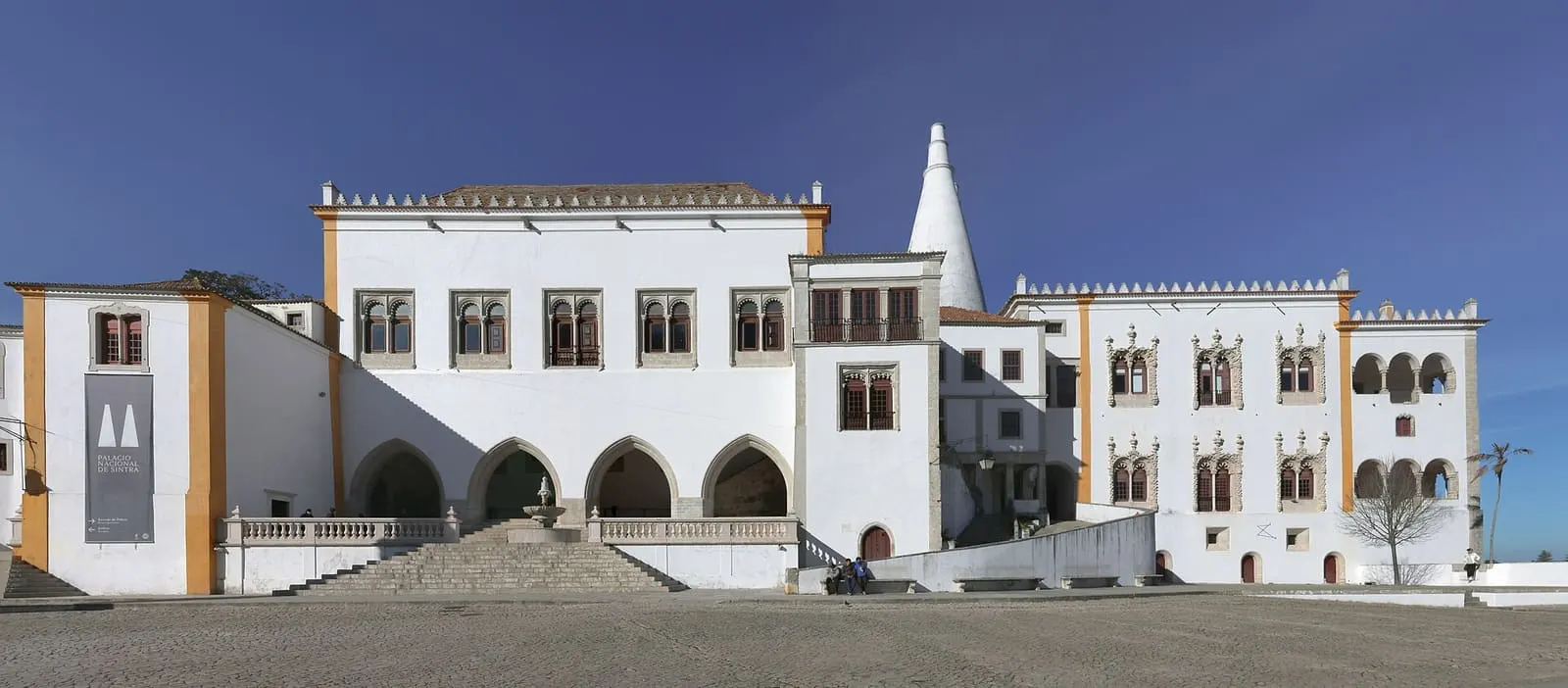
The Sintra National Palace, a former medieval royal palace in the center of Sintra, famous for its two conical chimneys and the Hall of Swans, Hall of Magpies…
- Location
- Sintra, Lisboa
- Built
- séc. XV–XVI
- Style
- Medieval, gótico, manuelino e renascentista
The Sintra National Palace, also known as the Royal Palace or Town Palace, stands in the heart of the historic center of Sintra, in the Lisbon district. It is the only Portuguese medieval royal palace to have survived to the present day largely intact, thanks to continuous royal occupation from the early 15th century until the end of the monarchy in 1910. Its two conical chimneys, visible from across the town, have become Sintra’s unmistakable emblem.
A palace built by successive reigns
Although traces of an Islamic alcázar precede it, the palace’s current appearance stems mainly from two major construction campaigns. The first, promoted by King João I around 1415, gave the palace a Gothic structure organized around courtyards, including the grand Hall of Swans and the kitchen topped by the famous chimneys. The second, during the reign of King Manuel I (1495–1521), added the Manueline wing, with twin windows, imported Sevillian Mudéjar tiles, and the sumptuous Hall of Coats of Arms.
Rather than following a unified plan, the complex grew organically, incorporating structures from different periods around courtyards, staircases, and galleries. Hence its irregular silhouette and the coexistence of medieval, Gothic, Manueline, and Renaissance elements—a quality that makes the palace a living document of the evolution of Portuguese royal taste over five centuries.
Few buildings convey the passage of time so clearly: each room in the Town Palace bears witness to a reign, and walking through it is to traverse the history of the Portuguese crown itself.
The halls and their decorative program
The interior preserves some of Portugal’s most remarkable painted ceilings. The Hall of Swans, once the banquet hall, features a coffered ceiling with twenty-seven swans; the Hall of Magpies is decorated with numerous magpies holding roses, a motif traditionally linked to an episode at the court of King João I. On the noble floor, the Hall of Coats of Arms displays a dome with seventy-two coats of arms of noble families arranged around the royal arms, above 18th-century tile wainscoting.
The royal kitchen, topped by the 33-meter-high conical chimneys, retained the capacity to serve grand court banquets. The palace also holds dramatic memories, such as the room where King Afonso VI was confined for years in the late 17th century.
Significance and classification
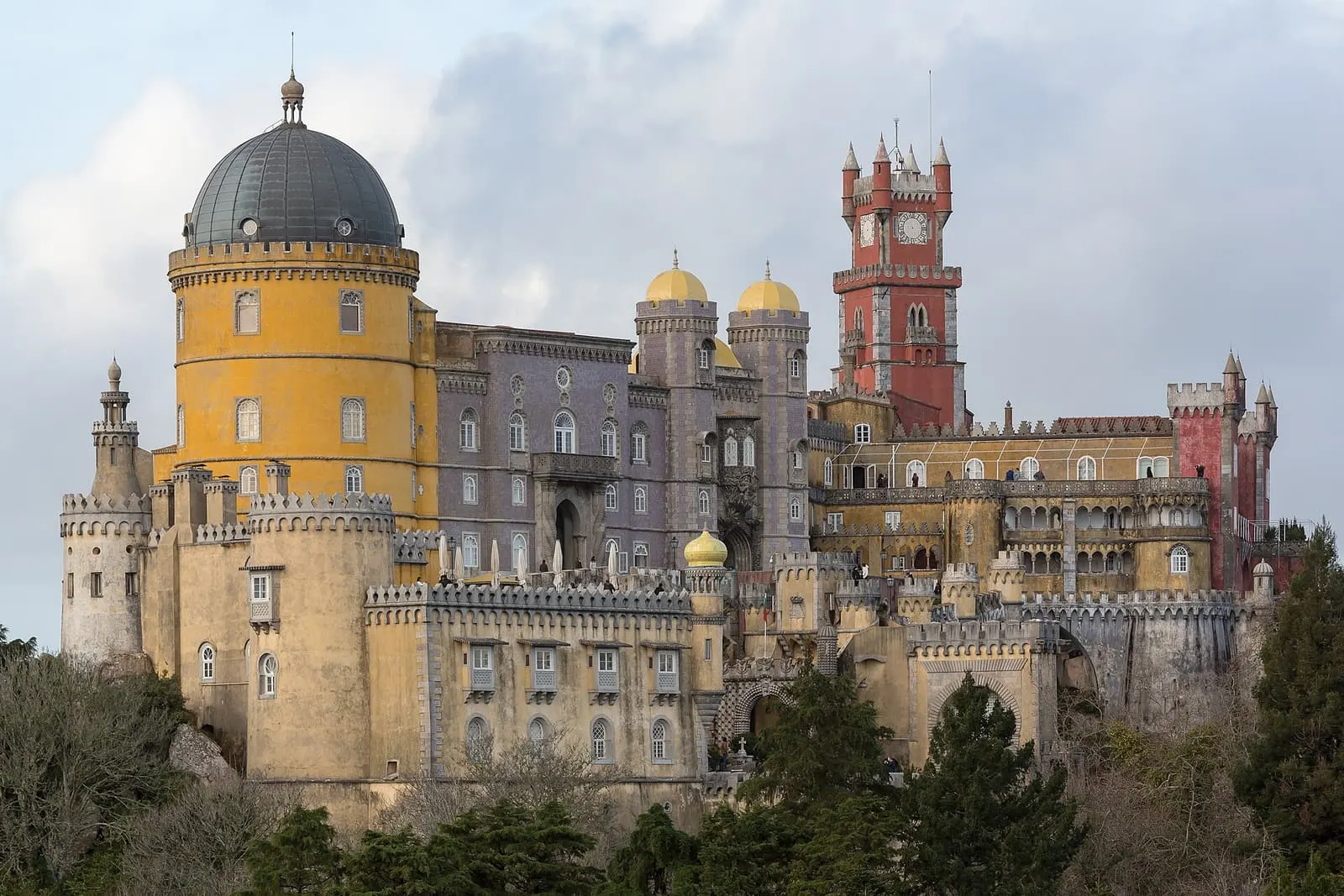
Designated a National Monument in 1910, the Sintra National Palace is now managed by Parques de Sintra – Monte da Lua and forms part of the Cultural Landscape of Sintra, inscribed on the UNESCO World Heritage list in 1995. Together with the Romantic Pena National Palace and the exotic Monserrate Palace, it forms the remarkable group of royal palaces that make Sintra one of Portugal’s most historically and architecturally rich sites.
Frequently asked questions
- Why does Sintra Palace have two large conical chimneys?
- They are the chimneys of the royal kitchen, standing about 33 meters high, designed to vent smoke from the large ovens and stoves used in court banquets. They became the iconic symbol of the palace and of Sintra itself.
- What is the difference between Sintra National Palace and Pena Palace?
- Sintra National Palace is the former medieval royal palace located in the historic center of the town. Pena Palace is a 19th-century Romantic construction built on the mountain peak. They are distinct monuments, both part of the Cultural Landscape of Sintra.
- What is the Hall of Coats of Arms?
- It is a vaulted hall from the early 16th century whose ceiling displays 72 coats of arms of Portugal's leading noble families, arranged around the royal arms. It is one of Europe's most remarkable heraldic programs.
Sources
Keep exploring
Heritage nearby
More places to discover from here. Approximate straight-line distances, within 50 km.