Monumentos
Tumbas clasificadas como Monumento Nacional
Nine tombs classified as National Monument, in Braga, Óbidos, Lisbon, Santarém, Grijó, Oliveira do Conde and Penafiel: what the records and decrees confirm.
- Ubicación
- Braga, Braga
Some of the oldest funerary monuments in Portugal hold their own national classification, independent of the church or monastery that houses them. The Atlas do Património Classificado lists nine tombs as National Monument, across seven municipalities. This guide presents them with what the records and decrees allow us to affirm, and states plainly where I found no more than the name. For the context of Portuguese funerary sculpture, see Escultura Portuguesa.
Braga: Tomb of Archbishop D. Diogo de Sousa
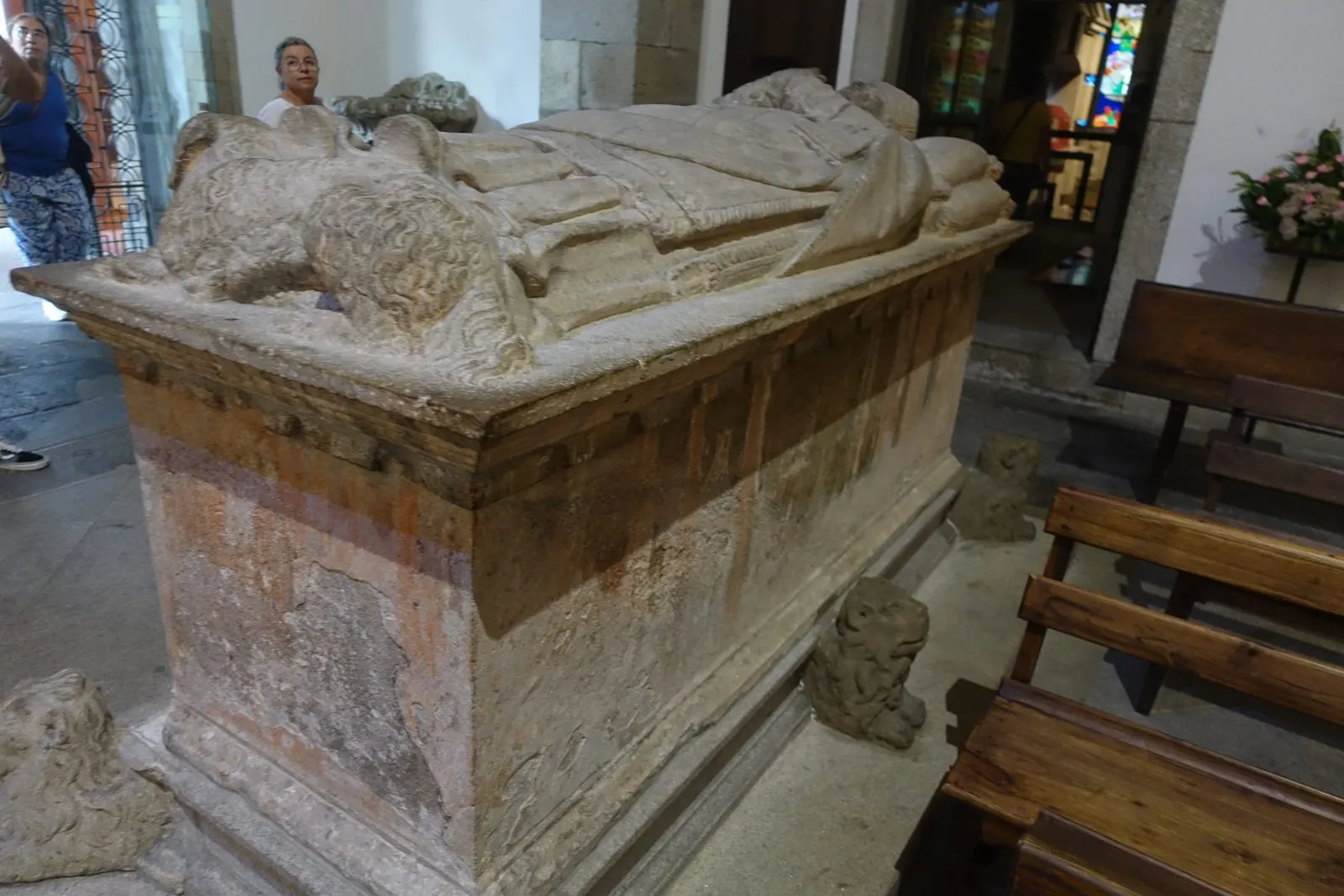
Classified (NINV 74937) as «Túmulo do Arcebispo D. Diogo de Sousa, na Sé de Braga», by the decree of 16 June 1910. The photograph on this page shows a tomb with a recumbent effigy and lions at the base, in the Braga Cathedral; the source file identifies it as the tomb of D. Diogo de Sousa. See the Sé de Braga and the city of Braga.
Óbidos: Tomb of D. João de Noronha, o Moço
The Atlas (NINV 3147) places it in the Church of Santa Maria de Óbidos and gives as its instrument Decree no. 22 735, of 24 June 1933. I read it in the Diário do Governo no. 140: it declares the Church of Santa Maria de Óbidos a property of public interest, and classifies as national monument «o túmulo e monumento funerário de D. João de Noronha, o Moço, que se encontra na referida igreja». See Óbidos.
Lisbon: two tombs
The Tomb of João das Regras (NINV 3351) is in the Church of São Domingos de Benfica and is a National Monument by the 1910 decree. Decree no. 22 734, of 24 June 1933, confirms it: in declaring the church a property of public interest, it refers to «o túmulo de João das Regras, que já é monumento nacional», and adds the great altarpiece of the chancel, two altarpieces of the transept, four paintings of the second and third altars, and the sixteenth-century chest holding the bones of Vasco Martins de Albergaria.
The Tomb of Queen D. Mariana Vitória (NINV 3350) is in the Church of São Francisco de Paula, in the parish of Estrela, also classified by the 1910 decree. I have no official source read on its sculpture or date.
Santarém: two tombs in the Church of São Nicolau
The Atlas records the Tomb of João Afonso, founder of the former hospital of Santarém (NINV 3947), in the Parish Church of São Nicolau, and the Tomb of Fernão Rodrigues Redondo (NINV 3946), in the chapel of São Pedro, «actualmente anexa» to the same church. Both by the 1910 decree. I did not read a description of either. See Santarém.
Vila Nova de Gaia: Tomb of D. Rodrigo Sanches
Located, according to the Atlas (NINV 3807), in the cloister of the Grijó Monastery, it is a National Monument by the 1910 decree. There is further development in the guide to the Mosteiro de Grijó.
Carregal do Sal: Tomb of Fernão Gomes de Góis
It is in the Parish Church of Oliveira do Conde (NINV 4251) and was classified by the 1910 decree. I found no official source describing the work or its date.
Penafiel: Tomb of Monte de São Roque
The record (NINV 3700) is the only one in this group that names no church or monastery, only the parish of Penafiel; classified by the 1910 decree. I could not confirm, from an official source, what it is or exactly where it stands, and so I do not describe it.
Taken together
Eight of these tombs were classified in the 1910 decree, and one, that of Óbidos, in 1933, in the same instrument that declared the church housing it of public interest. As the group brings together tombs from different periods, the title of this guide refers only to the protection category; the dates and sculptors of each work are left unstated where I could not confirm them. For the largest-scale Gothic funerary sculpture, see the tombs of Alcobaça and Batalha in Escultura Portuguesa and Gothic architecture.
How to visit
Most are in churches or cathedrals, and access depends on worship and each building’s opening hours. When I consulted sources on 5 November 2026 I found no official opening hours for these tombs. Please confirm with the parishes, dioceses and municipalities.
Photograph by Joseolgon, 9 September 2023. Original on Wikimedia Commons, under CC BY 4.0; resized and compressed for the web, without altering the composition.

Preguntas frecuentes
- How many tombs are National Monuments in this guide?
- Nine: one in Braga, one in Óbidos, two in Lisbon, two in Santarém, one in Grijó (Vila Nova de Gaia), one in Oliveira do Conde (Carregal do Sal) and one in Penafiel.
- What was the classification decree?
- For eight of them, the decree of 16 June 1910, published in the Diário do Governo no. 136, of 23 June 1910. The tomb of D. João de Noronha, o Moço, in Óbidos, was classified by Decree no. 22 735, of 24 June 1933, according to the Atlas do Património Classificado.
- Are all the tombs inside churches?
- Not necessarily. The records place them in cathedrals, parish churches, the Church of São Domingos de Benfica, a monastic cloister and an annexed chapel; the Tomb of Monte de São Roque, in Penafiel, has no associated church in the record.
- Can I visit these tombs?
- Those in churches depend on each church's opening hours. When I consulted sources on 5 November 2026 I found no official opening hours for these tombs; please confirm with the parish, the diocese or the municipality.
Fuentes
- Património Cultural, I.P. — Atlas do Património Classificado e em Vias de Classificação (NINV 3147, 3350, 3351, 3700, 3807, 3946, 3947, 4251 e 74937)
- Diário do Governo, I série, n.º 136, de 23-06-1910 — Decreto de 16 de junho de 1910
- Diário do Governo, I série, n.º 140, de 24-06-1933 — Decretos n.º 22:734 e n.º 22:735