Périodes & Styles
Romanticism and Revivalist Architecture
Romanticism and revivalisms in 19th-century Portuguese architecture: Neo-Manueline, Neo-Gothic, and Neo-Moorish, from Pena Palace to Monserrate and Buçaco.
- Construction
- c. 1839–1910
- Style
- Romantismo, Revivalismos historicistas
Romanticism introduced a new sensibility to 19th-century Portuguese architecture, evoking historical nostalgia, a taste for the picturesque, and a deep dialogue between construction and landscape. Breaking away from the sobriety of dominant Neoclassicism, Romantic architects and patrons turned to medieval and 16th-century influences, freely reinterpreting them. This historicist approach gave rise to revivalist styles—recycled vocabularies of Gothic, Manueline, and Islamic elements—not for archaeological accuracy but to compose emotionally charged scenes steeped in memory.
From Nostalgia to National Identity
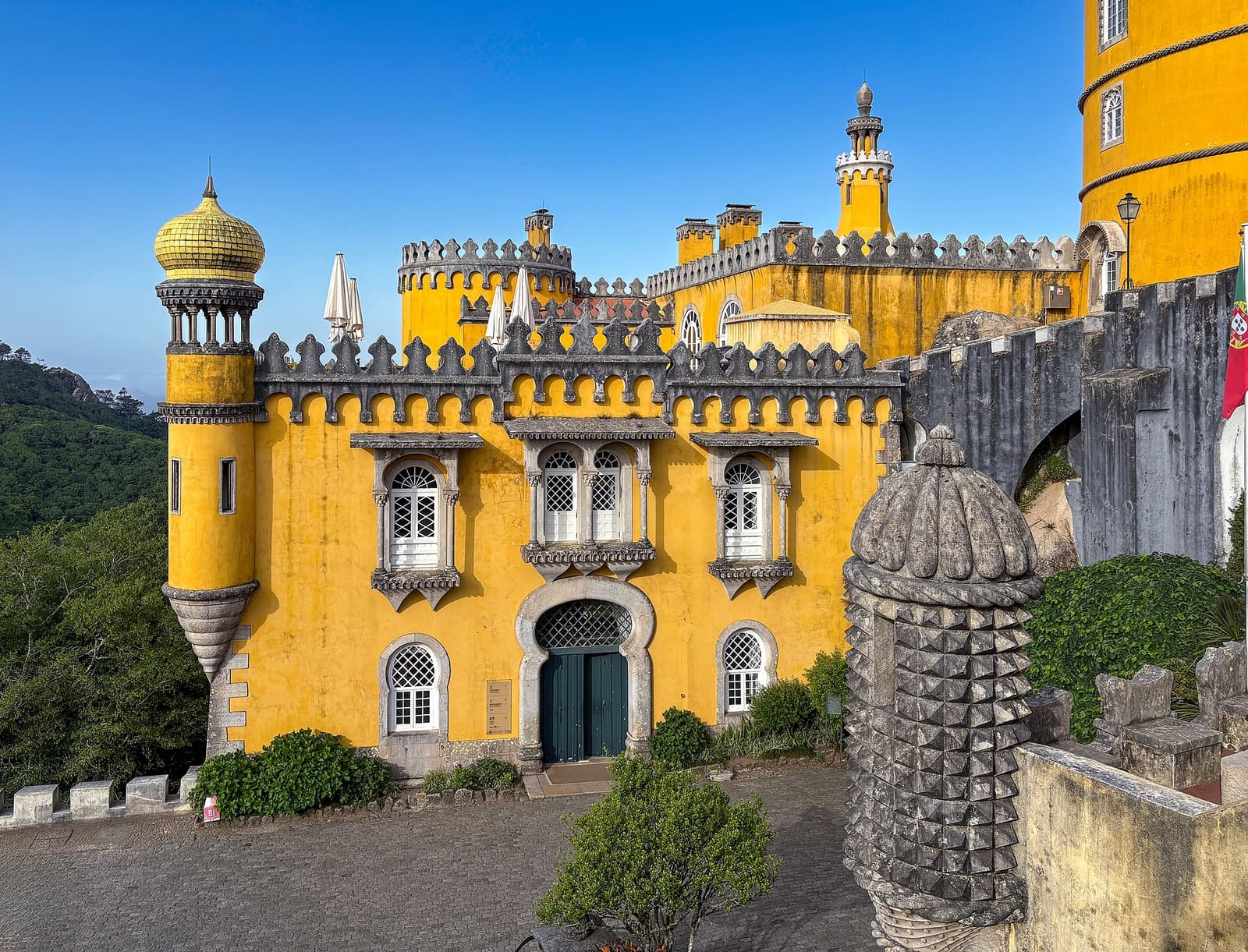
The turning point took place in Sintra. In 1839, King Consort Ferdinand II of Saxe-Coburg-Gotha acquired the ruins of the former Monastery of Our Lady of Pena and, with the help of German engineer Wilhelm Ludwig von Eschwege, built a palatial fantasy atop the mountain that would become the manifesto of Portuguese Romanticism. The Pena National Palace combines Neo-Gothic, Neo-Manueline, Neo-Moorish, and Neo-Renaissance elements in a single ensemble, arranged with scenic freedom that prioritizes poetic effect over stylistic coherence.
The novelty was not merely formal. In an era of rising nationalism, the past became political, and architecture sought historical forms as reflections of collective identity. Portugal found its mirror in the Neo-Manueline style, a revival of the aesthetic from the reign of King Manuel I—epitomized by the Jerónimos Monastery and Belém Tower—transformed into a national style. While much of Europe adopted Neo-Gothic as a patriotic language, Portugal cultivated its own vocabulary, linked to the memory of the Age of Discoveries and maritime grandeur.
Revivalism did not copy the past—it summoned it. Each Manueline or Moorish reference was less an archaeological exercise than a way of inhabiting history.
The Styles of Romantic Taste
Under the umbrella of historicism, several revivalist styles coexisted. Neo-Gothic drew inspiration from medieval Christian architecture; Neo-Romanesque revived earlier forms; the Neo-Moorish, particularly favored in gardens and reception halls, evoked the Iberian Islamic heritage through horseshoe arches, stucco, and tilework. Often, these styles were not isolated but deliberately combined in an eclectic mix where diversity was the project’s essence.
The second great Sintra landmark, the Monserrate Palace, exemplifies this fusion: Gothic, Moorish, and Renaissance elements intertwine seamlessly, extending into a botanical garden where nature itself becomes part of the work. The relationship between building and landscape—mountain, forest, garden—is, in fact, a defining trait of Romantic taste, inherited from the English picturesque garden tradition.
Persistence and Legacy
Romanticism was not short-lived. It endured into the early 20th century, leaving behind ambitious scenographic works. Italian set designer and architect Luigi Manini conceived the Buçaco Palace Hotel, an erudite replica of Manueline motifs from Belém Tower and Jerónimos, and also designed Quinta da Regaleira (completed in 1910) in Sintra—a symbolic and esoteric synthesis of revivalist imagination.
By the early 20th century, Art Nouveau and modernism introduced new grammars, closing the Romantic chapter. Yet its legacy remains embedded in Portugal’s cultural landscape: in palaces, country estates, and gardens that transformed mountains and outskirts into memory-laden settings, still among the nation’s most unique heritage sites today.
Questions fréquentes
- When did Romantic architecture emerge in Portugal?
- Architectural Romanticism is considered to have emerged in Portugal by the late 1830s, marked by the construction of Pena Palace in Sintra, and remained influential until the early 20th century.
- What distinguishes Portuguese revivalism from other European movements?
- While Europe predominantly adopted Neo-Gothic as a national style, Portugal cultivated Neo-Manueline—a revival of the 16th-century Manueline style—as an expression of national identity.
- What are the main examples of Romantic architecture in Portugal?
- Notable examples include Pena National Palace and Monserrate Palace in Sintra, Buçaco Palace Hotel, and Quinta da Regaleira, all characterized by an eclectic mix of historicist styles.