Denkmäler
Roman Ruins of Tróia
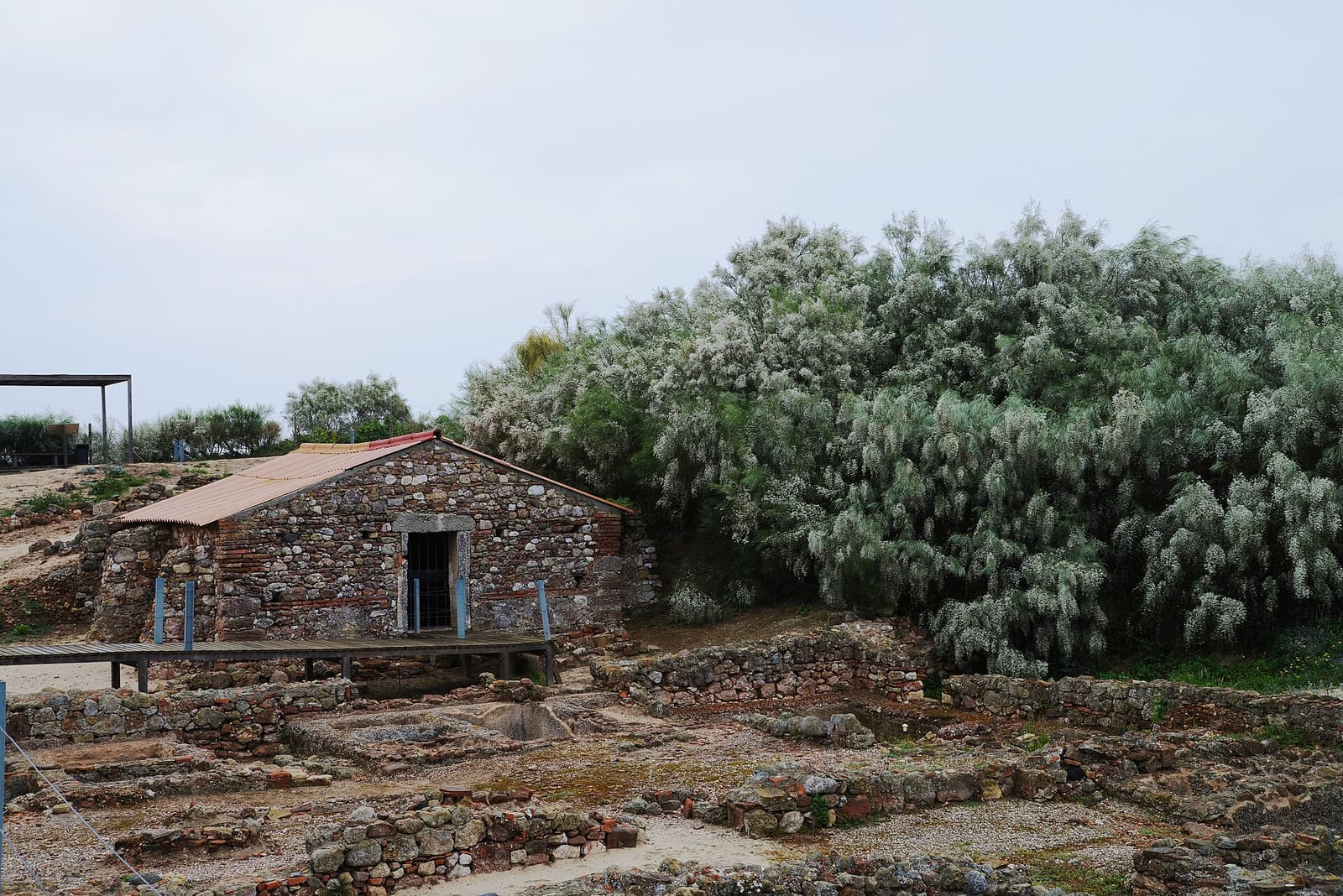
The Roman Ruins of Tróia, located on the peninsula facing Setúbal, are the largest known fish-salting and processing complex from the entire Roman Empire.
- Lage
- Carvalhal, Grândola, Setúbal
- Errichtet
- Séculos I – VI d.C.
- Stil
- Romano
The Roman Ruins of Tróia occupy the northwestern side of the Tróia peninsula, on the left bank of the Sado estuary, facing the city of Setúbal but within the territory of the parish of Carvalhal (municipality of Grândola, Setúbal district). Classified as a National Monument since 1910, the site represents the largest fish-salting and processing complex known in the entire Roman world, continuously active between the 1st and 6th centuries AD.
A Factory on an Imperial Scale
The choice of location was no accident. The Sado estuary provided shelter, abundant fish, and nearby salt deposits—three essential conditions for an industry that transformed tuna, mackerel, and other species into long-lasting preserves and the famous garum, the fermented fish sauce that flavored tables across the Mediterranean. The workshops were organized around central courtyards, flanked by series of masonry tanks lined with opus signinum—the cetariae—where fish was layered with salt.
Around twenty workshops have been identified, varying greatly in size: the largest exceeded 1,000 m² and contained nineteen tanks, while the smallest, at 135 m², had nine. This concentration of industrial units, entirely focused on maritime exports, sets Tróia apart from simple coastal villae and justifies its interpretation as a true industrial cluster.
Tróia inverts the romantic image of Roman ruins: here, there are no temples or theaters, but rows of salting tanks—the raw testimony of an Atlantic economy driven by fish and salt.
Baths, Necropolises, and the Paleochristian Basilica
The long occupation of the site left much more than workshops. Excavations have uncovered a bath complex covering about 450 m², featuring an apodyterium, frigidarium, tepidarium, and caldarium heated by a hypocaust, with traces of mosaics and a palaestra. There is also a residential area—the so-called Rua da Princesa—a mausoleum, and necropolises with diverse funerary typologies. Late Christianity left its mark in a Paleochristian basilica with once-frescoed walls, a sign that the community survived the religious conversion of the Late Empire.
Archaeological interest in Tróia is longstanding. The first known excavations date back to the second half of the 18th century, sponsored by the then-infanta D. Maria, the future Queen Maria I; in the mid-19th century, the Lusitanian Archaeological Society revealed mosaics and painted walls; and between 1948 and 1967, campaigns exposed the baths, salting houses, necropolises, and basilica.
Tróia in the Context of Roman Lusitania
The complex is part of the dense economic network Rome established along the coast of the province of Lusitania, which includes sites studied on the page about Roman archaeology in Portugal. Across the Sado from Tróia, the city of Setúbal inherited the Roman name Caetobriga, with which the complex maintained close supply and market relations. In terms of scale and preservation, Tróia rivals the great Roman urban sites in the country, such as the Roman Ruins of Conímbriga, yet it offers a rare perspective: that of a Roman industry frozen in its working state.
Häufige Fragen
- Where are the Roman Ruins of Tróia located?
- They are situated on the left bank of the Sado estuary, on the northwestern side of the Tróia peninsula, facing Setúbal, in the parish of Carvalhal, municipality of Grândola, Setúbal district.
- What was the purpose of the Roman complex at Tróia?
- It was a major industrial center for fish salting and processing, producing preparations like garum, which were exported by sea throughout the Roman Empire between the 1st and 6th centuries AD.
- Can the Roman Ruins of Tróia be visited?
- Yes. The site is open to the public with a visitor circuit established in 2011, passing through the salting workshops, baths, and the Paleochristian basilica, part of which is only accessible on guided tours.
Quellen
Weiter entdecken
Kulturerbe in der Nähe
Weitere Orte in der Umgebung entdecken. Ungefähre Entfernungen als Luftlinie, im Umkreis von 50 km.