Periods & Styles
Romanesque Architecture and Art in Portugal
The Romanesque in Portugal (11th-13th centuries): cathedrals, monasteries and churches of Coimbra, Braga and the Vale do Sousa, between the Reconquista and the…
- Built
- Séculos XI-XIII
- Style
- Românico
Romanesque architecture is the first great monumental style of Christian Portugal. It reached the territory in the late 11th century, carried by the Europeanisation of Peninsular culture: the Cluniac monastic reform, the replacement of the Mozarabic rite by the Roman liturgy, and the arrival of clergy and master builders from beyond the Pyrenees. Its apogee coincides with the very formation of the kingdom, between the arrival of Count Henry (1095) and the reign of Afonso Henriques, making the Romanesque a language at once religious and identitarian.
Characteristics of an art of stone
The Portuguese Romanesque is, above all, an architecture of masses. The churches follow longitudinal plans, with one or three naves separated by arcades on columns and pillars, closed off to the east by semicircular apses. The walls are thick, pierced by few and narrow openings, supporting barrel or groin vaults. The effect is that of a fortress of faith: sober, robust, turned inward.
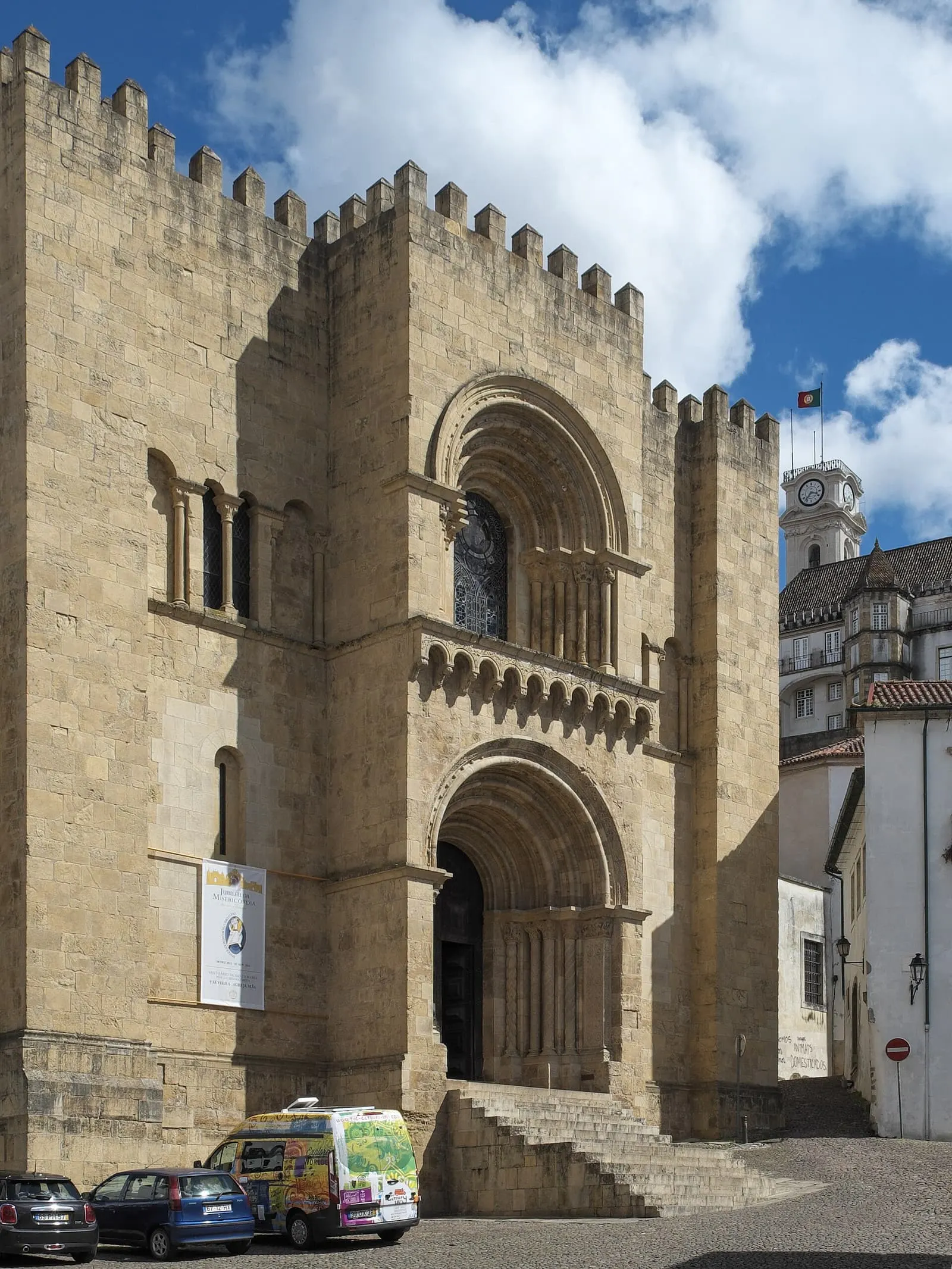
Decoration concentrates on the building’s sensitive points — portals, capitals, corbels and tympana. The foliate capitals, distant heirs of the Corinthian order, sit alongside figural scenes, fantastical animals and geometric interlace. The Old Cathedral of Coimbra alone brings together some 380 carved capitals, making it one of the largest centres of Romanesque sculpture in the country.
More than importing a style, the Portuguese masters adapted it: the Romanesque here is late, persistent and rustic, surviving in rural settings long after the court had adopted the Gothic.
Cathedrals, monasteries and the Vale do Sousa
The geography of the Portuguese Romanesque is drawn from north to south. The Cathedral of Braga, seat of the oldest archbishopric, was one of the first great building sites, influenced by the model of the cathedral of Santiago de Compostela. In Coimbra, the Old Cathedral rose throughout the 12th century under the direction of the masters Robert, Bernard and Soeiro: by 1185 it already hosted the coronation of Sancho I, and it remains the most intact of the Portuguese Romanesque cathedrals.
It was above all in the Entre-Douro-e-Minho region, and particularly in the Vale do Sousa, that the Romanesque gained rural density. Around Benedictine monasteries such as Paço de Sousa, granite parish churches multiplied that today form the heart of the Rota do Românico (Romanesque Route). Temples such as the Church of the Saviour of Bravães, with its celebrated carved portal, show how local workshops translated an erudite vocabulary into a popular and vigorous language.
From Romanesque to Gothic
From the mid-13th century, the arrival of the mendicant orders and the taste for taller, more luminous spaces opened the way to Gothic architecture in Portugal. The transition was not abrupt: for decades, Romanesque and Gothic solutions coexisted in the same buildings, and in many parishes of the north the Romanesque continued to be built when it was already a style of the past in the great centres.
For this reason, the Romanesque legacy is not measured by cathedrals alone. It resides in the web of small churches, bridges and monasteries that structured the medieval territory and which, restored over the course of the 20th century, gave Portugal one of the most coherent Romanesque landscapes of the Iberian Peninsula.
Frequently asked questions
- When did Romanesque architecture appear in Portugal?
- The Romanesque reached Portuguese territory in the late 11th century, accompanying the Cluniac monastic reform and the adoption of the Roman liturgy, and it took hold throughout the 12th and 13th centuries, during the formation of the kingdom.
- What is the most representative Romanesque monument in Portugal?
- The Old Cathedral of Coimbra (Sé Velha), consecrated around 1174-1175, is the only Romanesque cathedral from the time of the Reconquista to have survived practically intact, and is regarded as the country's reference work in the style.
- Where are Portugal's Romanesque buildings concentrated?
- The greatest density is found in the Entre-Douro-e-Minho region, above all in the Vale do Sousa, and in the Coimbra area; the Romanesque is rarer to the south, where the Reconquista arrived later.