Monuments
Church of São Salvador de Bravães
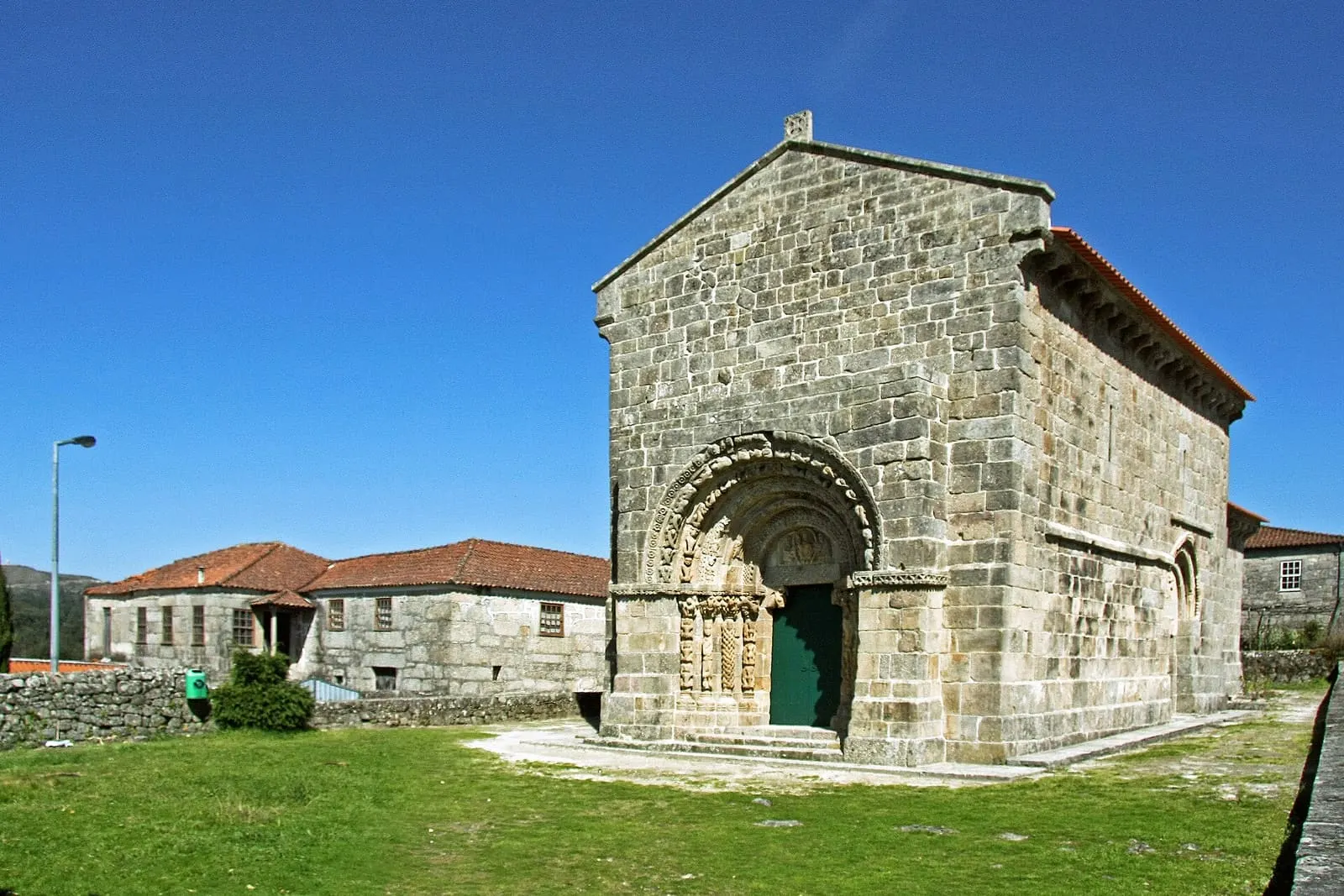
The Church of São Salvador de Bravães, in Ponte da Barca, is one of the jewels of the Romanesque architecture of the Minho, famed for its profusely carved portal.
- Location
- Bravães, Ponte da Barca, Viana do Castelo
- Built
- Finais do séc. XII – inícios do séc. XIII
- Style
- Românico
Beside the old road that led to Ponte da Barca, in the valley of the river Lima, stands a small granite church whose façade concentrates one of the densest lessons in Romanesque sculpture in all of northern Portugal. The Church of São Salvador de Bravães is what remains of a former Minho monastery, now vanished, and it impresses less by its size than by the extraordinary decorative richness of its western portal.
A vanished monastery
Tradition links the founding of the cenobium to D. Vasco Nunes de Bravães, and medieval documentation confirms the existence of a Benedictine monastic community in the region. The church that has come down to us was probably built between the end of the twelfth century and the beginning of the thirteenth, although it preserves features that point back to the previous century. Nothing survives of the conventual structure: only the church, with a single nave closed off by a narrower and lower chancel, withstood the transformations of the following centuries.
This simplicity of plan is characteristic of the rural Romanesque of the Minho, in which local workshops of stonemasons adapted, on a parish scale, a repertoire learnt in the great works. The historian Carlos Alberto Ferreira de Almeida emphasised precisely at Bravães the way in which the style was “assumed and regionalised” by Portuguese masters, making this church an exemplary case of how the Romanesque took root in the territory.
At Bravães, the modesty of the construction contrasts with the ambition of the sculptural programme — it is in the stones of the portal, not in the proportions of the building, that its grandeur is measured.
The portal that makes its fame
The axial portal of the western façade is the feature that justifies the monument’s renown. It is composed of five round-arched archivolts, resting on small columns whose shafts, capitals and bases were carved from top to bottom. Across them parade rosettes, geometric interlacing, birds, serpents, quadrupeds and confronted human figures — including, on two shafts, pairs of figures face to face, a rarity in the national Romanesque. In the tympanum, serene and framed by the mystic mandorla, appears Christ in Majesty, flanked by two angels.
The side doorways reinforce the symbolic programme: the southern one holds in its tympanum the Mystic Lamb, while the northern one displays a stylised Tree of Life between two animals. This iconographic ensemble, read as a whole, articulates central themes of medieval eschatology — the glory of Christ, sacrifice and salvation — and makes Bravães a true book in stone for the medieval faithful who approached the church.
Alongside other landmarks of the Romanesque of the North, such as the Church of São Pedro de Rates or the Church of São Martinho de Mouros, Bravães belongs to the great family of churches that defines the architectural identity of the region, today showcased by routes such as the Romanesque Route.
Recognition and visiting
The exceptional nature of the ensemble earned it classification as a National Monument in 1910, in the first list of properties protected by the Portuguese State. Despite its discreet location in a rural parish of the Alto Minho, it remains an essential destination for those touring the Romanesque monuments of the North and seeking to understand how a European aesthetic acquired a Minho accent. The serenity of the place, amid fields and close to the Lima, adds to the monument a dimension that no photograph of its famous portal can fully convey.
Frequently asked questions
- Where is the Church of São Salvador de Bravães?
- It stands in the parish of Bravães, municipality of Ponte da Barca, district of Viana do Castelo, beside the valley of the river Lima, in the Alto Minho.
- Why is the church of Bravães famous?
- For the exceptional quality of its Romanesque portal, with five profusely carved archivolts and a tympanum depicting Christ in Majesty flanked by angels, considered one of the finest of the Portuguese Romanesque.
- When was it classified as a National Monument?
- It was classified as a National Monument in 1910, forming part of the first group of monuments protected by the Portuguese State.
Sources
Keep exploring
Heritage nearby
More places to discover from here. Approximate straight-line distances, within 50 km.