Themes
Pombaline Azulejo
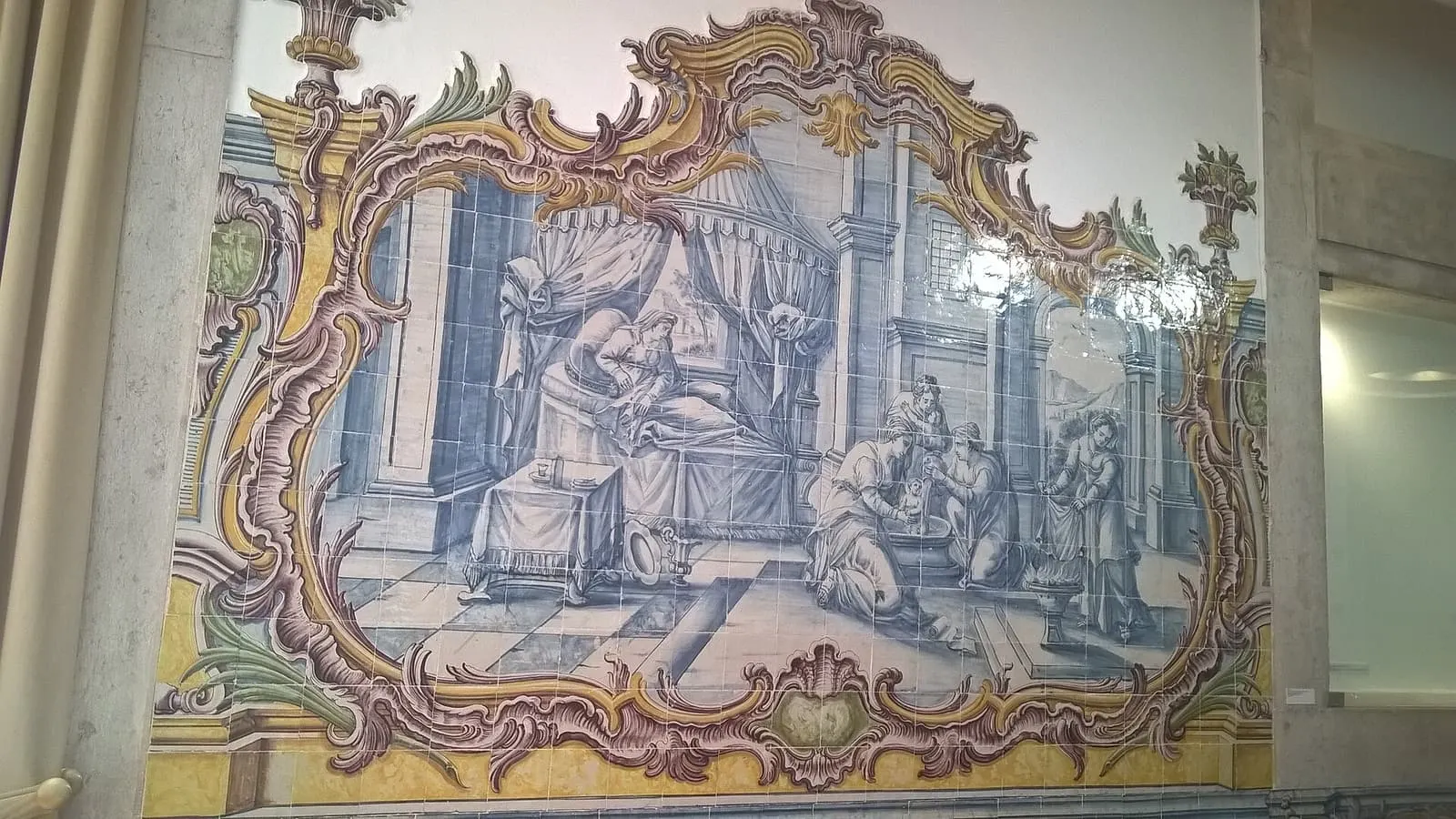
The Pombaline azulejo in Lisbon: the serial production of pattern tiles and the evolution from Rococo to Neoclassicism, tied to the rebuilding of the capital…
- Built
- c. 1755–1800
- Style
- Rococó e Neoclássico
The Pombaline azulejo designates the tilework that took hold in Portugal in the second half of the eighteenth century, in the wake of the rebuilding of Lisbon after the earthquake of 1 November 1755. More than a single style, it is a phenomenon of technical and aesthetic rationalisation: the ceramic response to a city that needed to be rebuilt with speed, economy and visual coherence. The term derives from the name of Sebastião José de Carvalho e Melo, first Marquis of Pombal, minister of King José I, under whose direction the orthogonal grid of Lisbon’s Baixa was raised — one of the first European examples of planned earthquake-resistant urbanism.
From urgency to norm
The devastation of 1755 imposed a new logic on tile revetment. In place of the great figurative blue-and-white panels that had dominated the first half of the century, the reconstruction favoured the pattern azulejo: pieces of uniform dimension, repeatable and combinable, capable of covering dados in rooms, corridors and stairways of any shape. This modularity — in which all the tiles share the same measurements, varying only in colour and motif — allowed extensive surfaces to be assembled at low cost and on a large scale, meeting the priorities of Pombaline policy.
The strength of the Pombaline azulejo lies less in the virtuosity of each piece and more in the intelligence of the system: a finite vocabulary of modules that, recombined, clothe an entire city.
The decorative schemes recovered the dynamic rhythm of the seventeenth-century azulejo, with rotating and diagonal motifs, frequently alternating a radial-design element, a border and a lattice motif. The result was a sober and repetitive ornamentation, perfectly aligned with the restraint of the urbanism of Pombaline Lisbon.
The Real Fábrica do Rato and the shift in taste
The pre-eminent production centre was the Real Fábrica de Louça, at Rato, in Lisbon, founded on 1 August 1767 under the direction of the Italian Tomás Brunetto and active until 1835. Installed next to the Real Fábrica das Sedas, the manufactory was part of the Marquis of Pombal’s policy of economic modernisation, replacing artisanal pottery with industrial-type ceramic production and training generations of azulejo painters.
It was from Rato that the Rococo taste applied to tilework was introduced into Portugal. The production articulated two coexisting tendencies: a late-Rococo strain, exuberant and animated, and a more rational, graphic and orderly stance that already heralded the Neoclassical vocabulary. The rocaille art abandoned bichromatism in favour of a polychrome balance, making the surfaces visually lighter.
From Rococo to Neoclassicism
In the last decade of the eighteenth century, the assimilation of Neoclassical aesthetics once again transformed the tilework that came out of Rato. The panels became low dados filled with light ornaments, of refined polychromy and without expression of volume, frequently organised around monochromatic medallions that evoked cameos and reliefs of Antiquity. This evolution accompanied the broader transition of Portuguese artistic periods and styles, from the exuberant to the restrained, from the narrative figurative to the abstract decorative.
The Pombaline azulejo thus constitutes a pivotal moment in the history of Portuguese decorative arts: the passage from the azulejo as a great mural picture to the azulejo as a modular constructive system. This legacy of standardisation and serial production would lastingly shape the relationship between ceramics and architecture in Portugal, preparing the ground for the massive spread of the façade azulejo in the following century.
Frequently asked questions
- What is the Pombaline azulejo?
- It is the tilework mass-produced in the second half of the eighteenth century, mostly of geometric pattern, associated with the rebuilding of Lisbon after the 1755 earthquake under the direction of the Marquis of Pombal.
- Why is it called Pombaline?
- The name derives from Sebastião José de Carvalho e Melo, first Marquis of Pombal, minister of King José I and the man responsible for the reconstruction of the capital, the period in which this type of revetment became widespread.
- Where were these tiles manufactured?
- Chiefly at the Real Fábrica de Louça, at Rato, in Lisbon, founded in 1767, which industrialised ceramic production and introduced the Rococo and, later, the Neoclassical taste.