Intangible Heritage
Capa de Honras of Miranda
The Mirandese Capa de Honras: the embroidered burel ceremonial cloak of the Terra de Miranda, the foremost piece of the male costume of Miranda do Douro in…
- Location
- Miranda do Douro, Bragança
- Built
- Origem medieval; designação documentada no século XIX
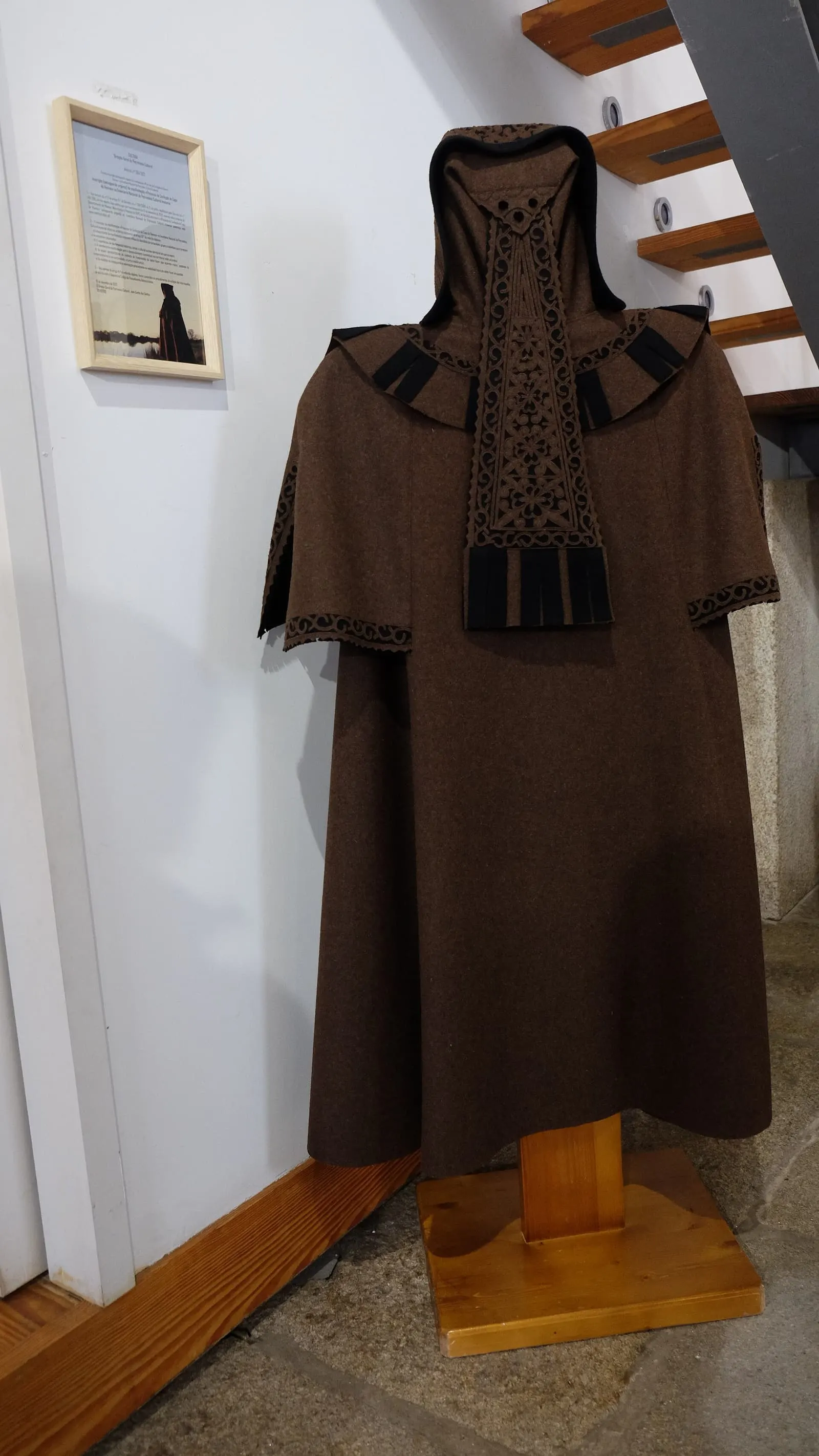
The Capa de Honras of Miranda, or Mirandese cloak of honour, is the most emblematic ceremonial garment of the Terra de Miranda, in the north-east of Trás-os-Montes. It is a piece of male clothing of medieval origin, cut from burel — a thick woollen cloth — and distinguished by embroidered appliqué running along the front opening and the back. More than a garment for warmth, the cloak served as a mark of prestige and social standing, and was held to be the supreme expression of the Mirandese man’s pride.
Material and making
The cloak is born of wool, which after shearing and washing goes through a long cycle of transformation: carding, spinning on the distaff or spindle, weaving and, finally, fulling, which thickens and waterproofs the cloth. The result is burel, a dense, irregular, warm cloth resistant to rain, in tones ranging from brown to black — the same weaving craft that links this tradition to the burel of the Serra da Estrela.
The piece is based on a semicircular form, with a short overcape reaching to the elbows, and a hood. The opening is trimmed with an embroidered appliqué of two panels, cut out and tacked using the picado technique, with patterned motifs of geometric, plant-form or heart-shaped design. The “honras” proper are the ornamental bands that run down the back, finished with fringes at the shoulders.
History and meaning
The origin of the cloak is lost in the Middle Ages. Some relate it to ecclesiastical vestments, in particular to the chasuble worn by Benedictine monks, and others, such as the researcher António Rodrigues Mourinho, derive it from models of the old Kingdom of León. The explicit term “capa de honras”, however, is only documented from the nineteenth century onwards.
Deeply rooted in the identity of this region with a language of its own — Mirandese —, the cloak appears in association with the solemn moments of communal life: festivals, pilgrimages, municipal ceremonies and religious celebrations. It is worn by the stewards and leading figures of the festivities and frequently accompanies the traditional manifestations of the Terra de Miranda, such as the dances of the pauliteiros of Miranda. In Miranda do Douro, the Menino Jesus da Cartolinha, venerated in the co-cathedral, wears a miniature version of the cloak during the ceremonies.
Safeguarding and the present day
The making of the Capa de Honras is today a rare art. Full command of the process — from weaving to embroidery — is concentrated above all in Sendim, in the municipality of Miranda do Douro, in the hands of very few artisans, which places this knowledge in a fragile situation. To document and protect it, the making process was inscribed in 2022 in the National Inventory of Intangible Cultural Heritage, at the proposal of the municipality. At the same time, the cloak has undergone a contemporary revaluation, inspiring pieces of fashion, jewellery and female versions, in an effort to keep alive one of the noblest traditions of Portuguese dress.
Frequently asked questions
- What is the Mirandese Capa de Honras?
- It is a male ceremonial garment from the Terra de Miranda, made of woollen burel and adorned with embroidered appliqué. Of medieval origin, it conferred social prestige on its wearer and is regarded as the foremost piece of the Trás-os-Montes costume of Miranda do Douro.
- Where is the Capa de Honras made today?
- Production is concentrated today in Sendim, in the municipality of Miranda do Douro (district of Bragança), where only a small number of artisans still master the entire process, from the weaving of the burel to the embroidery of the 'honras'.
- Is it classified as intangible cultural heritage?
- Yes. The process of making the Mirandese Capa de Honras was inscribed in the National Inventory of Intangible Cultural Heritage in 2022, on the initiative of the municipality of Miranda do Douro.