Intangible Heritage
Pauliteiros de Miranda
The Pauliteiros de Miranda, the ritual stick dance from Terra de Miranda in Miranda do Douro, performed by men to the sound of bagpipes, snare drum, and bass drum.
- Location
- Miranda do Douro, Bragança
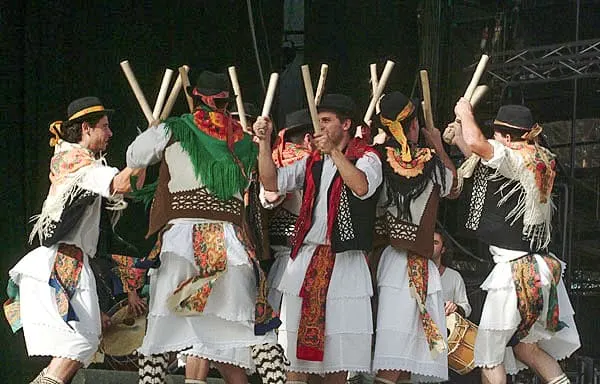
The Pauliteiros de Miranda are the performers of a ritual stick dance originating from Terra de Miranda, in the far northeast of Trás-os-Montes. Traditionally danced by eight men—though in recent decades also by women—the dance consists of a sequence of choreographed figures in which each pair of dancers clashes two short sticks, the palos or paulitos, to the rhythm of percussion and melody. Today, it is one of the most recognizable emblems of Mirandese cultural identity and a symbol of Portugal’s choreographic heritage.
Origin and Ritual Significance
The dance’s origins are lost to the lack of documentary sources, which has fueled various hypotheses. The most widespread interpretation places the pauliteiros within the broad genre of European sword dances, where bladed weapons may have been replaced by sticks, giving the dance a warrior-like and ritual character. Other theories evoke combat dances of pre-Roman peoples of the Douro or the later Christianization of festivities linked to solstices and agrarian cycles. Whatever its genesis, the dance has survived deeply rooted in the festive calendar of Terra de Miranda’s villages, performed mainly during patron saint festivals.
The geographical isolation of the Mirandese plateau, far from the country’s major routes, was decisive in preserving archaic cultural forms—from the pauliteiros to the Mirandese language, recognized as Portugal’s second official language.
The Dance and the Lhaços
The repertoire of the stick dance is called lhaços. Each lhaço is a unit combining unique melody, sung text, and choreography, with dozens of distinct lhaços, each with different names, figures, and tempos. Execution demands precision and memory: the dancers move in formation, alternating stick clashes between pairs and at the center, in a play of symmetries that can extend over long sequences. The figure of the mestre (master) guides the ensemble and ensures faithful transmission of the figures, safeguarding the continuity of knowledge across generations.
The dance is inseparable from its musical accompaniment. The sound comes from the Mirandese bagpipe, a reed instrument that leads the melody, supported by the snare drum and bass drum, which mark the vigorous beat to which the sticks respond. The piper and dancers form an indivisible whole, where the music calls the choreography and the choreography answers the rhythm.
Costume and Identity
The pauliteiros’ costume is one of their most visible trademarks. The dancers wear embroidered skirts over linen shirts, brown vests, woolen socks, leather boots, and hats, sometimes adorned with flowers and ribbons. Brightly colored scarves complete the ensemble, carefully arranged on the body. This attire, deeply connected to the region’s traditional clothing, dialogues with other notable pieces of Mirandese textile heritage, such as the Capa de Honras de Miranda, and contributes to the dance’s striking visual impact.
Throughout the 20th and early 21st centuries, the pauliteiros evolved from a local village practice into a regional and national icon, appearing at festivals, pilgrimages, and official representations both within and outside the country. This trajectory raises reflections on the tension between fidelity to tradition and adaptation to the stage. As a living expression, the Pauliteiros de Miranda are part of the realm of Portuguese intangible cultural heritage, whose safeguarding depends primarily on the continuous transmission among dancers, pipers, and communities.
Frequently asked questions
- What are the Pauliteiros de Miranda?
- They are practitioners of a ritual stick dance characteristic of Terra de Miranda, traditionally performed by eight men who clash two sticks to the sound of bagpipes, snare drum, and bass drum.
- Which instruments accompany the pauliteiros' dance?
- The dance is accompanied by the Mirandese bagpipe, the snare drum, and the bass drum, an ensemble that sets the rhythm for the lhaços performed by the dancers.
- What are lhaços?
- Lhaços is the name given to the repertoire of the Mirandese stick dance. Each lhaço combines unique music, sung text, and choreography, with dozens of distinct lhaços existing.