Places
Miranda do Douro
Miranda do Douro, a border town in the district of Bragança, with its Renaissance cathedral, medieval castle and the singular Mirandese culture of the plateau.
- Location
- Miranda do Douro, Bragança
Tucked into the far north-east of Portugal, on the right bank of the River Douro and a step away from the Spanish border, Miranda do Douro is the historic gateway to the Mirandese Plateau. At an altitude of around 750 metres, in a land of harsh winters and plateau horizons, the town combines a strategic military position with an unmistakable cultural identity, marked by a language of its own and by traditions that have survived the centuries-old isolation of this Trás-os-Montes borderland.
Origins and rise to city status
The medieval settlement took shape at the turn of the thirteenth century, when King Dinis granted it a charter and ordered the building of the castle that would defend this Douro crossing against Castile. For centuries Miranda was a front-line stronghold, with walls of granite and schist, a keep and turrets watching over the valley.
The great leap came in 1545. At the request of King John III, Pope Paul III established the diocese of Miranda, the first in Trás-os-Montes, and the town was raised to the status of city. For more than two centuries it was the ecclesiastical and administrative capital of the province, the seat of a bishop, canons and military authorities — a standing that justified the construction of its imposing cathedral.
Miranda’s grandeur was born of a decision of state: to make the Trás-os-Montes borderland the seat of a bishopric capable of asserting, in stone and liturgy, the presence of Portugal in the face of Castile.
The cathedral and the castle
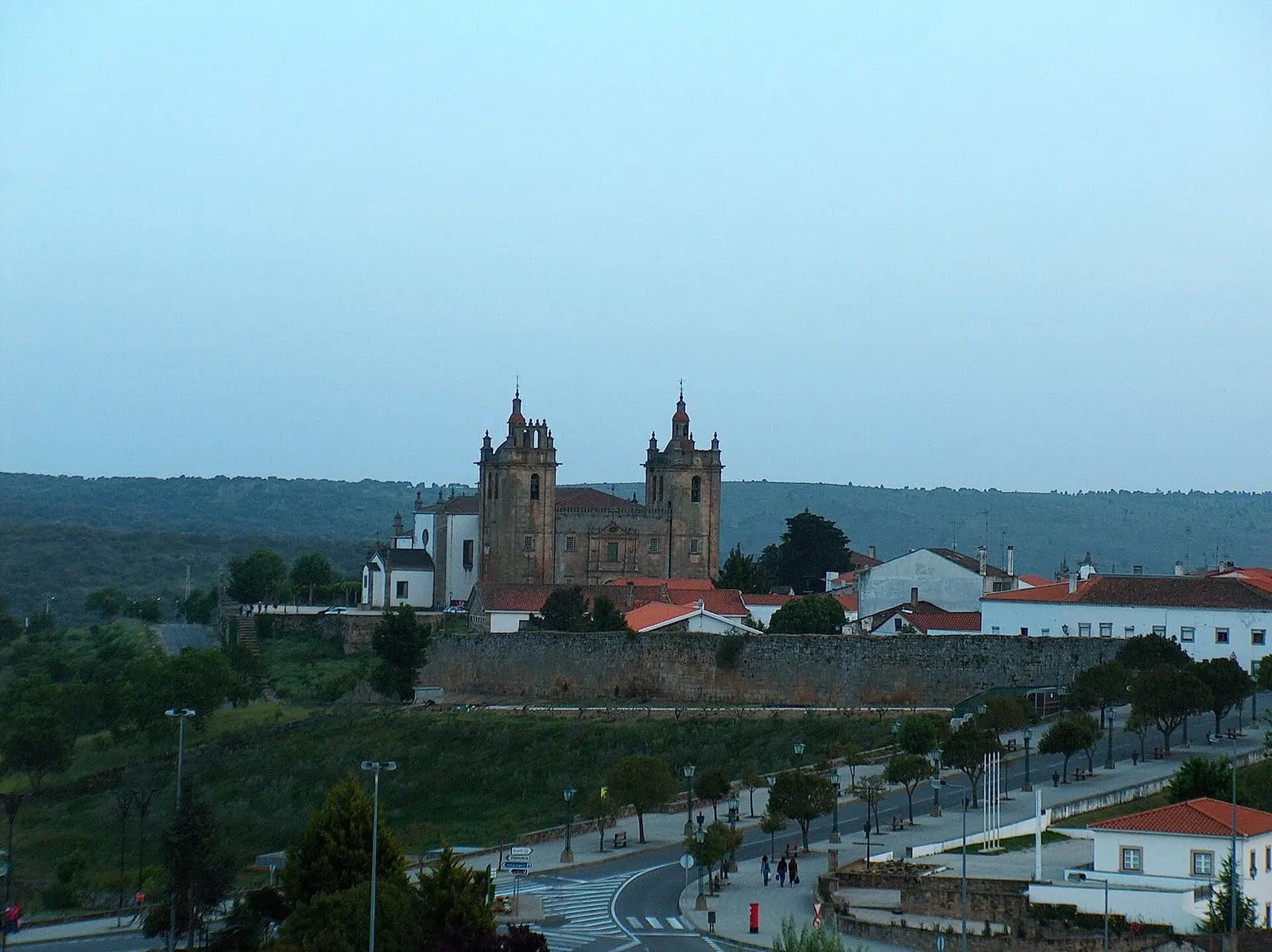
The Cathedral of Miranda do Douro, built from the mid-sixteenth century onwards, is one of the most remarkable examples of Mannerist and Renaissance architecture in the north of the country. With a robust façade flanked by two towers, it houses in its interior a carved-wood altarpiece and the celebrated Menino Jesus da Cartolinha, a votive figure dressed in garments offered by the faithful.
The town’s military destiny reached a tragic turning point in 1762, during the Seven Years’ War: a Spanish bombardment struck the castle’s powder magazine, whose explosion destroyed much of the fortress and caused hundreds of deaths. The ruins, with stretches of wall and the keep, still bear witness today to that past of an armed frontier, forming part of the monumental complex that earned the town its heritage classification. Miranda belongs to the network of border fortifications of Northern Portugal, alongside strongholds such as Bragança.
Mirandese language and culture
More than for its monuments, Miranda stands out for a rare intangible heritage. Here people speak the Mirandese language, a tongue of the Astur-Leonese family officially recognised by Portugal in 1999 as the country’s second language. It survived thanks to the isolation of the plateau and remains alive in place names, in schools and in local literature.
To this linguistic singularity is added a world of festivals, costumes and music. The Pauliteiros de Miranda, dancers who clash sticks together to the sound of the Mirandese bagpipe, are the most recognisable icon of this culture, performing warlike choreographies of ancestral origin. The honour capes of coarse wool, the rites of the winter solstice and the cuisine of the posta mirandesa complete an ensemble that makes this border town one of the most culturally distinctive territories in the Iberian Peninsula.
Frequently asked questions
- Where is Miranda do Douro?
- Miranda do Douro lies in the far north-east of Portugal, in the district of Bragança, on the right bank of the River Douro, close to the border with Spain, at an altitude of around 750 metres on the Mirandese Plateau.
- When was Miranda do Douro raised to the status of city?
- It was raised to city status in 1545, on the occasion of the creation of the diocese of Miranda, the first in Trás-os-Montes, established by a bull of Pope Paul III at the request of King John III.
- What is the Mirandese language?
- It is a language of the Astur-Leonese family, spoken on the Mirandese Plateau and officially recognised by Portugal in 1999 as the country's second official language, alongside Portuguese.
Sources
Keep exploring
Heritage nearby
More places to discover from here. Approximate straight-line distances, within 50 km.