Intangible Heritage
Mirandese Language
Mirandese, Portugal's second official language, of Asturleonese root, spoken in the Terra de Miranda in the north-eastern Trás-os-Montes.
- Location
- Miranda do Douro, Bragança
The Mirandese language, or Mirandese, is Portugal’s second official language and the living testimony of a linguistic frontier that predates the Portuguese state itself. Spoken in a small territory of the north-eastern Trás-os-Montes — the so-called Terra de Miranda — it is not a dialect of Portuguese, but a language in its own right, a branch of the Asturleonese stock that developed autonomously, apart from the Romanisation that gave rise to Galician-Portuguese.
An Asturleonese language on Portuguese soil
Mirandese descends from the Asturleonese varieties spoken in the former Kingdom of León, to which the Terra de Miranda was historically tied before the medieval borders were fixed. When the frontier stabilised, it left on the Portuguese side a community that continued to speak the language of its neighbours in the Iberian interior. For this reason Mirandese preserves archaic traits of medieval Asturleonese, alongside its own innovations that distinguish it from the varieties still spoken in Spain today.
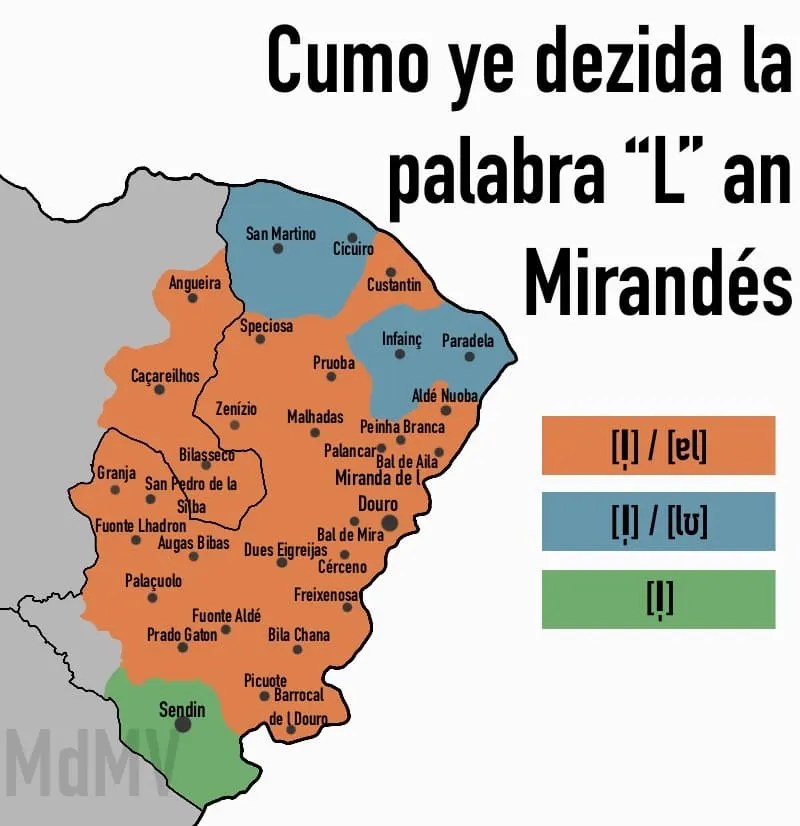
Three main variants are recognised: central Mirandese, considered the standard; raiano or northern Mirandese, spoken along the border; and Sendinese, characteristic of the village of Sendim, with singular phonetic features. This internal diversity, within a territory of a few hundred square kilometres, reveals the historical depth of the language’s roots.
From scorn to official recognition
For centuries Mirandese was a language of domestic and rural use, transmitted orally and regarded with some disdain as a “frontier” speech. Its scientific value was revealed by the philologist José Leite de Vasconcelos, who studied it at the end of the nineteenth century and identified it as a distinct language, devoting to it pioneering works that placed it on the map of European Romance studies.
Mirandese was not born of the corruption of Portuguese: it was born before it, and it survived because a community decided, generation after generation, to go on speaking the language of its ancestors.
The institutional turning point came with Law no. 7/99 of 29 January, which officially recognised the linguistic rights of the Mirandese community. The act enshrined the right to cultivate and promote the language, to teach it in schools and to use it before the public institutions of the municipality of Miranda do Douro. From then on, Mirandese began to be taught, standardised by an orthographic convention, and used in publications, literary translations and institutional acts.
A living and endangered cultural heritage
The language is the thread that binds together a remarkable set of cultural expressions of the region, part of Portuguese intangible cultural heritage. The texts and songs that accompany the dances of the pauliteiros de Miranda, the sound of the Mirandese bagpipe and the garb of the capa de honras de Miranda form, together with Mirandese, an indissoluble cultural whole whose heart lies in Miranda do Douro.
Despite legal recognition and revitalisation efforts, Mirandese faces a marked decline. The most recent studies estimate a few thousand speakers, with a strongly ageing community and a breakdown in transmission between generations, aggravated by the depopulation of the interior and the pressure of the Portuguese spread by the media. The future of the language now depends, to a large extent, on its effective presence in schools and on the cultural appreciation of those who speak it.
To protect Mirandese is to preserve not merely a system of sounds and words, but a way of naming and inhabiting the world all its own — one of the oldest and most singular voices of Portugal’s intangible heritage.
Frequently asked questions
- Is Mirandese an official language in Portugal?
- Yes. Law no. 7/99 of 29 January officially recognised the linguistic rights of the Mirandese community, granting Mirandese the status of Portugal's second official language, with recognised use in the municipality of Miranda do Douro.
- Which language family does Mirandese belong to?
- Mirandese belongs to the Asturleonese group of the Western Ibero-Romance languages, sharing its origin with the Asturian and Leonese spoken in Spain. It does not derive from Portuguese, but predates the very formation of Portugal.
- How many people speak Mirandese?
- The most recent estimates point to around 3,500 speakers, of whom a far smaller number use it regularly. UNESCO and linguists classify Mirandese as an endangered language.