Archaeology
Castro do Zambujal
Castro do Zambujal, in Torres Vedras: a large fortified Chalcolithic settlement in the Estremadura, a centre of copper metallurgy and a landmark of European…
- Location
- Torres Vedras, Lisboa
- Built
- c. 3000–1700 a.C.
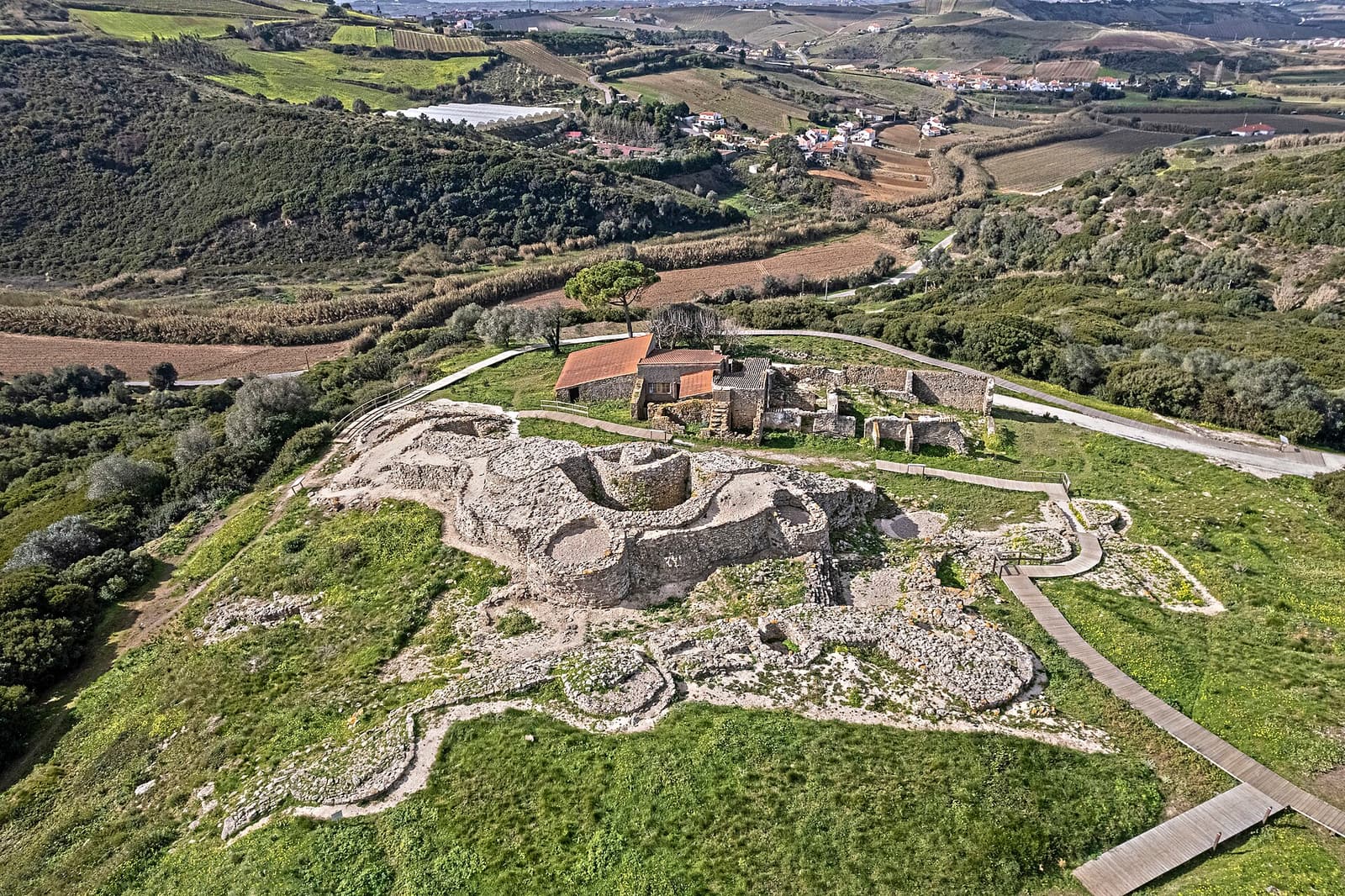
The Castro do Zambujal is one of the most remarkable fortified settlements of the Chalcolithic in Western Europe. Set on a hill about three kilometres from Torres Vedras, in the district of Lisbon, in the third millennium before our era it overlooked a wide arm of the sea — now vanished — that reached inland along the valley of the river Sizandro. This strategic position, linking the land to coastal navigation, helps to explain the wealth and the longevity of the occupation, which lasted approximately between 3000 and 1700 BC.
A defensive system in four phases
The monumentality of Zambujal lies above all in its fortifications, built and remodelled over four major construction phases. The central nucleus, about fifty metres across, was protected by walls of remarkable thickness, reinforced by circular and semicircular bastions and by hollow towers. In successive moments new lines of wall, barbicans and narrow access openings were added, forming one of the most complex prehistoric defensive systems in the Iberian Peninsula. Within the enclosure stood oval-plan huts, about six metres in diameter, built of adobe.
The care taken in the defence of Zambujal reveals a hierarchical society, capable of mobilising collective labour and of protecting reserves and prestige goods on a scale previously unknown in the western Iberian Peninsula.
Copper, ivory and Bell Beaker pottery
The community of Zambujal lived from cereal agriculture and stock-rearing, but it stood out above all as an important centre for the smelting and trade of copper in the Estremadura. Raw materials and exotic goods — gold, ivory, amphibolite — converged on the site, a sign of exchange networks that connected the Portuguese coast to the Mediterranean and to North Africa. It was also here that some of the earliest traces of Bell Beaker pottery were identified, the decorative style that would later spread across much of Europe. Zambujal thus belongs to the same cultural horizon as other great Chalcolithic settlements such as Vila Nova de São Pedro and the settlement of Leceia, which share the bastioned walls characteristic of this period of the Chalcolithic.
Discovery, excavation and classification
The site was recognised in 1932 by the archaeologist and teacher Leonel Trindade, a native of Torres Vedras, who carried out the first work there. Research took on another dimension from 1964, when the German Archaeological Institute began to fund systematic campaigns, directed by figures such as Hermanfrid Schubart and Michael Kunst; the Luso-German collaboration continues to this day. The Castro do Zambujal was classified as a National Monument in 1946, in recognition of its value for the study of Iberian prehistory. Most of the recovered finds are held in the Museu Municipal Leonel Trindade, in Torres Vedras, an institution that ensures public access to this fundamental chapter of Portuguese archaeology.
Frequently asked questions
- Where is the Castro do Zambujal?
- It lies about three kilometres south-west of the town of Torres Vedras, in the district of Lisbon, on a rise that once overlooked the ancient estuary of the river Sizandro.
- From what period does the Castro do Zambujal date?
- It is a Chalcolithic settlement, occupied roughly between 3000 and 1700 BC, corresponding to the Copper Age of the Portuguese Estremadura.
- Why is this archaeological site important?
- It was one of the largest fortified Chalcolithic settlements in Western Europe and a centre of copper metallurgy and trade, yielding some of the earliest known Bell Beaker pottery.
Sources
Keep exploring
Heritage nearby
More places to discover from here. Approximate straight-line distances, within 50 km.