Archaeology
Castro de Leceia
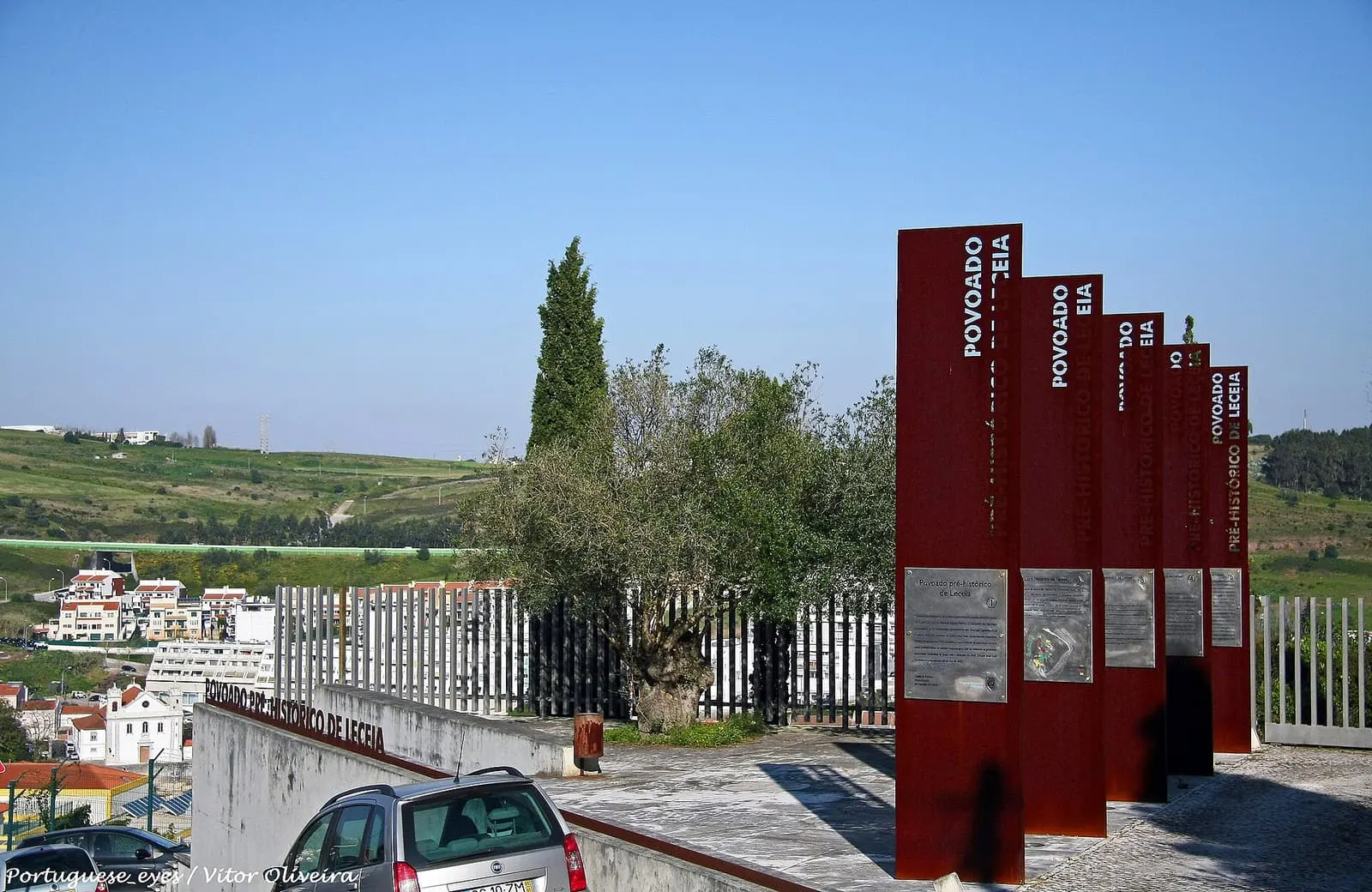
The Castro de Leceia, in Oeiras, is a fortified settlement of the Late Neolithic and the Chalcolithic with a stratigraphy rare in the Portuguese Estremadura.
- Location
- Barcarena, Oeiras, Lisboa
- Built
- c. 3300–2200 a.C.
The Castro de Leceia, more commonly known as the Prehistoric Settlement of Leceia, stands on a limestone spur above the right bank of the valley of the Ribeira de Barcarena, in the parish of Barcarena, municipality of Oeiras. It is one of the most thoroughly studied archaeological sites of the Lisbon Peninsula and a reference case for understanding the first fortified societies of western Europe.
A rare stratigraphic sequence
What sets Leceia apart from so many other settlements of the Estremadura is its stratigraphy. The preserved layers record, almost continuously, the passage from the Late Neolithic to the Chalcolithic, making it possible to follow the evolution of the inhabited area over more than a millennium. Radiocarbon dates place the occupation between about 3300 and 2200 BC.
The oldest layer, of the Estremaduran Late Neolithic (c. 3300–2900 BC), rests directly on the geological bedrock. After a brief abandonment, the site is reoccupied at the beginning of the Chalcolithic, when the defensive apparatus that would make Leceia famous was built. The following phases — Early, Full and Late Chalcolithic, the last marked by Bell Beaker pottery — succeed one another without major hiatuses, offering an exceptionally fine reading of the material culture.
Few settlements in Portugal allow one to read, in a single stratigraphic section, the transition between the world of the first farming communities of the Neolithic and the fully fortified Chalcolithic society.
The defensive system
At the beginning of the Chalcolithic a defensive device was raised, organised in three lines of walls, built with blocks of local limestone and reinforced on the outside by semicircular bastions. These structures were articulated with two pre-existing natural escarpments, which served as additional defence. The enclosure, with about one hectare of built area, had protected entrances and reveals a prior planning of space, of a proto-urban character, which places Leceia among the most important fortified settlements of the Copper Age in western Europe.
Inside, the houses evolved from circular plans, in the earliest phases, to constructions of ellipsoidal tendency, with a progressive densification of the settlement fabric. At its peak the population may have reached several hundred inhabitants.
Research and classification
The first finds were documented in 1878 by Carlos Ribeiro, geologist and pioneer of Portuguese archaeology, who presented the materials to the Lisbon Academy of Sciences. Already in the twentieth century, José Leite de Vasconcellos worked at the site. The systematic excavations, however, are owed to the research programme directed by João Luís Cardoso, carried out continuously between 1983 and 2002, across more than sixteen campaigns that exposed the structures visible today.
The complex has been classified as a Property of Public Interest since 1963 and was later museumised, being open to visitors. The materials recovered — figurines, tools of chipped and polished stone, pottery and traces of copper metallurgy — make Leceia a privileged archive of the 3rd millennium BC.
By its dimension and complexity, Leceia belongs to the same world as the great Chalcolithic settlements of the Estremadura and the Alentejo, alongside the Castro do Zambujal, Vila Nova de São Pedro and the ditched enclosure of Perdigões, with which it shares both the chronology and many traits of material culture.
Frequently asked questions
- Where is the Prehistoric Settlement of Leceia located?
- It lies at the place of Leceia, in the parish of Barcarena, municipality of Oeiras, district of Lisbon, on a spur above the right bank of the valley of the Ribeira de Barcarena.
- From what period does the settlement of Leceia date?
- The occupation spans the Late Neolithic and the Chalcolithic, with radiocarbon dates between about 3300 and 2200 BC, more than a millennium of almost continuous habitation.
- Is Leceia classified as heritage?
- Yes. The site was classified as a Property of Public Interest in 1963 and is now museumised and open to visitors.
Sources
Keep exploring
Heritage nearby
More places to discover from here. Approximate straight-line distances, within 50 km.