Archaeology
Vila Nova de São Pedro
Chalcolithic fortified settlement of Vila Nova de São Pedro in Azambuja, eponymous site of the VNSP culture of Estremadura and a National Monument.
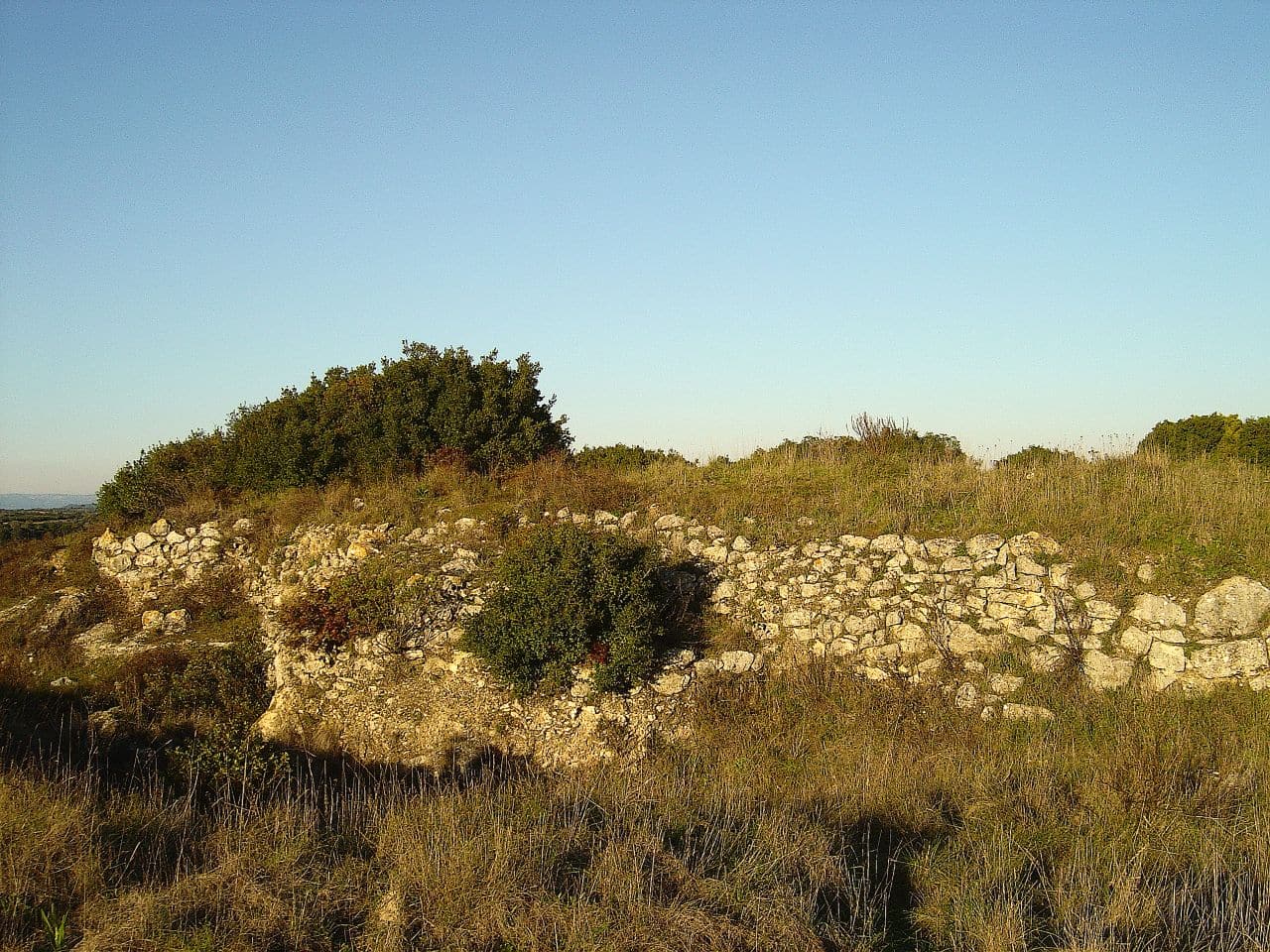
- Location
- Azambuja, Lisboa
- Built
- c. 3200–2000 a.C.
The fortified settlement of Vila Nova de São Pedro, located on a small limestone hill in the municipality of Azambuja, is one of the most emblematic sites of European prehistory. Its importance far exceeds its modest size: it was here that the so-called Vila Nova de São Pedro culture was defined in the first half of the 20th century — the material expression that best characterizes the Chalcolithic of Portuguese Estremadura, between approximately 3200 and 2000 BC.
A settlement with bastions
The central core of the settlement, about forty meters in diameter, was organized around a walled citadel reinforced by semicircular bastions, with successive outer wall lines corresponding to different phases of occupation. This defensive architecture — massive towers articulated with wall sections — is not unique to Vila Nova de São Pedro: it finds close parallels in the Castro do Zambujal, in Torres Vedras, and the settlement of Leceia, in Oeiras, which together form the classic triad of large Chalcolithic settlements on the Atlantic facade.
Inside, structures excavated into the substrate were detected, likely for storage purposes, as well as a cistern and traces of furnaces. The combined interpretation of these elements suggests a sedentary agro-metallurgical community that combined agriculture and pastoralism with textile production and, above all, copper metallurgy.
The findings and the definition of a culture
The excavations yielded an extraordinarily rich collection: thousands of flint arrowheads, Palmela-type points, decorated pottery — including Bell Beaker vessels —, schist plaques, symbolic idolatry, and numerous traces of copper smelting. The recurrence of these traits in dozens of sites in the region led researchers to recognize a distinct cultural facies, named after the eponymous site.
The significance of Vila Nova de São Pedro lies less in what can be seen today on the ground and more in what it taught: it was from this hill that the Chalcolithic of the western Peninsula was first understood.
The intensity of occupation made the settlement contemporary with the famous centers of southeastern Spain, such as Los Millares, integrating it into an Iberian network of fortified communities that shared technologies, settlement patterns, and long-distance contacts.
Research history and classification
Identified in 1936, the site was excavated by Afonso do Paço and Eugénio Jalhay over thirty-one campaigns between 1937 and 1967, in one of the longest field programs in Portuguese archaeology. After Jalhay’s death, Paço continued the work alone until his death in 1968. The vast collection is housed in the Carmo Archaeological Museum in Lisbon, under the custody of the Portuguese Archaeologists Association.
In recognition of its value, Vila Nova de São Pedro was classified as a National Monument in 1971, being the only site with this status in the municipality of Azambuja. Since 2017, the VNSP 3000 project, approved by the Directorate-General for Cultural Heritage, has resumed excavation and study of the settlement, returning to the field a site that continues to hold a central place in Portuguese archaeology and in understanding the transition to the Bronze Age.
Frequently asked questions
- What is the Vila Nova de São Pedro culture?
- It refers to the material culture of the Chalcolithic period in Portuguese Estremadura, characterized by fortified settlements with semicircular bastions, intensive copper metallurgy, and abundant flint arrowheads. It takes its name from the eponymous settlement in Azambuja.
- Who excavated the Vila Nova de São Pedro settlement?
- It was identified in 1936 and excavated by Afonso do Paço and Eugénio Jalhay over 31 campaigns between 1937 and 1967, under the auspices of the Portuguese Archaeologists Association.
- Is the site classified?
- Yes. It has been classified as a National Monument since 1971 (Decree No. 516/71), being the only National Monument in the municipality of Azambuja.
Sources
Keep exploring
Heritage nearby
More places to discover from here. Approximate straight-line distances, within 50 km.