Typologies
Statuary and commemorative monuments
Public statuary and commemorative monuments in Portugal: from the royal statues of the nineteenth century to civic sculpture and historical commemoration in…
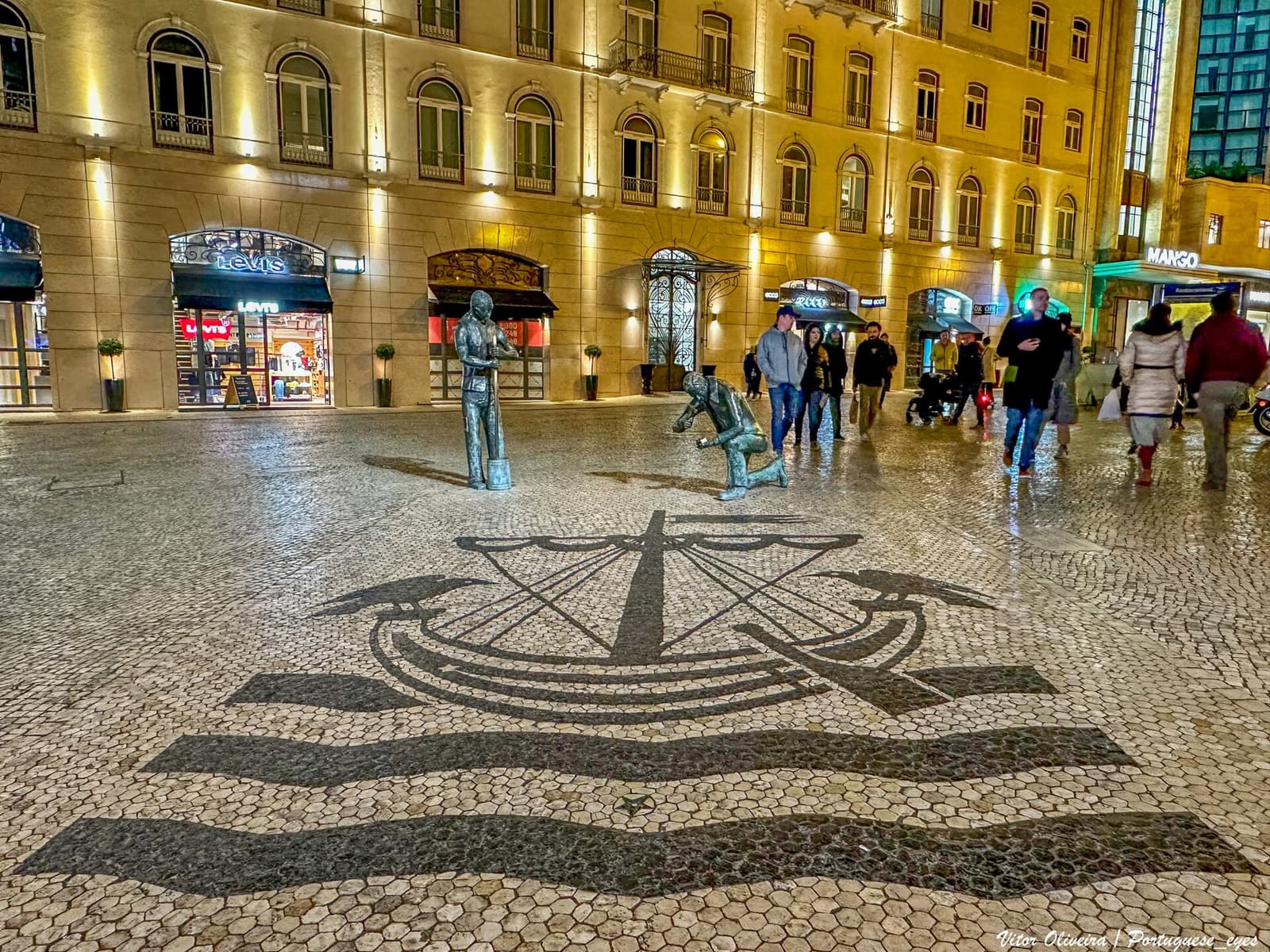
Public statuary and commemorative monuments form a singular typology of heritage: unlike the castle or the church, they do not arise from a utilitarian or liturgical function, but from a deliberate will to remember. They are objects that fix a face, a deed or a collective value within urban space, in dialogue with the square, the garden or the belvedere that houses them. To read a monument is also to read the age that wished to raise it.
From the royal statue to the civic monument
The starting point of modern Portuguese monumental statuary is the equestrian statue of King José I (1775), modelled by Joaquim Machado de Castro for the centre of the Terreiro do Paço, in the heart of the Baixa rebuilt after the earthquake. Royal, allegorical and deeply tied to the Pombaline programme, it sets the tone for the sculpture that follows: during much of the eighteenth century and the early nineteenth, to commemorate is, above all, to exalt the sovereign.
The nineteenth century shifts that axis. With liberalism and the assertion of a civic and national culture, the monument ceases to evoke only the king and begins to celebrate the nation, its literary heroes and its historical landmarks. The statue of Luís de Camões (1860–67), by Vítor Bastos, in the square of the same name, is exemplary: paid for by public subscription, with contributions from Brazil and the former colonies, it transforms the poet into a collective symbol. There followed the monument to King Pedro IV in the Rossio (1870), designed by the French architect Davioud, and the Monument to the Restorers (1886), which evokes the Restoration of Independence of 1640 through the allegories of Independence and Victory, by Simões de Almeida and Alberto Nunes.
The nineteenth century invented the habit of peopling squares with bronzes: each statue is, at heart, a thesis on who deserves to be remembered.
Naturalism and the Porto school
Alongside official commissions, nineteenth-century Portuguese sculpture reached artistic maturity with the so-called naturalist school. António Soares dos Reis (1847–1889), a tutelary figure, left public works such as the statue of Afonso Henriques in Guimarães and the monument to Brotero in Coimbra, combining academic rigour and restrained emotion. His most notable disciple, António Teixeira Lopes (1866–1942), extended that path in an intimate register that also marked the funerary and commemorative statuary of the turn of the century. This tradition intersects with the broader history of sculpture in Portugal, which runs from prehistoric stelae to contemporary art.
The monument as a political instrument
In the twentieth century, the Estado Novo regime made statuary and the commemorative monument an instrument of propaganda and of the construction of a national narrative. The paradigmatic case is the Padrão dos Descobrimentos, in Belém: raised in 1940 in perishable materials for the Portuguese World Exhibition and rebuilt in stone in 1960, on the fifth centenary of the death of the Infante Dom Henrique. Conceived by the architect Cottinelli Telmo and the sculptor Leopoldo de Almeida, it evokes a stylised caravel peopled with historical figures, in an “austere classicism” that owed much to the Monument to Gonçalves Zarco (Funchal, 1927) by Francisco Franco.
This ideological dimension explains why commemorative monuments are, today, the object of public debate — over whom they celebrate, what they omit and how they should be interpreted. As a typology of built heritage, civic statuary demands a twofold reading: that of artistic quality and that of the programme of memory that commissioned it. Many of these ensembles are part of the list of the monuments of Portugal and enjoy legal protection, which fully inscribes them within classified heritage.
Frequently asked questions
- What distinguishes a commemorative monument from other sculptures?
- A commemorative monument is erected in public space to evoke a person, an event or a collective value. Unlike museum or altar sculpture, it is tied to a place and to a civic intention of memory, often with inscriptions, dates and allegories.
- What is the oldest equestrian statue in Lisbon?
- The equestrian statue of King José I, at the centre of the Terreiro do Paço, unveiled in 1775 and modelled by Joaquim Machado de Castro, is the founding reference of modern Portuguese monumental statuary.
- Who were the leading sculptors of Portuguese public statuary?
- Machado de Castro in the eighteenth century; Vítor Bastos, Soares dos Reis and Teixeira Lopes in the nineteenth century; and Francisco Franco and Leopoldo de Almeida in the twentieth century are central names in civic and commemorative statuary in Portugal.