Typologies
Aqueducts of Portugal
The aqueducts of Portugal: from Roman arcades to the great hydraulic works of the 16th and 18th centuries that supplied water to Lisbon, Évora and Tomar.
- Style
- Engenharia hidráulica (romana, renascentista e barroca)
Bringing water to a city was for centuries one of the most challenging problems to solve. The springs were distant, nearby rivers were too brackish or polluted, and stagnant water from cisterns brought disease. The solution was one of humanity’s oldest and most ingenious public works: the aqueduct, a channel that carries water by gravity from a distant spring to the heart of the settlement. This typology encompasses Portugal’s great conduits, from Roman arcades to the monumental hydraulic works of the 16th and 18th centuries.
How an aqueduct works
The principle is as simple as it is demanding: water always flows downward. Between the spring and its destination, the canal maintains a minimal yet rigorously constant gradient — just a few centimeters per kilometer — ensuring the water advances without ever receding or stagnating. Calculating and materializing this slope across dozens of kilometers of rugged terrain was the true engineering feat, inherited from Vitruvius’ treatise and Roman expertise.
Contrary to what the image of grand arcades suggests, most of an aqueduct runs hidden, underground or flush with the ground. The arcades — the rows of arches that so impress us — only rise where the canal must cross a valley, maintaining the necessary elevation in the air. They are thus the monumental exception of a structure that is, for the most part, invisible.
An aqueduct is a level line drawn across the landscape: the arch only appears where the terrain falls away. The grandeur of the arcade actually measures the depth of the valley it had to span.
From ancient Rome to free-flowing waters
The Romans spread aqueducts across their Empire, linking hydraulic engineering to urban prestige and the comfort of public baths and fountains. In Portuguese territory, Roman archaeology reveals this legacy at sites like Conímbriga, whose prosperous town depended on an aqueduct for its water supply. Lisbon and Évora, among others, inherited collection systems and routes that would be repurposed centuries later.
The great revival of this typology came in the Early Modern period. In Évora, the Água de Prata Aqueduct was commissioned by King João III and designed by royal architect Francisco de Arruda, inaugurated in 1537; it runs about 18 km and still contributes to the water supply of the city’s UNESCO-listed historic center. In Tomar, the Pegões Aqueduct, begun in 1593 under Filippo Terzi’s direction, carried water to the Convent of Christ through some 180 arches that double in the valley’s deepest sections.
Lisbon’s masterpiece
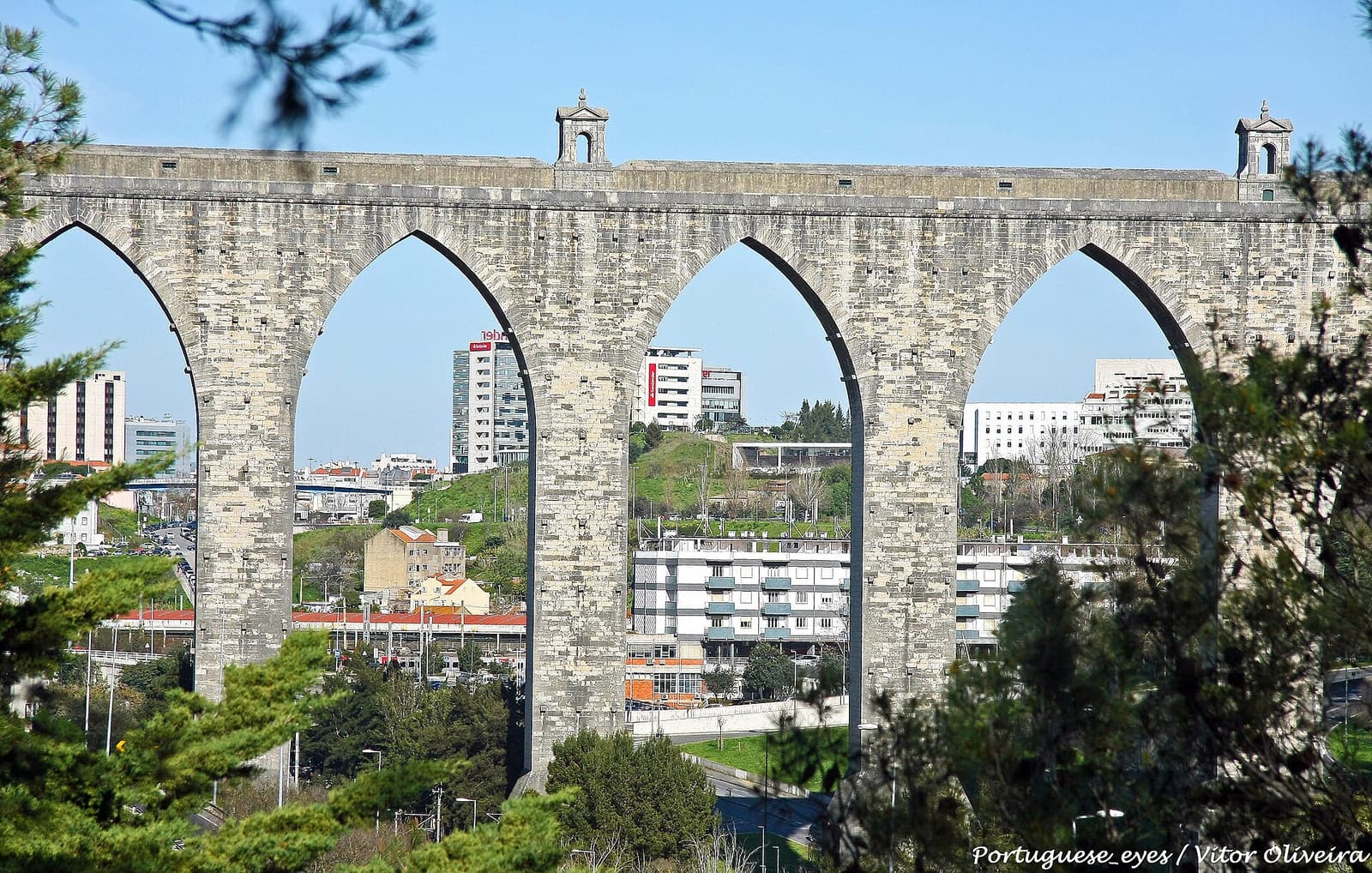
The most ambitious of all was the Águas Livres Aqueduct, commissioned by King João V starting in 1731 to solve Lisbon’s chronic shortage of drinking water. Funded by a tax on essentials — the Real de Água — the project brought together architects and engineers like Manuel da Maia and spanned several decades. Its main section channels water from Belas to the Amoreiras reservoir, but it’s the arcade over the Alcântara valley that made history: 35 arches spanning about 940 meters, crowned by the world’s tallest stone ogival arch at nearly 65 meters.
That this stone machine survived the 1755 earthquake practically intact, while so much of the city collapsed, speaks to the solidity with which these monuments were conceived. Just as fortifications defended the territory, aqueducts ensured daily survival — and in Évora and other systems, they continue to do so, long after modern piping has taken their place.
Frequently asked questions
- How does an aqueduct work?
- An aqueduct channels water by gravity from a spring to the city through a canal with a very slight and constant gradient. Most of the route runs underground or at ground level; only when crossing valleys does the canal rise on arcades, the monumental and most visible part of the structure.
- What is the largest aqueduct in Portugal?
- The most famous is the Águas Livres Aqueduct in Lisbon, whose arcade over the Alcântara valley includes the world's largest stone ogival arch, standing about 65 meters tall. In terms of arcade length, the Água de Prata Aqueduct in Évora and the Pegões Aqueduct in Tomar are also among the most remarkable.
- Are there Roman aqueducts in Portugal?
- Yes. Conímbriga, near Coimbra, preserves remains of its Roman aqueduct, while Lisbon, Évora and other cities had earlier water collection systems. Many modern aqueducts were built over routes or springs already utilized in antiquity.