Themes
Military architecture and fortifications
From the medieval castle to the bastioned fortress: how the defence of the territory shaped the landscape and produced an engineering knowledge exported…
The condition of being a frontier defined Portugal from its founding. It is no surprise that military architecture is one of its densest heritage strands — and one of those that best reveals the evolution of technique, because in war error costs lives and models change quickly.
The medieval castle
The first layer is that of the rock-built castle: a commanding position, walls with a wall-walk, the keep as the last redoubt. Guimarães, Bragança, Marvão and Sortelha belong to this generation, in which defence was entrusted to the height and thickness of the stone. The line of castles along the border with Castile still traces, today, the old frontier on the map.
The artillery revolution
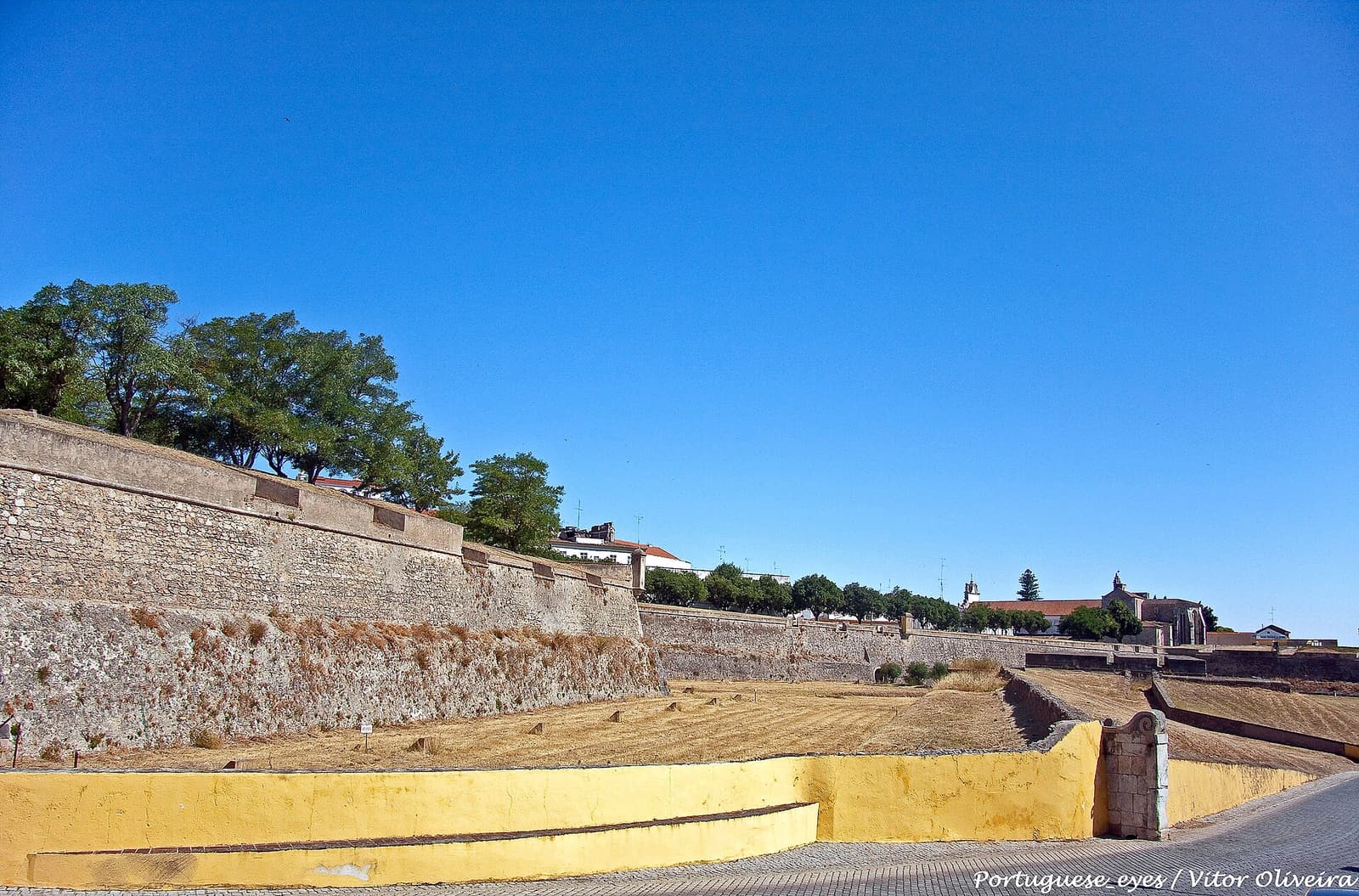
Gunpowder changes everything. From the sixteenth century onwards, high walls become easy targets for the cannon. The bastioned fortification is then born: low, thick walls set at angles, organised into star-shaped bastions that cover one another by fire, with no blind spots. It is geometry applied to survival.
Elvas, classified by UNESCO, is the largest assemblage of land-based bastioned fortifications preserved in the world — an entire city turned into a defensive machine.
A knowledge of engineers
The construction of these works required a specialised corps: the military engineers, trained in lessons of fortification and architecture, who mastered mathematics, drawing and works management. It was they, and not the civil architects, who designed a good part of the Portuguese cities of the Early Modern period — and who carried that knowledge to the fortified strongholds of Brazil, Africa and Asia.
The War of the Restoration
The great building impulse comes with the War of the Restoration (1640–1668), when independence from Spain forced the border to be fortified at a forced march. Elvas, Almeida, Valença, Estremoz: the frontier filled with stars of stone, in an engineering effort that shaped forever the landscape of the Portuguese interior.
To read a fortification is to read, in the stone, the state of the military technique of its time — and, with it, the degree of threat that justified raising it.