Themes
The Manueline
The style of the reign of King Manuel I: an exuberant and hybrid late Gothic, financed by the Expansion, which became the first Portuguese architectural signature.
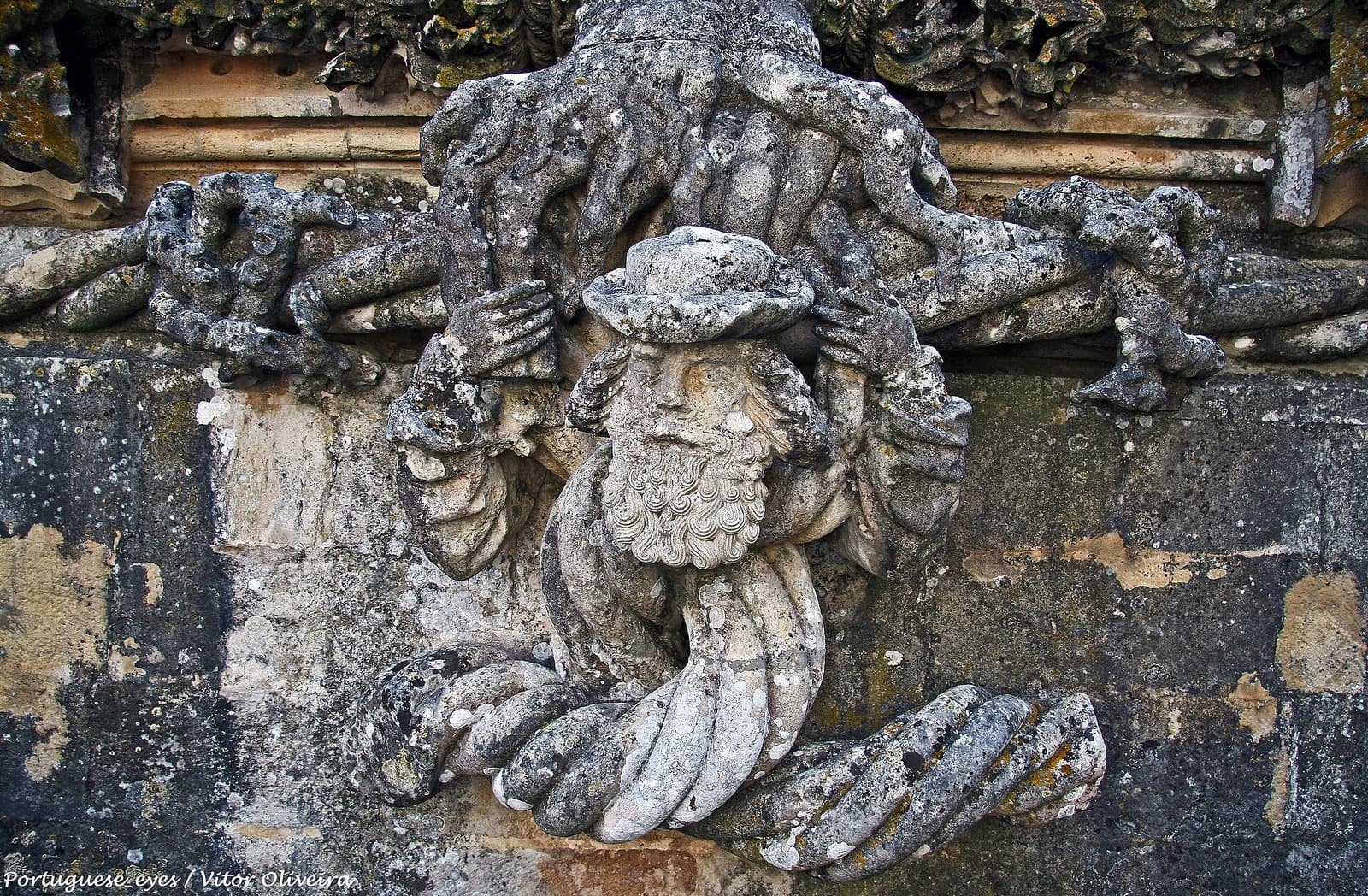
No other age gave Portugal so recognisable a language. The Manueline — a nineteenth-century designation, formed from the name of King Manuel I (1495–1521) — is not, strictly, an autonomous style, but a moment: the instant when the late Gothic crosses paths with the wealth and the imagination of the first globalisation.
A late Gothic, but not only
Structurally, the Manueline is Gothic: pointed arches, ribbed vaults, buttresses. The novelty lies in the ornamentation. Over the Gothic elements grows a naturalistic and maritime repertoire — sailors’ cables and knots, anchors, armillary spheres, corals, thistles and foliage — interwoven with royal heraldry: the cross of the Order of Christ and the armillary sphere, the king’s personal emblem.
The famous Chapter Window of the Convent of Christ, in Tomar, is the manifesto of the style: a tangle of stone that turns the wall into an instant of controlled exuberance.
The wealth that finances it
The Manueline is inseparable from its economy. The great works — Jerónimos, Tomar, the Batalha Monastery in its final phase, the Belém Tower — are paid for with the gold and the spices of the oceanic routes. The nautical ornamentation is not innocent decoration: it is propaganda, the inscription of the imperial project in the stone of the churches.
A synthesis of worlds
What makes the Manueline fascinating is its hybridity. In it coexist the Flemish Gothic, the Castilian Plateresque, Mudéjar echoes and, at times, motifs come from India and North Africa which the artists reinterpret. It is the architecture of a country that, in a couple of decades, came into contact with almost the whole of the known world — and that recorded that vertigo in the very matter of its monuments.
Because it lasted little more than a generation, the Manueline is also a style datable almost to the decade: to find it is to place oneself, with precision, in the brief and dazzled peak of the Portuguese Renaissance.