Themes
Roman and pre-Roman Portugal
From the Iron Age hillforts to the cities of Lusitania: the first urban layer of the Portuguese territory and what survives of it.
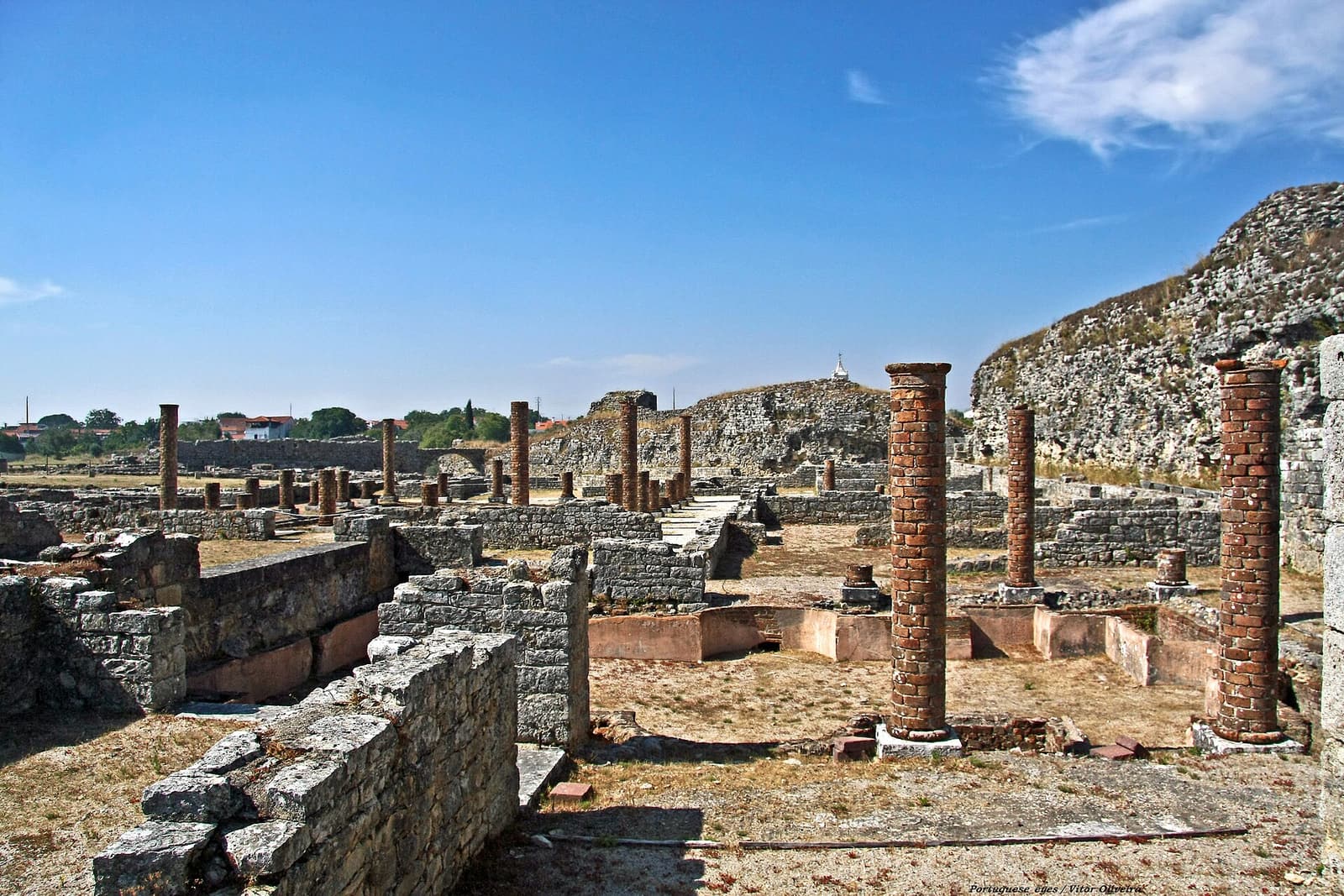
Before the cathedrals and the castles, there were cities. The first urbanisation of the territory that would become Portugal is Roman — and it rests, in turn, on an indigenous substrate of fortified settlements that preceded it by many centuries.
The world of the hillforts
In the Northwest, the Iron Age left behind the castro culture: settlements of circular stone houses on the tops of defensible hills, ringed by walls. The Citânia de Briteiros, near Guimarães, is the most eloquent example — an indigenous city that survived already within the Roman world, showing how the two cultures coexisted before one absorbed the other.
Lusitania
The Roman conquest, consolidated in the first century BC, integrated the territory into the province of Lusitania and the northern Gallaecian lands. With Rome came regular urbanism: the forum, the baths, the theatre, the road network, the aqueduct. Cities such as Bracara Augusta (Braga), Ebora (Évora) and Olisipo (Lisbon) were born or refounded along the Roman model, and some have never since ceased to be inhabited.
Conímbriga, the frozen city
The site that best allows the Roman city to be read in Portugal is Conímbriga, near Condeixa. Abandoned and spared from rebuilding, it preserves mosaic floors, the conduits of its baths, and the late wall raised in haste against the invasions — built, in part, with stones torn from the city’s own buildings.
The wall of Conímbriga is a dramatic document: in it one can read the exact moment when security came to matter more than ornament, and the classical city began to draw in upon itself.
The invisible legacy
Much of the Roman inheritance lies not in the ruins, but beneath our feet: the layout of many streets, the boundaries of rural estates, the names of places. Roman archaeology teaches us to look at the Portuguese territory as a palimpsest, in which the oldest layer continues to condition the form of those superimposed upon it.