Archaeology
Menhir of Almendres
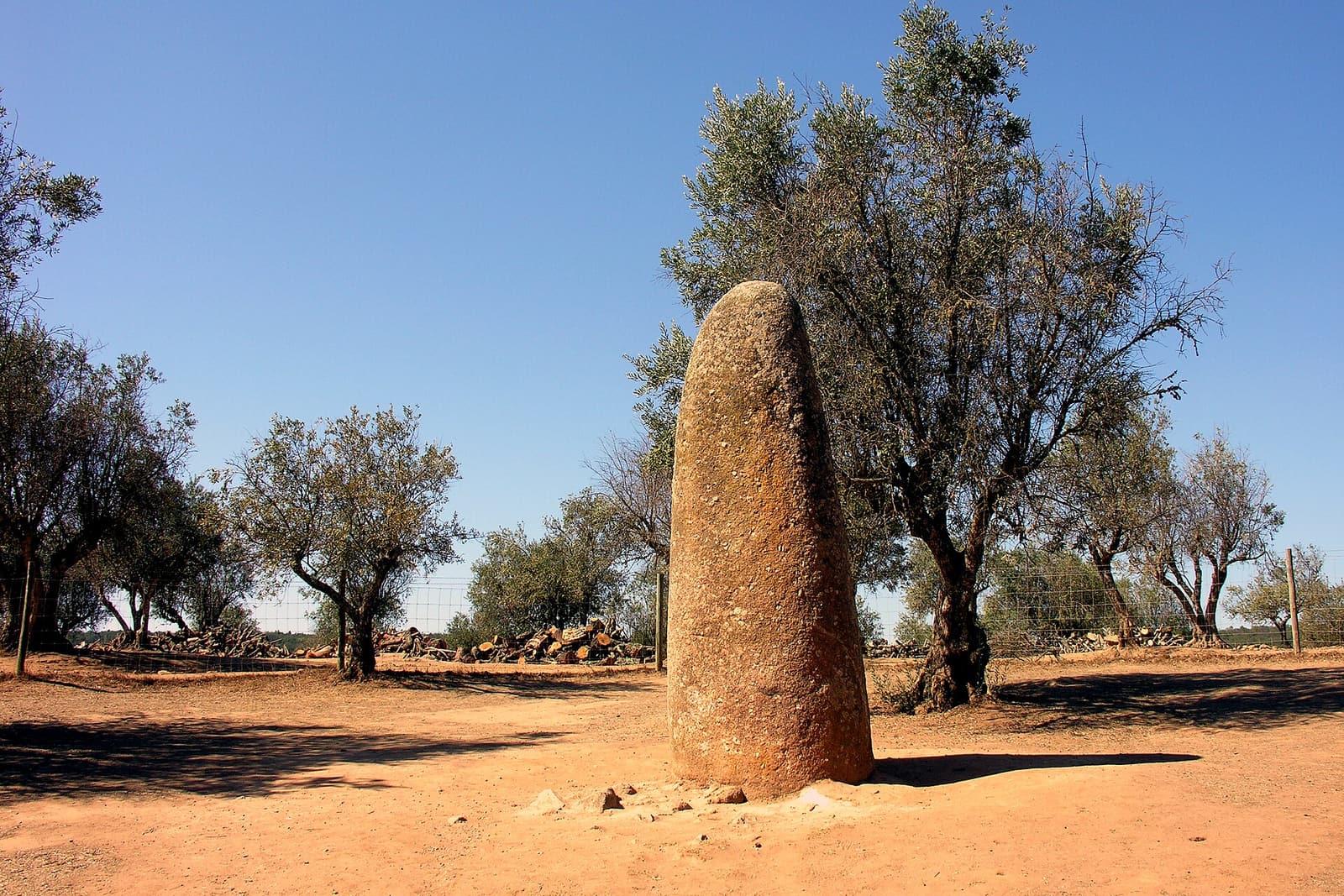
The Menhir of Almendres, near Évora: an engraved granite monolith aligned with the Almendres Cromlech at the summer solstice sunrise.
- Location
- Nossa Senhora de Guadalupe, Évora
- Built
- VI–V milénio a.C.
The Menhir of Almendres is a large prehistoric monolith driven into the slope of a hill in the municipality of Évora, a few kilometres south of the city. Solitary and imposing, it rises in isolation amid an olive grove, set apart from the ensemble to which it belongs: the celebrated Almendres Cromlech, the largest structured megalithic enclosure on the Iberian Peninsula. The stone has been classified as a Property of Public Interest since 1974.
An engraved granite landmark
It is a menhir of porphyritic granite about 3.5 metres tall above the ground, with an elliptical cross section measuring roughly 1.20 by 0.80 metres. Its elongated, slightly tapering form is characteristic of the menhirs of the Évora region. The upper third preserves engravings in subtle relief — among which a crook (báculo) motif and wavy lines can be recognised — now much worn by erosion. The meaning of these signs remains uncertain, but it belongs to the symbolic repertoire that runs across the monoliths of the neighbouring cromlech, where motifs such as the crook are associated with schematic figures.
Reading the monument calls for caution. The menhir was re-erected in recent times by the owner of the land, so that its present orientation does not necessarily match the original one. Even so, its position in the terrain, close to the spot where it is thought to have fallen, preserves the essence of its value: its relationship with the Almendres enclosure.
Alignment with the solstice
Observed from the cromlech, the menhir marks on the horizon the exact point where the sun rises on the longest day of the year.
It is this geometric relationship that turns an apparently isolated stone into an element of a system. The line joining the main enclosure to the menhir, located about 1.3 km to the northeast, points toward the sunrise at the summer solstice. Such a correspondence reinforces the hypothesis, defended by several researchers, that the Almendres combined ceremonial functions with the observation of the celestial cycles — a kind of monumental calendar inscribed in the landscape. In this framework, the menhir would have acted as an astronomical sighting marker or beacon, linking human time to the apparent movement of the sun.
Antiquity and context
The Almendres ensemble was raised over a prolonged period, between the end of the 6th and the beginning of the 3rd millennium BC, from the Middle Neolithic to the later phases of Alentejan megalithism. The menhir shares this deep chronology, being one of the oldest testimonies to the monumentalisation of the landscape in Portuguese territory. It belongs to the same tradition that produced colossi such as the Menhir of Meada, the largest on the Iberian Peninsula, and is part of the vast phenomenon of megalithism that marked central Alentejo.
As an example of the so-called statue-menhirs and stelae, the monument illustrates the passage from a purely abstract sculpture to supports on which signs charged with symbolic meaning are inscribed. A visit to the menhir completes the journey through the megalithic world of Évora, making it possible to understand that the cromlech was not a monument closed in on itself, but the centre of a network of significant points distributed across the surrounding landscape.
Frequently asked questions
- Where is the Menhir of Almendres located?
- It stands in the parish of Nossa Senhora da Tourega e Nossa Senhora de Guadalupe, in the municipality of Évora, isolated in an olive grove about 1.3 km northeast of the Almendres Cromlech.
- What is the relationship between the menhir and the Almendres Cromlech?
- Seen from the cromlech, the menhir marks the point on the horizon where the sun rises at the summer solstice, suggesting an astronomical and ceremonial intent shared by both monuments.
- What are the menhir's dimensions?
- It is a granite monolith about 3.5 metres tall above the ground, with an elliptical cross section of roughly 1.20 by 0.80 metres.
Sources
Keep exploring
Heritage nearby
More places to discover from here. Approximate straight-line distances, within 50 km.