Archaeology
Menhir of Meada
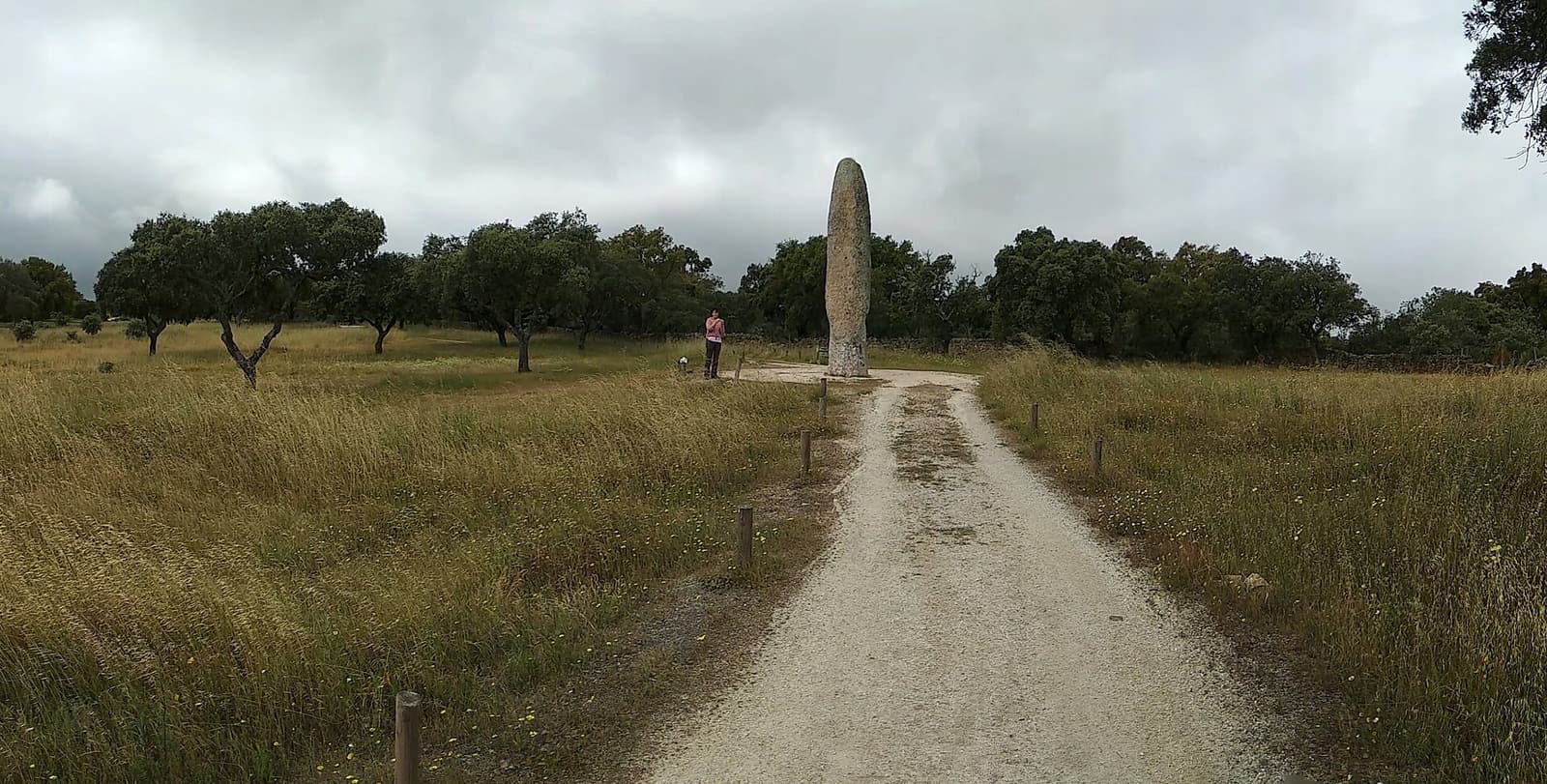
The Menhir of Meada, in Castelo de Vide, is the largest menhir on the Iberian Peninsula, standing 7.5 metres tall, raised around 5000 BC in the Alentejo.
- Location
- Castelo de Vide, Portalegre
- Built
- c. 5000 a.C.
Raised in a clearing in the hills, north of Castelo de Vide, the Menhir of Meada is the largest monument of its kind on the entire Iberian Peninsula. Standing roughly 7.5 metres tall, with a maximum diameter of 1.25 metres and an estimated weight of eighteen tonnes, it is one of the most imposing manifestations of European megalithism and, at the same time, one of the oldest: the available datings place its erection in the first centuries of the sixth millennium BC, around 5000 BC.
A colossus of granite
The menhir was carved from a block of coarse-grained porphyritic granite, a cylindrical form that tapers towards the top. There, a protuberance in relief unmistakably evokes a glans, underlined by the groove that delimits it. This phallic morphology, recurrent in the great Alentejan menhirs, is generally read as a celebration of fecundity and fertility, associating the monument with the agrarian cults of the Neolithic communities that then occupied these lands of transition between the Tagus and the Serra de São Mamede.
The scale of the Menhir of Meada reminds us that these stones were not isolated markers but collective works: raising and securing an eighteen-tonne block required organised labour, technical knowledge and a shared symbolic intent.
The dating rests on a charcoal sample collected at the base of the emplacement pit which, when subjected to radiocarbon analysis, yielded an interval of around 5010 to 4810 BC (calibrated). These figures place the monument among the most ancient of the peninsular megalithic horizon, contemporary with the first great undertakings to monumentalise the landscape.
Discovery, fall and restoration
The menhir was identified in 1965, then fallen and fractured into two parts — a break that is thought to date back to Roman times, perhaps through the deliberate dismantling of a pagan symbol. It lay prone for decades until, in the 1990s, an archaeological intervention made it possible to reunite the two fragments and raise it once more in its original position, restoring the monumental verticality that today impresses all who visit it.
The monument lies within a region particularly rich in prehistoric remains, where menhirs, dolmens and other menhir-statues and stelae abound, documenting the human occupation of the Alentejan interior over millennia. This concentration makes the territory of Castelo de Vide one of the reference centres of Portuguese megalithic art.
Significance and classification
By virtue of its exceptional size, antiquity and state of conservation after restoration, the Menhir of Meada constitutes an indispensable landmark of the national prehistoric heritage. It is classified as a National Monument and lies within the boundaries of the Serra de São Mamede Natural Park, which links its cultural value to the protection of a landscape setting of great quality.
Comparison with other great isolated monuments, such as the celebrated Menhir of Almendres on the outskirts of Évora, helps to situate it within a broader tradition of megaliths with a probably ritual and astronomical function. Taken together, these monoliths reveal communities capable of mobilising considerable resources to inscribe, upon the landscape itself, their conceptions of time, fertility and the sacred.
Frequently asked questions
- Where is the Menhir of Meada located?
- It lies about twelve kilometres north of the town of Castelo de Vide, in the district of Portalegre, in the heart of the Serra de São Mamede Natural Park.
- Why is the Menhir of Meada famous?
- Standing roughly 7.5 metres tall, it is the largest menhir on the Iberian Peninsula and one of the oldest megalithic monuments in Europe, dated to around 5000 BC.
- Is the Menhir of Meada classified?
- Yes, it is classified as a National Monument, the highest degree of protection for Portuguese cultural heritage.
Sources
Keep exploring
Heritage nearby
More places to discover from here. Approximate straight-line distances, within 50 km.