World Heritage
Historic Centre of Évora
An Alentejo museum-city where the Roman temple, the medieval cathedral and the Renaissance palaces coexist within the same walls. World Heritage since 1986.
- UNESCO
- World Heritage
Some cities are worth a single monument; Évora is worth its continuity. Within its walls, two thousand years of history are superimposed without rupture — and it is this intact stratification, more than any single building, that justified the inscription of its historic centre on the World Heritage List in 1986.
The Roman city
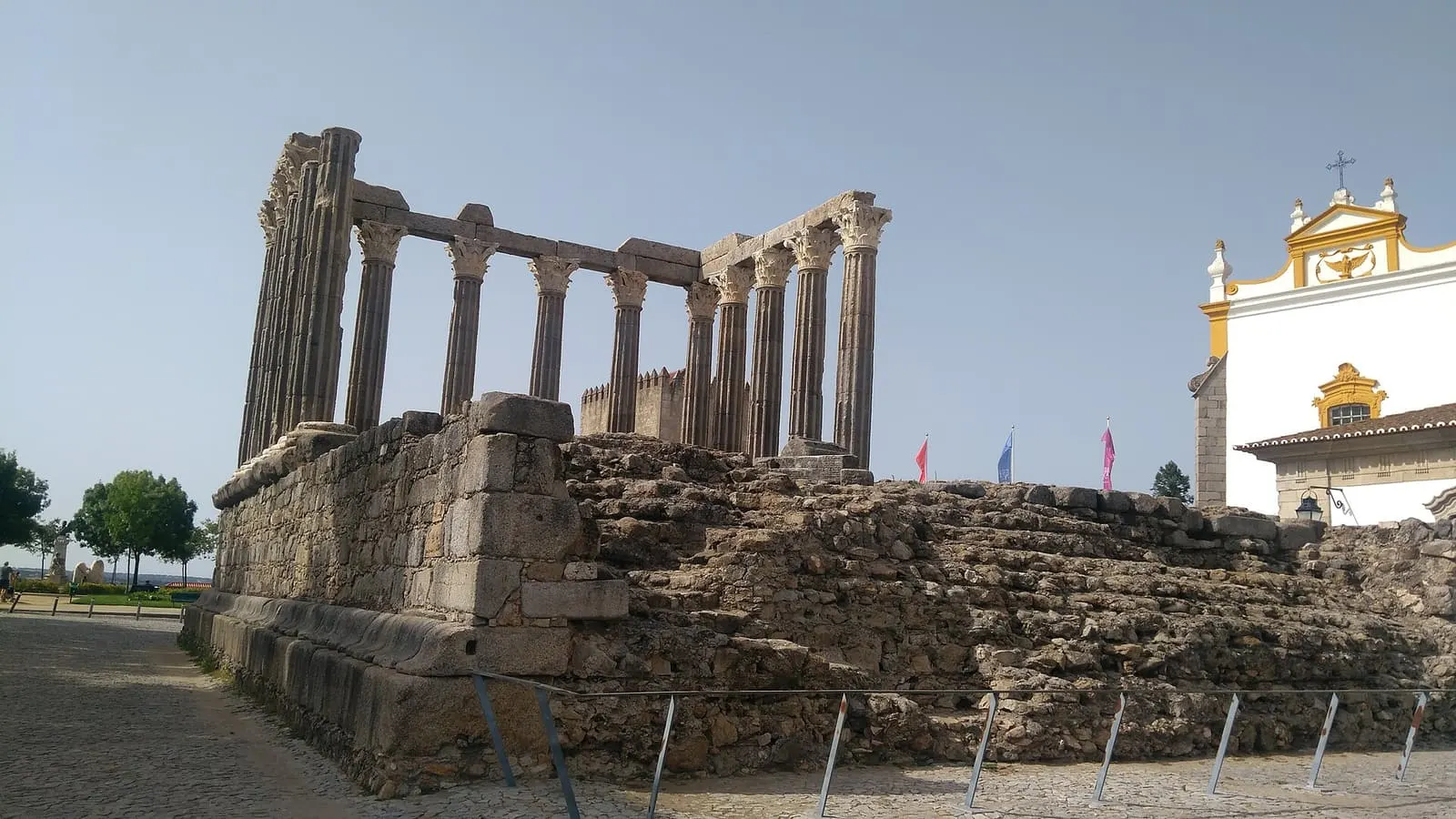
Roman Ebora left the city its most famous monument: the first-century temple, long said to be “of Diana”, raised on a podium at the high point of the town. Its survival is owed to a fortunate accident — it was walled up and used as a slaughterhouse and small fort for centuries, which preserved its Corinthian columns until the nineteenth-century clearing.
The capital of a kingdom
In the Middle Ages and the Renaissance, Évora was a frequent residence of the court and one of the intellectual centres of the kingdom. The Cathedral, Gothic and granite, dominates the city; around it multiply the palaces, the convents and the Jesuit University. The city is enriched by a learned architecture that makes it, in the sixteenth century, a small capital.
Évora is a rare case of a city that stopped growing at just the right moment. The loss of importance in the following centuries spared it from demolition — and bequeathed to us a historic centre of an almost unique integrity.
The Chapel of Bones and the Baroque taste
Among its many monuments, few make an impression like the Chapel of Bones, lined with the remains of thousands of people and presided over by the inscription “We bones that are here, for yours we wait”. It is the Baroque, memento-mori face of a city that, at every corner, compels reflection on the passage of time.
A lesson in the whole
The value of Évora lies not in the sum of its parts, but in its urban coherence: the mesh of streets, the whitewashed colour, the rhythms of the façades, the constant relationship between the built fabric and the wall. It is the best Portuguese demonstration that heritage can be an entire city — and not merely what stands out within it.