Archaeology
Megalithism in Portugal
Megalithism in Portugal: dolmens, menhirs and stone circles of the Neolithic and Chalcolithic, from the Alto Alentejo to the Almendres, the oldest monumental…
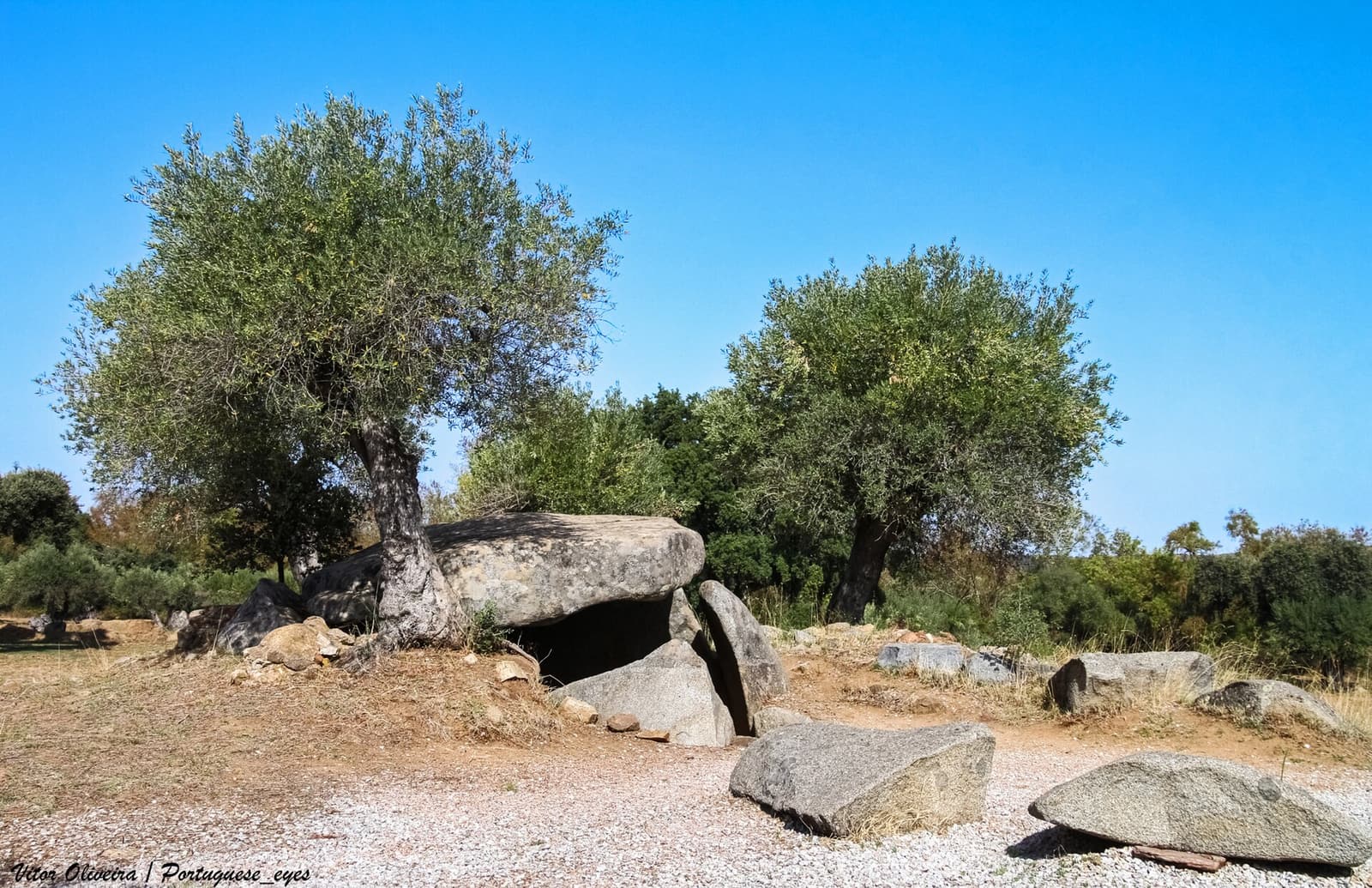
- Built
- c. 5500–2000 BC
- Style
- Megalithic architecture
Megalithism refers to the set of practices that, in late prehistory, led communities of farmers and herders to raise monuments using blocks of stone of great size — from the Greek megas (large) and lithos (stone). It is neither a single “culture” nor a people, but a horizon of constructional solutions that spread along the Atlantic façade of Europe, from southern Scandinavia to the Mediterranean. The Portuguese territory, and very particularly the Alentejo, preserves some of the oldest and most numerous examples of this phenomenon, with dates that reach back to the middle of the sixth millennium BC — earlier, therefore, than Stonehenge and the pyramids of Egypt.
Chronologically, Portuguese megalithism spans above all the Neolithic and the Chalcolithic, roughly between about 5500 and 2000 BC, with reuses that extend into the Bronze Age. It was during that long interval, marked by settlement of the land, the domestication of plants and animals and growing social complexity, that the landscape became populated with collective tombs, standing stones and ceremonial enclosures.
Dolmens, menhirs and stone circles
The megalithic typology is organised around three large families. The dolmen — for which the traditional Portuguese term is anta — is a collective tomb formed of vertical orthostats that support a capstone, configuring a chamber often reached by a passage. Originally, the dolmen was enveloped by a tumulus of earth and stone, the mamoa, today almost always vanished. In these spaces the dead were laid in a contracted position, accompanied by pottery, polished axes, flint blades and ornamental beads.
The menhir is an isolated stone, set upright in the ground, without funerary function; some appear decorated with engravings of crosiers, suns or schematic representations. When several menhirs are grouped in circles, ellipses or alignments, they form a stone circle (cromlech), a monument of ritual character markedly connected to the observation of solar cycles and to the symbolic organisation of space.
Megalithism is not merely an architecture of death: the stone circles and menhirs reveal communities that ordered the horizon, marked the solstices and inscribed in the granite a cosmology that is now only partially legible.
The great Alentejo nucleus
It is in the Alto and Centro Alentejo that Portuguese megalithism attains its fullest expression. On the outskirts of Évora stands the Cromeleque dos Almendres, the largest assemblage of menhirs on the Iberian Peninsula, with about 95 monoliths arranged in two great elliptical structures, built in successive phases from the end of the sixth millennium BC. A short distance away lies the Anta Grande do Zambujeiro, one of the largest dolmenic chambers in Europe, with orthostats exceeding six metres in height.
The region of Reguengos de Monsaraz constitutes another notable focus, where the Monsaraz megalithic complex brings together dolmens, menhirs and stone circles in a landscape that keeps alive the relationship between the monuments and the land. The density of these remains has made the Alentejo an international reference for the study of Atlantic megalithism.
Study and preservation
The scientific recognition of Portuguese megalithism begins in the late nineteenth century, with the pioneering work of researchers such as Estácio da Veiga and the Mendes Correia brothers, but it was above all from the 1960s and 1980s onwards that systematic excavations and new datings redefined the antiquity and complexity of the phenomenon. Many of these monuments are today classified and integrated into visitor circuits, constituting one of the most singular chapters of Portuguese archaeology and a major testimony of the first societies to transform the Iberian landscape in a monumental way.
Frequently asked questions
- What is megalithism?
- It is the cultural and architectural phenomenon, characteristic of late prehistory, that consists of building monuments with large blocks of stone — dolmens, menhirs and stone circles. In Portugal it unfolds mainly between the Neolithic and the Chalcolithic, from the middle of the sixth millennium BC onwards.
- What is the difference between a dolmen, a menhir and a stone circle?
- The dolmen (Portuguese *anta*) is a funerary monument, with a chamber and sometimes a passage, originally covered by a tumulus of earth or stone (mamoa). The menhir is a stone set upright in the ground, isolated and non-funerary. The stone circle (cromlech) is a group of menhirs arranged in a circle, ellipse or alignment, linked to ritual practices and to observations of the sky.
- Where are megalithic monuments concentrated in Portugal?
- The greatest density is found in the Alentejo, especially in the municipalities of Évora, Reguengos de Monsaraz, Mora and Pavia. There are also important clusters in the Beiras, in the Algarve and throughout the Atlantic west of the Iberian Peninsula.