Themes
The Saint Vincent Panels
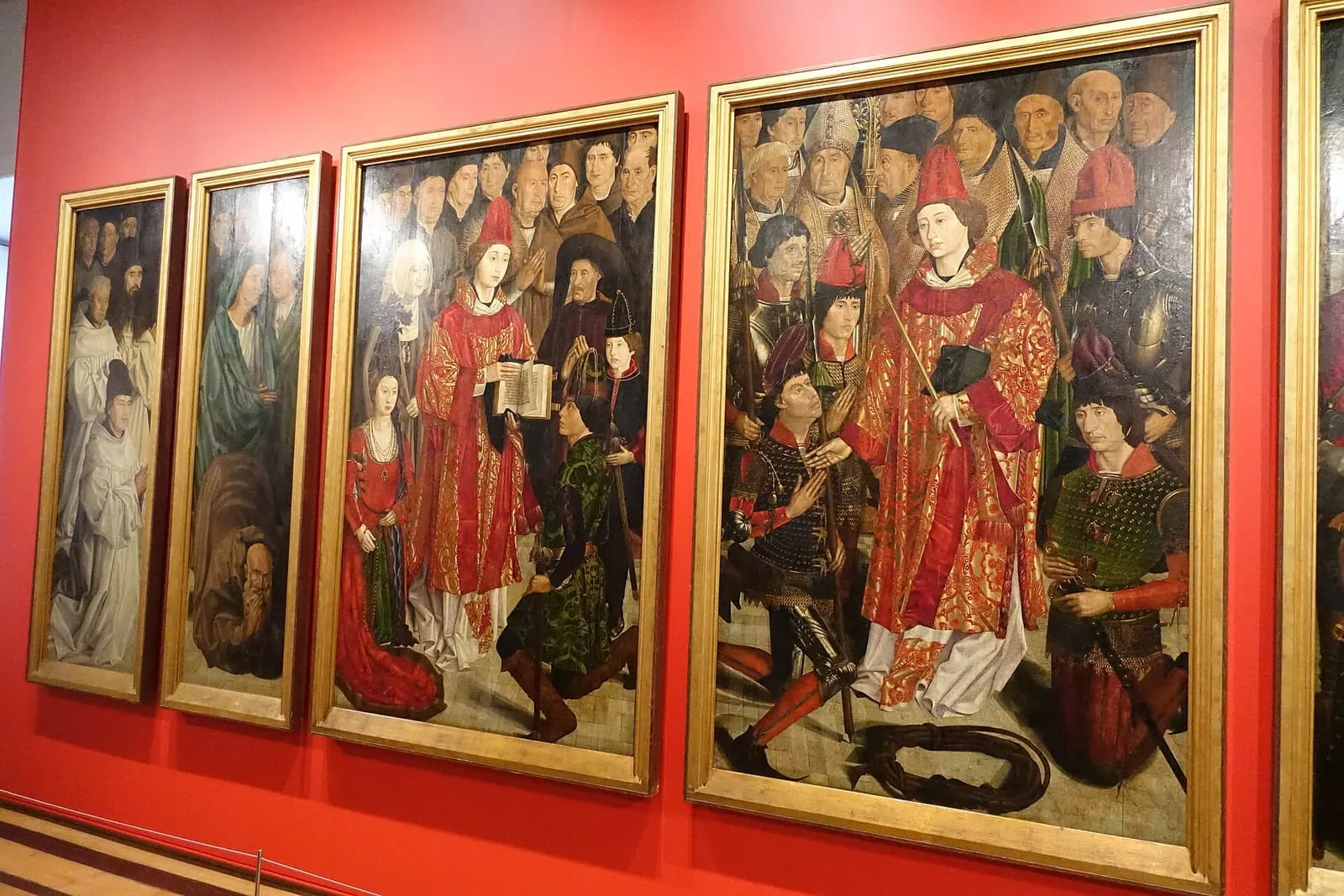
The Saint Vincent Panels, a six-panel polyptych attributed to Nuno Gonçalves, a masterpiece of 15th-century Portuguese painting at the National Museum of…
- Location
- Lisboa, Lisboa
- Built
- c. 1470
- Style
- Gótico tardio
The Saint Vincent Panels constitute one of the most fascinating enigmas and an absolute masterpiece of Portuguese painting. It is a six-panel polyptych, generally attributed to Nuno Gonçalves, court painter to King Afonso V, and traditionally dated to around 1470. The work is now housed at the National Museum of Ancient Art in Lisbon, where it occupies a dedicated room and is recognized as a major piece of the so-called Portuguese Primitives.
Structure and Iconography
The ensemble consists of two large central panels and four smaller side panels. The names by which the panels are still known today were proposed by José de Figueiredo in the early 20th century: Panel of the Friars, Panel of the Fishermen, Panel of the Prince, Panel of the Archbishop, Panel of the Knights, and Panel of the Relic.
In total, around 58 figures are distributed across the painted surface, grouped in a solemn assembly around a central saint—depicted twice, dressed in a deacon’s habit—usually identified as Saint Vincent, patron saint of Lisbon. The composition brings together members of the court, clergy, nobility, and common people, forming a collective portrait of 15th-century Portuguese society. The precision with which individualized faces, garments, weapons, and liturgical objects are depicted gives the ensemble exceptional documentary value.
Few European works of the 15th century feature such a gallery of individual portraits: each face seems to belong to a real person, supporting the interpretation of the panels as a vast collective portrait of a nation.
Discovery and Attribution
Although their existence was known from ancient sources—Francisco de Holanda mentioned in 1548 a work by Nuno Gonçalves on the altarpiece of the Chapel of Saint Vincent in Lisbon Cathedral—the panels were only rediscovered in 1882, in the Patriarchal Palace near the Monastery of Saint Vincent de Fora, the site that gave them their name. The recognition of their value was due to the studies by Joaquim de Vasconcelos and the conservation intervention led by Luciano Freire at the Academy of Fine Arts, before the work was transferred to the museum.
The attribution to Nuno Gonçalves relies mainly on Holanda’s testimony and the quality consistent with that of a royal painter, though no documented signature exists. The dating itself remains debated: the classical interpretation points to the 1470s, but more recent analyses of the wood support have opened the possibility of an earlier execution. The identification of the portrayed figures—including the possible presence of Prince Henry the Navigator and members of the royal household—continues to fuel heated historiographical controversy.
Meaning and Artistic Context
The panels belong to the moment when Portuguese painting absorbed the lessons of Flemish realism, then spreading across Europe, without losing its own gravity and monumentality. The meticulous definition of textures, garments, and accessories brings the work closer to the Northern tradition, but the hieratic arrangement of the figures and the absence of narrative depth give it a singular character.
Due to the ambition of the program and the mastery of execution, the Saint Vincent Panels have become an icon of Portuguese cultural identity, associated with the memory of the Age of Discovery and often invoked as a portrait of an era. Alongside other fundamental pieces of Portuguese decorative arts, they form the essential core of the national artistic heritage, closely tied to the imagery of Lisbon Cathedral, where the original altarpiece to which they may have belonged was likely housed.
Frequently asked questions
- Where are the Saint Vincent Panels located?
- The six panels are displayed at the National Museum of Ancient Art in Lisbon, where they were transferred in 1910, being one of the most celebrated pieces in its collection.
- Who painted the Saint Vincent Panels?
- The work is attributed to Nuno Gonçalves, court painter to King Afonso V, active between approximately 1450 and 1492. The attribution is not unequivocally documented but is now widely accepted.
- How many figures are represented in the panels?
- The ensemble features around 58 figures, arranged around a central saint, portraying different strata of 15th-century Portuguese society.