Monuments
Lisbon Cathedral (Santa Maria Maior)
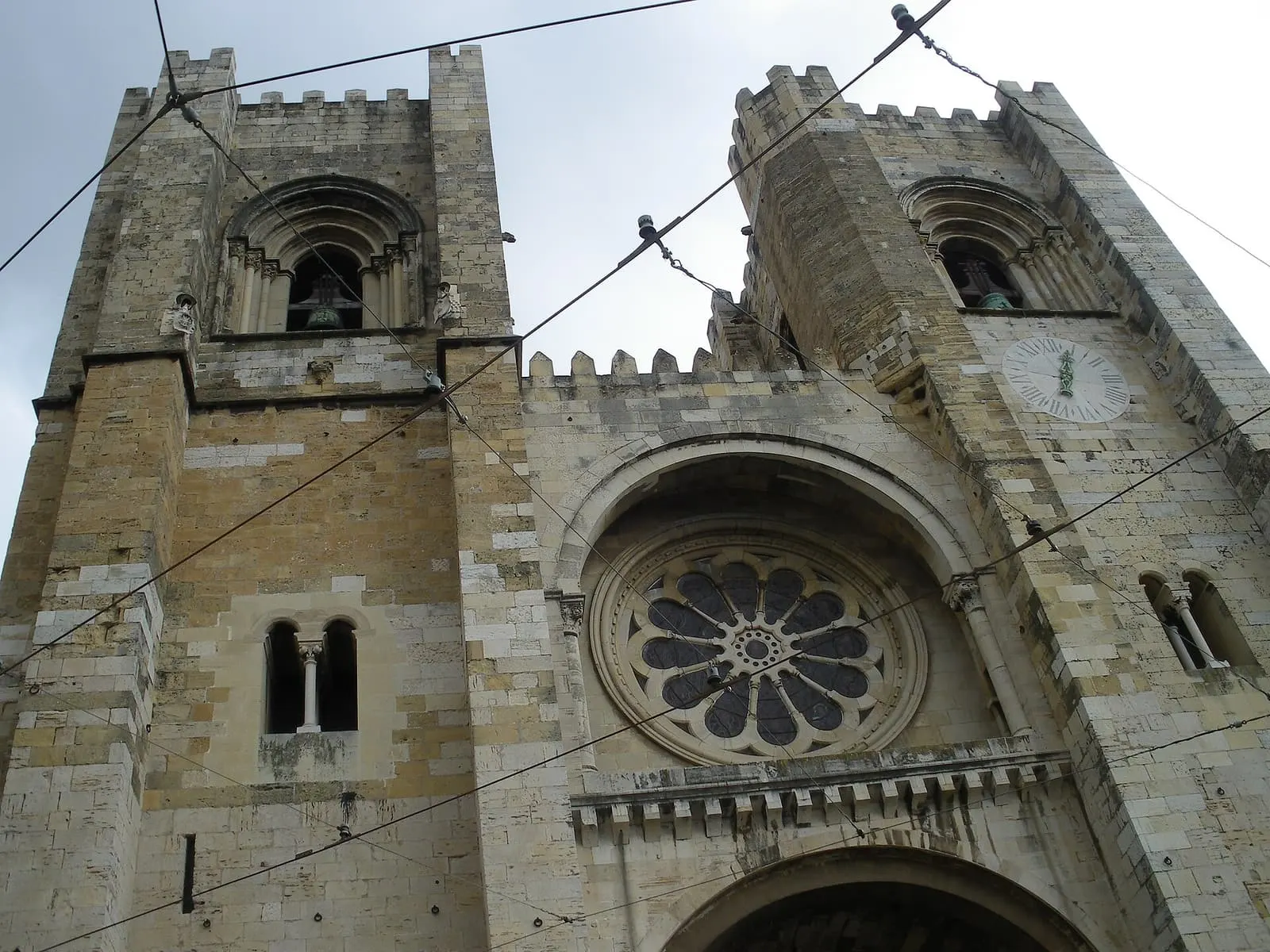
Lisbon Cathedral (Santa Maria Maior), a Romanesque cathedral founded in 1147 on the castle hill, featuring a Gothic cloister, chancel, and treasury.
- Location
- Lisboa, Lisboa
- Built
- 1147–séc. XIII
- Style
- Românico, com acrescentos góticos e barrocos
Lisbon Cathedral, formally the Church of Santa Maria Maior, is the city’s oldest cathedral and one of Portugal’s most emblematic Romanesque works. It stands on the slope descending from São Jorge Castle to the Tagus River, in the heart of medieval Lisbon, and has served as the seat of the Lisbon patriarchate for over eight centuries. Its two-towered facade with a rose window encapsulates the memory of the city’s Christian foundation after the Reconquista.
Foundation and Construction
The cathedral originated from the conquest of Lisbon from the Almohads by Afonso Henriques in 1147, with the support of crusaders bound for the Holy Land. On the site of the former main mosque, a new church dedicated to Saint Mary was consecrated, and the first bishop of Christian Lisbon was the Englishman Gilbert of Hastings. Construction of the Romanesque building continued through the second half of the 12th century and the early decades of the 13th, giving the cathedral the appearance of a fortress-church, with thick walls, robust towers, and few openings—a design language shared with other cathedrals of the period, such as Porto Cathedral and Coimbra’s Old Cathedral.
More than a temple, the Romanesque cathedral was conceived as a symbol of sovereignty: its compact silhouette asserted, over the reconquered city, the presence of a new power.
From Gothic to Baroque
The cathedral’s construction history reflects successive campaigns that superimposed different styles. During the reign of Dinis I, the Gothic cloister was built, with an unusual plan and pointed arches; under Afonso IV (1325–1357), the apse was rebuilt with an ambulatory, intended as a royal pantheon, in a Gothic style of remarkable elegance. The 1755 earthquake ruined the chancel and part of the vaults, which were later rebuilt in Baroque and Neoclassical styles. This stratification aligns the cathedral with the trajectory of other great medieval cathedrals, such as Évora Cathedral, where each era left its mark.
Treasury, Relics, and Classification
The cathedral still preserves its treasury, housed in the sacristy and adjoining rooms, containing goldsmith work, 16th-century processional crosses, liturgical vestments, and illuminated manuscripts. The cathedral is associated with the cult of Saint Vincent, Lisbon’s patron saint, whose relics, according to tradition, were brought here from the Algarve. Since the late 20th century, important archaeological excavations in the cloister have uncovered Roman, Visigothic, and Islamic remains, demonstrating the site’s long occupation.
Classified as a National Monument since 1907, Lisbon Cathedral remains one of the city’s landmarks and a material witness to its multiple historical layers. To contextualize its importance within the regional heritage, see also the cultural heritage ensemble of Lisbon and the Tagus Valley.
Frequently asked questions
- When was Lisbon Cathedral founded?
- Construction of the cathedral began shortly after the conquest of Lisbon by Afonso Henriques in 1147, on the site of the former main mosque. The Romanesque structure was completed in the early decades of the 13th century.
- What architectural styles can be found in the Cathedral?
- The Romanesque style predominates in the facade, nave, and transept, but the ambulatory and cloister are Gothic, resulting from 13th and 14th-century renovations, while the chancel was rebuilt in Baroque style after the 1755 earthquake.
- Is it possible to visit the cloister and treasury?
- Yes. The Gothic cloister, with open-air archaeological excavations, and the Cathedral treasury, containing goldsmith work, vestments, and manuscripts, are part of the visiting circuit, usually requiring an admission ticket.
Sources
Keep exploring
Heritage nearby
More places to discover from here. Approximate straight-line distances, within 50 km.