Themes
Art Nouveau and Modernist Azulejos
20th-century Portuguese tilework, from Jorge Colaço's Art Nouveau to the abstract modernism of Maria Keil and Querubim Lapa, between Lisbon and Porto.
After five centuries of tradition, azulejos entered the 20th century torn between two opposing impulses: the temptation to repeat past glories and the desire to reinvent them as a modern language. From this tension emerged one of the richest chapters in Portuguese tile art — spanning from Art Nouveau’s ornamental exuberance to modernism’s geometric purity.
Art Nouveau and Figurative Panels
The turn of the century brought Portugal the international taste of Art Nouveau: sinuous lines, vegetal motifs and a celebration of craftsmanship. Applied to tiled façades, this new aesthetic covered residential buildings in Lisbon, Setúbal, Aveiro and Leiria with stylized flowers, peacocks and loose-haired women in soft colors that extended Symbolist imagery onto the streets. Sacavém Pottery Factory was a production hub, mastering printing techniques that made patterns accessible to ordinary urban settings.
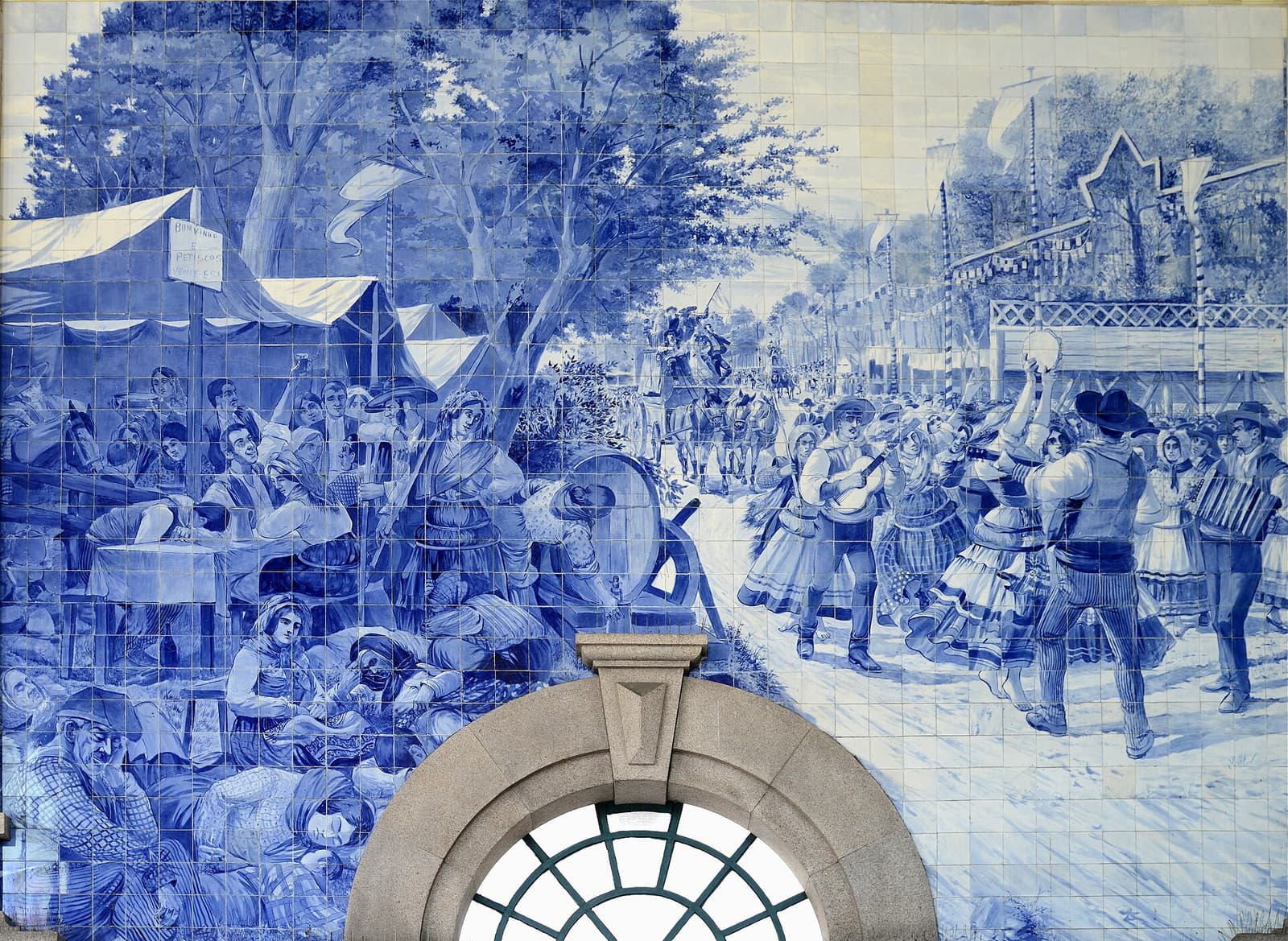
Simultaneously, large figurative panels emerged with historicist and late-Romantic tastes, finding their undisputed master in Jorge Colaço (1868-1942). A trained painter, Colaço worked on glazing and subjected pieces to a second firing, achieving watercolor-like effects. His panels at Porto’s São Bento Station (1905-1916) depict battles, pilgrimages and ethnographic scenes; others adorn Casa do Alentejo and the grand Battle of Aljubarrota panel (1922) in Eduardo VII Park. He reportedly signed over a thousand panels in Portugal and abroad.
With Colaço, azulejos ceased being mere cladding to become mural painting: ceramic walls narrated national history with the ambition of canvas art.
From Art Deco to Nationalist Impulses
During the 1920s-30s, azulejos embraced Art Deco tastes — geometric patterns, symmetries and flat colors — visible in Vila Franca de Xira façades and works by artists like Raúl Lino for Cerâmica Constância Factory. Under the Estado Novo regime, a backward-looking tile style prevailed, serving historical and regionalist narratives while still indebted to Colaço’s figurative grammar.
The impending artistic renewal resonated in Jorge Barradas’ work, who from the 1940s restored plastic freedom to azulejos, aligning them with contemporary painting and paving the way for the next generation.
Maria Keil and Modernist Abstraction
The major modernist shift came through Maria Keil (1914-2012). Working from Viúva Lamego Factory, Keil designed abstract panels for Lisbon Metro’s inaugural stations (1957-1972) — Portugal’s most extensive public abstract mural project for decades. Reviving the ancient corda seca technique for entirely new geometric and chromatic language, she transformed underground spaces into public galleries and restored prestige to a declining art form.
With her emerged modernism’s first azulejo generation, featuring Querubim Lapa (1925-2016, often regarded as Portugal’s greatest 20th-century ceramist), Manuel Cargaleiro, Lino António and later Eduardo Nery. Working primarily at Viúva Lamego, these artists turned cities — metro stations, public buildings, façades — into canvases for public art blending tradition and avant-garde. Thus 20th-century azulejos completed the circle opened in the Middle Ages: from modular medieval patterns to contemporary abstraction, while remaining quintessentially Portuguese wall art.
Frequently asked questions
- Who was the main Art Nouveau tile artist in Portugal?
- Jorge Colaço (1868-1942) was the leading figure of figurative tilework in the early 20th century, creator of the panels at São Bento Station in Porto and Casa do Alentejo in Lisbon.
- Who renewed modernist azulejos in Portugal?
- Maria Keil (1914-2012) and Querubim Lapa (1925-2016) led the modernist renewal, particularly through Viúva Lamego Factory and the panels for Lisbon Metro's early stations.
- Where can you see Art Nouveau azulejos in Portugal?
- On façades in Lisbon, Setúbal, Aveiro and Leiria, and in Jorge Colaço's figurative panels across train stations, hotels and public buildings nationwide.