Intangible Heritage
Peniche Bobbin Lace
Peniche bobbin lace, a centuries-old textile craft from the Leiria coast, is the handmade emblem of the town and a benchmark of Portuguese lace.
- Location
- Peniche, Leiria
- Built
- séc. XVII
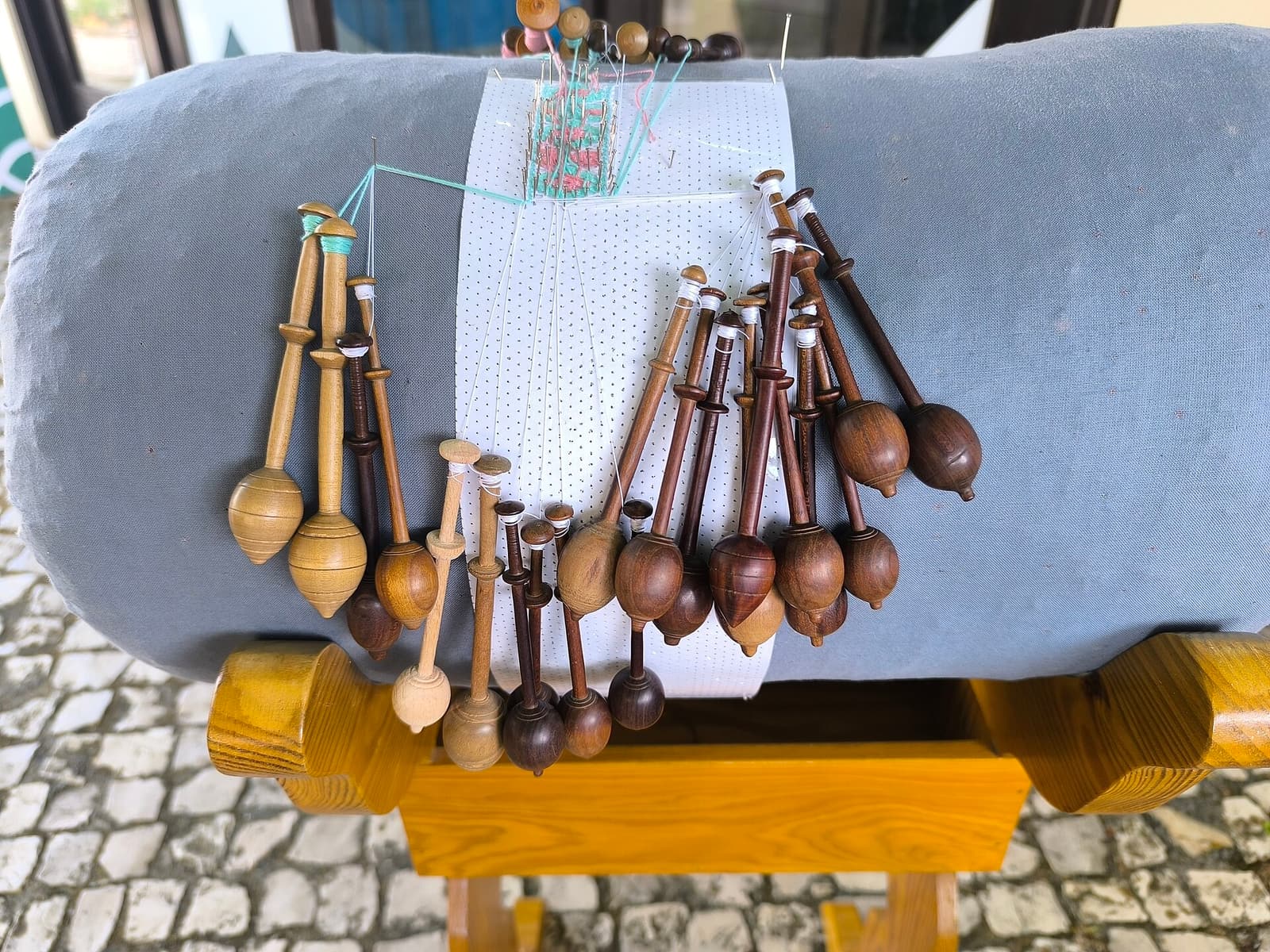
Peniche bobbin lace is one of Portugal’s most remarkable traditional textile crafts and the emblematic handicraft of this fishing town on the Leiria district coast. It is a manual production art where the lacemaker intertwines dozens of threads wound around small wooden pieces—the bobbins—handled in pairs over a cylindrical cushion, creating delicate white pieces of great complexity. Peniche’s reputation was such that, for a long time, nearly all bobbin lace produced in the country became generically known as “Peniche lace.”
History and origin
The earliest documents referencing this art in Peniche date back to the 17th century, though oral tradition among the oldest lacemakers traces it to earlier periods. One hypothesis for its arrival links it to commercial and maritime relations established with sailors and fishermen from the Flemish ports of Bruges and Antwerp, European hubs of bobbin lace.
The craft gained significant social prominence throughout the 19th century: by 1862, an estimated 962 lacemakers were active in the town. While men went fishing, many women combined fish salting and processing with lacemaking, often at their doorsteps. In 1887, the Rainha Maria Pia Industrial Drawing School was founded, later renamed the School of Arts and Crafts, which included lacemaking instruction until the course’s closure in the mid-20th century.
Technique and know-how
Creating a piece begins with a design transferred onto pricked cardboard—the pricking—which serves as a guide. Over the cushion, the lacemaker secures the threads with pins and weaves the lace through rhythmic, repeated bobbin movements, combining stitches like the foot, whole stitch, and half stitch. Historically, the complexity of pieces required collaboration among different roles: the lacemaker, the finisher, the seller, and the pricking designer.
This knowledge has always been transmitted orally within families, generation to generation, through informal learning processes starting at a young age. Like other expressions of intangible cultural heritage in Portugal, its continuity depends on the active transfer of knowledge between experienced lacemakers and new generations.
Recognition and local identity
Bobbin lace is deeply intertwined with Peniche’s identity, a town also marked by its imposing fortress. To study, preserve, and promote this heritage, the municipality established a lace school-workshop in 1987 and, in 2016, inaugurated a museum dedicated to the craft’s material and intangible dimensions.
Alongside other recognized Portuguese handicrafts, such as Estremoz clay figurines or the broader tradition of bobbin lace, Peniche’s know-how stands as a cultural reference whose preservation relies on the ongoing work of lacemakers and local institutions keeping the art alive.
Frequently asked questions
- What is Peniche bobbin lace?
- It is a traditional textile art crafted by hand, intertwining threads wound around bobbins that the lacemaker handles in pairs over a cushion, following a pricked cardboard pattern. It is the emblematic handicraft of Peniche.
- Since when has bobbin lace been made in Peniche?
- The tradition dates back at least to the 17th century, the era of the first documents referencing this art in the town. By 1862, there were approximately 962 lacemakers in the locality.
- How is lacemaking learned?
- The know-how is passed down orally through generations within families. Traditionally, girls began learning at a young age, a practice reinforced by local schools and workshops throughout the 19th and 20th centuries.