Archaeology
Roman Villa of Milreu
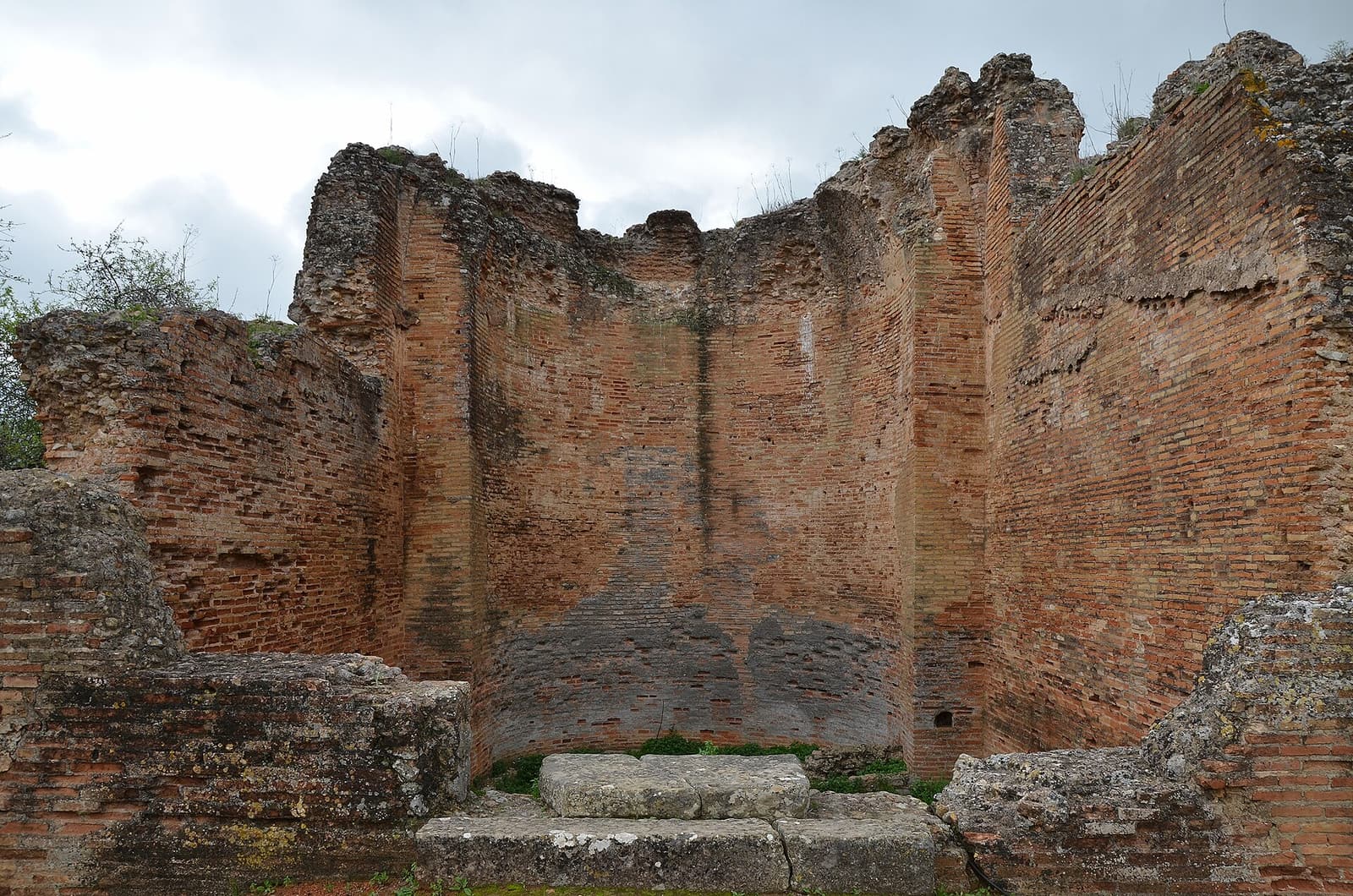
Roman villa of Milreu in Estói (Faro), one of the most remarkable Roman complexes in the Algarve, featuring a temple-mausoleum and fish mosaics.
- Location
- Estói, Faro
- Built
- Séculos I–IV d.C.
- Style
- Romano
The Roman Villa of Milreu stands on an agricultural plateau in the parish of Estói, north of Faro, and represents one of the most complete and well-preserved testimonies of Roman presence in the Algarve. The site combines, within a single complex, a manor residence, baths, production facilities, and above all, a remarkable temple-mausoleum — a combination that makes Milreu an exceptional document of rural and religious life in ancient Lusitania.
From rural villa to manor residence
The occupation of the site dates back to the 1st century AD, when a modest agricultural estate was established here. Over the 2nd and 3rd centuries, successive expansions transformed it into a grand villa, organised around a peristyle courtyard. The property combined residential and productive functions: remnants of olive presses and facilities for processing agricultural products survive, reflecting the economic activities that sustained its owners’ wealth. The presence of baths with hypocaust heating systems, decorated with mosaic floors, confirms the sophistication of a provincial elite living according to Roman urban models.
The mosaics largely tell the story of their owners’ tastes. Marine motifs dominate — fish, dolphins, and aquatic creatures — frequently associated with wealth generated by fishing and the salt-curing industry, which thrived along the Algarve coast. This iconography links Milreu to other contemporary sites, such as the Roman ruins of Cerro da Vila in Vilamoura, where a similar connection to the sea is documented.
The water temple-mausoleum
The feature that distinguishes Milreu from almost all its Iberian counterparts is the temple built in the 4th century. Rectangular in plan and raised on a podium, it was dedicated to water worship, a theme that runs through its entire decoration: the frieze encircling the building’s base extends for dozens of metres with mosaics teeming with fish and marine creatures. This typological rarity, in a rural context and a late period, makes it one of the most studied structures in Portuguese Roman archaeology.
The survival of Milreu’s temple through three successive faiths — pagan, Christian, and Islamic — encapsulates, in a single building, a thousand years of the Algarve’s religious history.
The monument’s longevity is remarkable. After the pagan era ended, the temple was adapted into a Christian basilica in late antiquity, acquiring a baptistery; later, in an Islamic context, it was repurposed for Muslim worship. This rare and well-documented continuity of use elevates the site beyond the Roman sphere, embedding it in the long durée of Roman Portugal’s archaeology.
Rediscovery and preservation
Scientific investigation of the site began in 1877 with Estácio da Veiga, a pioneer of Algarve archaeology, and continued in the 20th century with campaigns conducted in partnership with German institutions, which clarified the complex’s chronology and layout. In 1910, Milreu was classified as a National Monument, joining the select group of properties protected in Portugal’s first major heritage listing.
Today the site is museumised and open to visitors, with an interpretive centre providing context for the ruins. It lies a short distance from Estói Palace, on a route that crosses different eras of Faro municipality’s heritage, and clearly exemplifies the principles of Roman architecture in Portugal, balancing the functionality of a productive villa with the monumentality of a cult building.
Frequently asked questions
- Where is the Roman villa of Milreu located?
- It is situated in the parish of Estói, municipality of Faro, in the Algarve, approximately nine kilometres north of the city of Faro.
- What made the Milreu villa famous?
- Its 4th-century temple-mausoleum, dedicated to water worship and adorned with fish mosaics, is rare in Hispania and among the best-preserved in the Iberian Peninsula.
- When was it discovered and classified?
- It was excavated by Estácio da Veiga in 1877 and classified as a National Monument in 1910.
Sources
Keep exploring
Heritage nearby
More places to discover from here. Approximate straight-line distances, within 50 km.