Monuments
Estói Palace
Estói Palace, a romantic Rococo-inspired mansion in Faro municipality, famed for its tiled terraced gardens and now operating as a heritage hotel.
- Location
- Estói, Faro
- Built
- 1840–1909
- Style
- Rococó / Romantismo
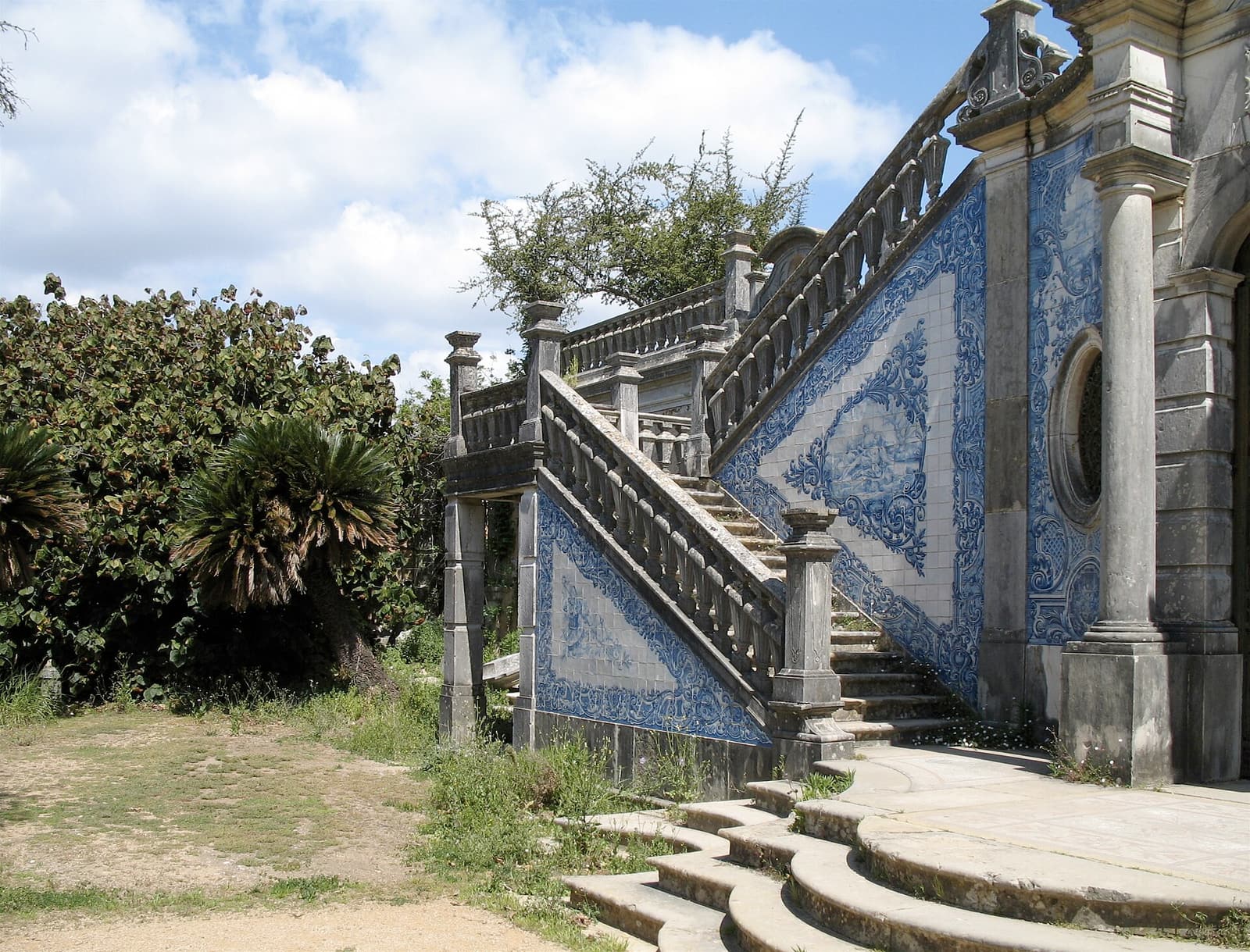
Estói Palace, also known as Quinta de Estói or Quinta do Carvalhal, is a 19th-century mansion located in the village of Estói, Faro municipality. Considered one of the most remarkable examples of leisure architecture in the Algarve, it stands out for the decorative exuberance of the building and, above all, for its tiled terraced gardens. It has been classified as a Property of Public Interest since 1977.
History and construction
The estate originated from an 18th-century country house linked to the Carvalhal e Vasconcelos family, but the palace as we know it today resulted from a long and discontinuous process. Construction began around 1840, remaining unfinished after the death of its promoter. The decisive impulse came in 1893 when José Francisco da Silva — a wealthy emigrant returned from Brazil — acquired the property and invested much of his fortune in completing the work. The palace was solemnly inaugurated in May 1909, with celebrations lasting several days.
The campaign led by José Francisco da Silva gave the building its eclectic character, combining references from Baroque, Rococo, Neoclassicism and the then-fashionable Romanticism. Its overtly palatial style frequently associates it with the Queluz National Palace, evoked both in its decorative language and in the logic connecting the palace to its gardens. The result is one of the most accomplished expressions of Rococo in Portugal within an Algarve context.
Gardens and decoration
The most celebrated element is the garden, organized across three levels connected by monumental staircases. Fountains, statuary and blue-and-white tile panels cover walls, benches and artificial grottoes, creating a scenographic route culminating in a belvedere terrace. Among the sculptural pieces stand out a marble Three Graces group and various allegorical motifs. The palace interior preserves lavishly ornamented rooms and a Louis XV-style chapel with painted ceilings.
In its conception, Estói Palace belongs to the tradition of Portuguese leisure estates, where noble house and garden form an inseparable whole designed for leisure and display. The profusion of narrative and ornamental tilework also makes it a significant repository of late 19th-century ceramic art for facades and exteriors.
Heritage hotel and visits
Acquired by Faro Municipal Council in 1987, the palace underwent a lengthy restoration process. Adaptation works for its hotel conversion began in 2003 under architect Gonçalo Byrne’s design, with the Pousada Palácio de Estói opening in 2009 in partnership with Pestana Group. The historic building was preserved and complemented by a contemporary wing for guest rooms — a solution reconciling tourism with heritage preservation.
Located about ten kilometres from Faro, the ancient village of Estói retains other heritage assets nearby, making the palace a natural starting point to explore this territory. The gardens and parts of the premises remain accessible to visitors, offering close appreciation of one of southern Portugal’s most distinctive Romantic architecture ensembles.
Frequently asked questions
- Where is Estói Palace located?
- It is situated in the village of Estói, in Faro municipality, Algarve, approximately 10 km from the city of Faro.
- Can Estói Palace be visited?
- Yes. The palace operates as a hotel, but the historic gardens and parts of the premises remain accessible to the public.
- What is its heritage classification?
- It has been classified as a Property of Public Interest since 1977, under Decree No. 129/77.
Sources
Keep exploring
Heritage nearby
More places to discover from here. Approximate straight-line distances, within 50 km.