Themes
Portuguese Azulejo
An overview of the Portuguese azulejo, from its sixteenth-century arrival from Seville to Baroque blue and white and contemporary creations, and its place in…
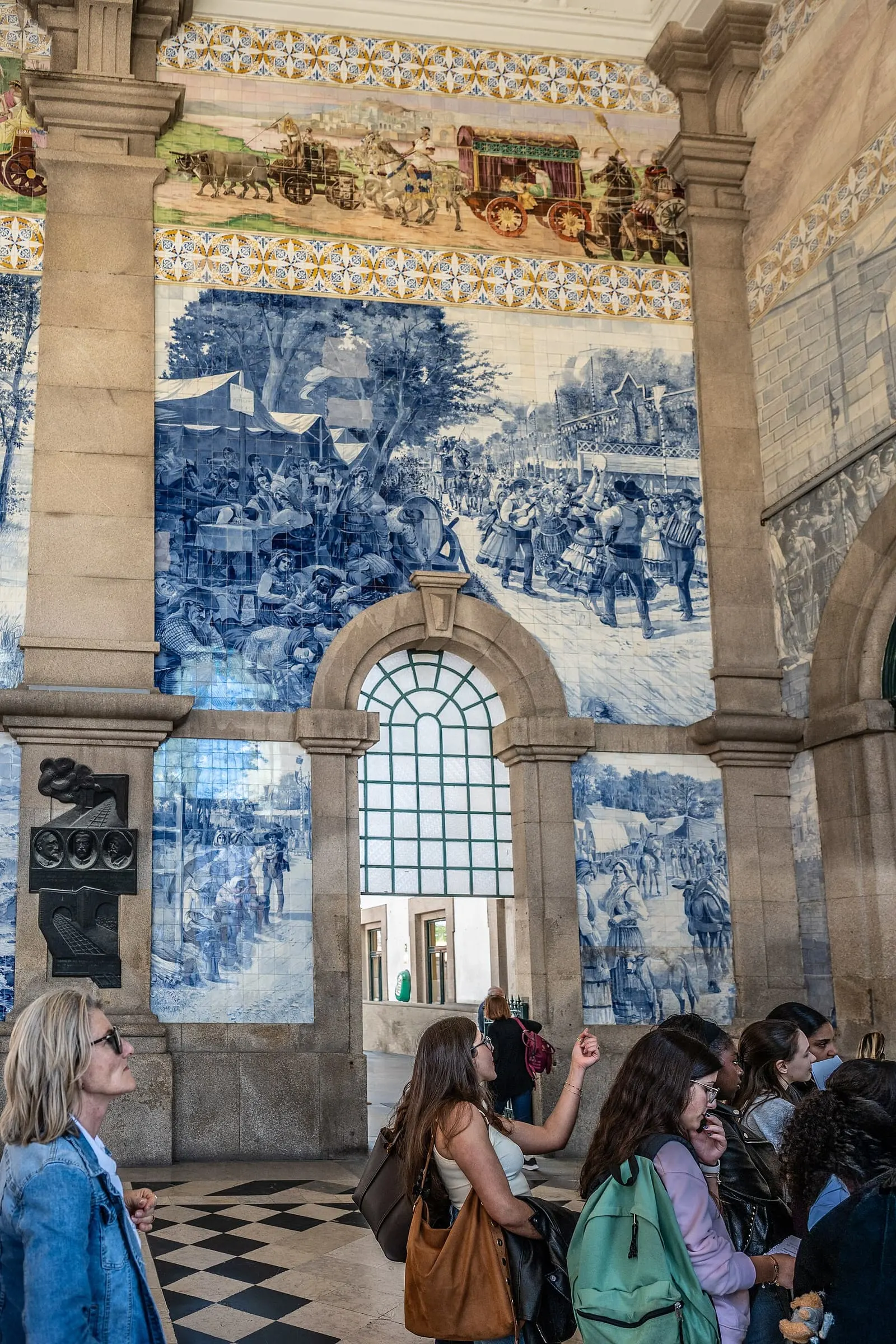
The azulejo is, more than a wall covering, one of the artistic languages that most distinctively identify Portugal. Applied to façades, churches, palaces, staircases, stations and gardens, it has accompanied the country’s built landscape for five centuries, combining function and ornament: it protects and cools walls, organises surfaces and, above all, narrates. Through its historical continuity and the scale on which it covers the territory, it constitutes a central chapter of the Portuguese decorative arts and an unavoidable element of the national built heritage.
From the Hispano-Moorish arrival to majolica
The word derives from the Arabic az-zulayj, “polished stone”, and points to the cut mosaics (alicatados) of the Iberian Islamic tradition. It was by this route that the azulejo entered Portugal: around 1500, King Manuel I had rooms of the Palácio Nacional de Sintra covered with Hispano-Moorish panels imported from Seville, executed using the corda-seca (dry-cord) and aresta (raised-edge) techniques, which separated the glazes with grooves or small ridges of clay to prevent the colours from mixing during firing.
The great technical turning point came in the mid-sixteenth century with majolica, which arrived from Italy: by coating the tile with a white, opaque tin glaze, it became possible to paint directly onto the surface, as on a canvas. This opened the way for figurative composition, of which the Renaissance panels of the Quinta da Bacalhoa are an early example.
The Baroque cycle and blue and white
Over the course of the seventeenth century, the art of the repeated seventeenth-century pattern developed, in which polychrome modules multiply to form continuous carpets of great decorative effect. It was also the era of the first great church revetments, such as those of the Igreja de São Roque in Lisbon.
The turn of the eighteenth century made the azulejo a monumental narrative medium: entire surfaces came to tell biblical stories, mythological scenes and episodes of everyday life.
Around 1700, under the influence of Chinese porcelain and European engraving, the fashion for the blue and white azulejo took hold. In the so-called “cycle of the masters”, workshops such as that of António de Oliveira Bernardes signed vast figurative programmes. After the earthquake of 1755, Pombaline azulejo work adapted to the reconstruction of Lisbon, with more sober modules of faster production, suited to the utilitarian spirit of the new city.
From the nineteenth century to contemporary creation
Nineteenth-century industrialisation democratised the façade azulejo, which covered urban buildings from Porto to Lisbon and became a hallmark of the cities. At the turn of the century came Art Nouveau interpretations and, already in the twentieth century, the azulejo asserted itself as a medium of public art: Jorge Colaço executed great historicist panels, while Maria Keil conceived the revetments of the Lisbon Metro, restoring to the medium a modern, abstract dimension.
This uninterrupted vitality sets the Portuguese case apart in the European panorama of glazed ceramics and connects it intimately with the broader tradition of Portuguese ceramics and faience. The reference collection for understanding this trajectory is held at the Museu Nacional do Azulejo in Lisbon, housed in the former Convento da Madre de Deus, whose collection documents the evolution of the art from the sixteenth century to our own day.
Frequently asked questions
- What is the origin of the word azulejo?
- It derives from the Arabic az-zulayj, meaning polished or smooth stone. The word has no etymological connection to the colour blue (azul), even though the blue and white azulejo became its most celebrated image.
- When did the azulejo arrive in Portugal?
- The first significant ensembles date from the early sixteenth century, when King Manuel I had Hispano-Moorish azulejos imported from Seville applied in the Palácio Nacional de Sintra, around 1500.
- Where can the history of the Portuguese azulejo be studied?
- The Museu Nacional do Azulejo in Lisbon, housed in the former Convento da Madre de Deus, holds the principal collection and traces the evolution of azulejo art from the sixteenth century to the present day.