Monuments
Church of São Roque (Lisbon)
The Church of São Roque in Lisbon: a Mannerist Jesuit church on Largo Trindade Coelho, famed for the opulent Chapel of St John the Baptist made in Rome.
- Location
- Lisboa, Lisboa
- Built
- 1553–1619
- Style
- Maneirista
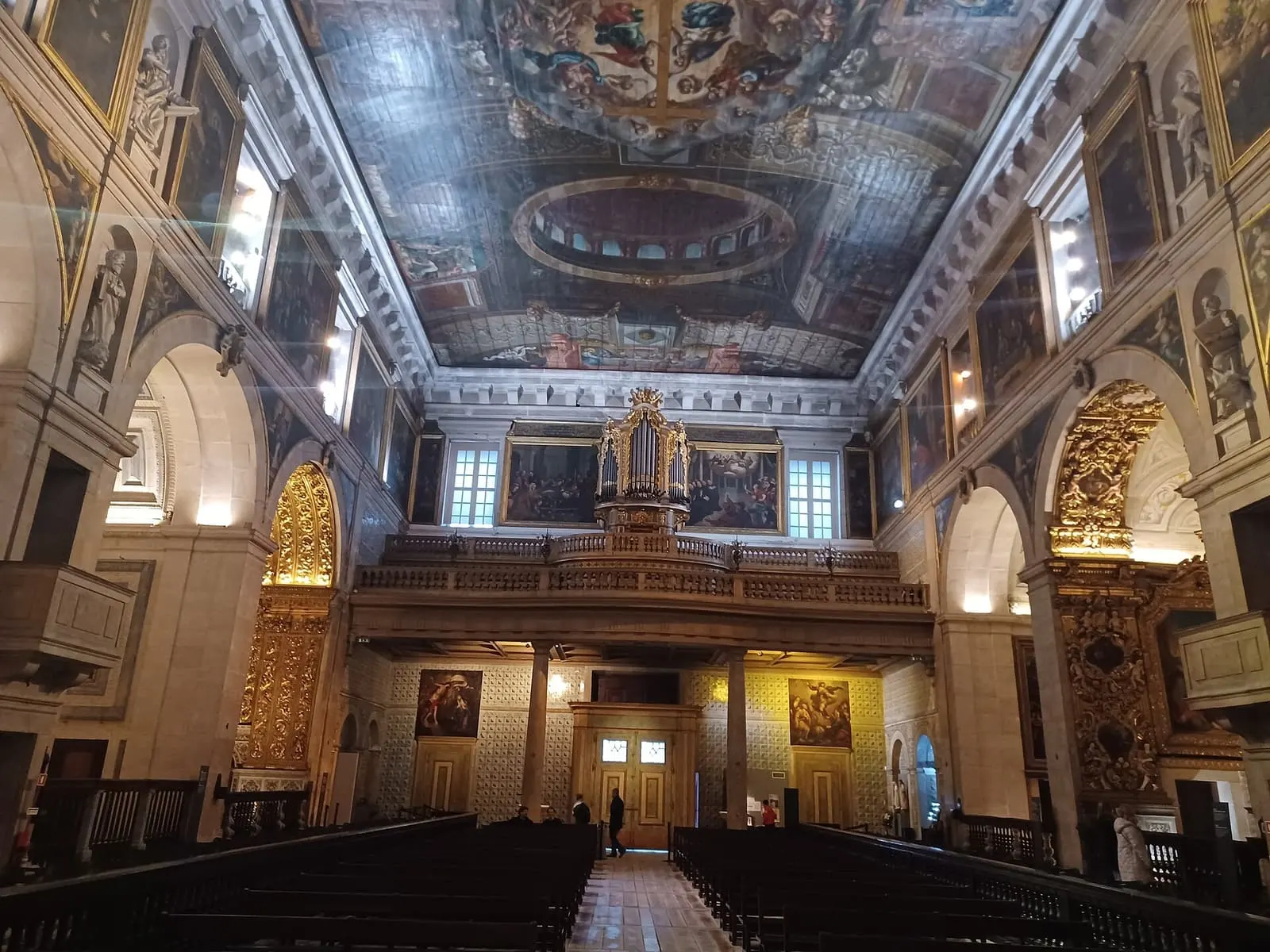
The Church of São Roque, on Largo Trindade Coelho in Lisbon, is one of the most singular churches in the city: outwardly, a sober and almost austere façade; within, one of the richest interiors of the Portuguese Baroque. It was the first church of the Society of Jesus built on Portuguese soil and one of the earliest Jesuit churches in the world, a founding landmark of a model of worship space conceived for preaching.
From plague hermitage to Jesuit professed house
Devotion to St Roch, invoked against the plague, took root on this high point of the city in the early sixteenth century, when a small hermitage stood here beside a cemetery for plague victims. In the mid-sixteenth century the site was granted to the Jesuits, who built their professed house here. The present church began to be erected in 1553 and the works extended until around 1619, the design being attributed to Afonso Álvares and Filippo Terzi.
The result is one of the most representative works of religious Mannerism in Portugal. The plan, a single broad and unobstructed nave free of major visual barriers, corresponds to the so-called “hall church” or preaching-church model, conceived so that the congregation could see and hear the preacher. The flat ceiling, painted in illusionistic perspective, is one of its most remarkable features and converses with the decorative tradition running through several periods and styles of the nation’s architecture.
The Chapel of St John the Baptist, made in Rome
The high point of São Roque is the Chapel of St John the Baptist, commissioned by King John V and an embodiment of the magnificent taste of his reign. Designed by Luigi Vanvitelli and Nicola Salvi, it was built and assembled entirely in Rome, with rare marbles, lapis lazuli, agate, alabaster, gilded bronzes and mosaics that imitate painting. Blessed by Pope Benedict XIV in 1744, it was then dismantled, transported by sea and reassembled in Lisbon in 1747.
Few works reveal so clearly the scale of John V’s ambition: an entire chapel, commissioned from afar and financed with the gold of Brazil, transported piece by piece from Rome to a corner of Lisbon.
The chapel made São Roque an almost unique case in Europe — an Italian interior of high ceremony within a Portuguese church — and its treasury of vestments and liturgical implements, today partly displayed in the adjoining museum, ranks among the most valuable in the country.
Survival, the Misericórdia and heritage
The church’s robustness proved decisive in 1755: unlike so many Lisbon churches ruined by the earthquake, São Roque survived practically intact. For this reason it was handed over to the Santa Casa da Misericórdia de Lisboa, which transferred its headquarters there after losing its original church, near the Lisbon Cathedral. That institutional link endures to this day, and the Misericórdia manages the complex of the church and the Museu de São Roque.
Listed as a National Monument in 1910, the church forms part of the capital’s circuit of religious heritage, alongside works such as the Church of Santa Engrácia (National Pantheon) and the monumental ensemble that the future nomination of Pombaline Lisbon seeks to promote. Among its nine chapels, painted ceilings and collection of sacred art, São Roque remains one of the essential places for understanding Portuguese Baroque and Mannerism, and one of the unmissable stops among the monuments of Portugal.
Frequently asked questions
- Why is the Chapel of St John the Baptist famous?
- It was commissioned by King John V, designed and executed in Rome with rare marbles, lapis lazuli, agate and mosaics, blessed by Pope Benedict XIV in 1744, and then dismantled and reassembled in Lisbon. It is regarded as one of the most expensive chapels in the Europe of its time.
- Did the Church of São Roque survive the 1755 earthquake?
- Yes. The church withstood the 1755 earthquake almost without damage. It was then handed over to the Santa Casa da Misericórdia de Lisboa, which established its headquarters there after the destruction of its original church.
- Can the interior and the museum be visited?
- Yes. The church remains in use for worship and is open to visitors, and alongside it stands the Museu de São Roque, with sacred art and the chapel's treasure, managed by the Santa Casa da Misericórdia de Lisboa.
Sources
Keep exploring
Heritage nearby
More places to discover from here. Approximate straight-line distances, within 50 km.