Typologies
Schist Houses and the Schist Villages
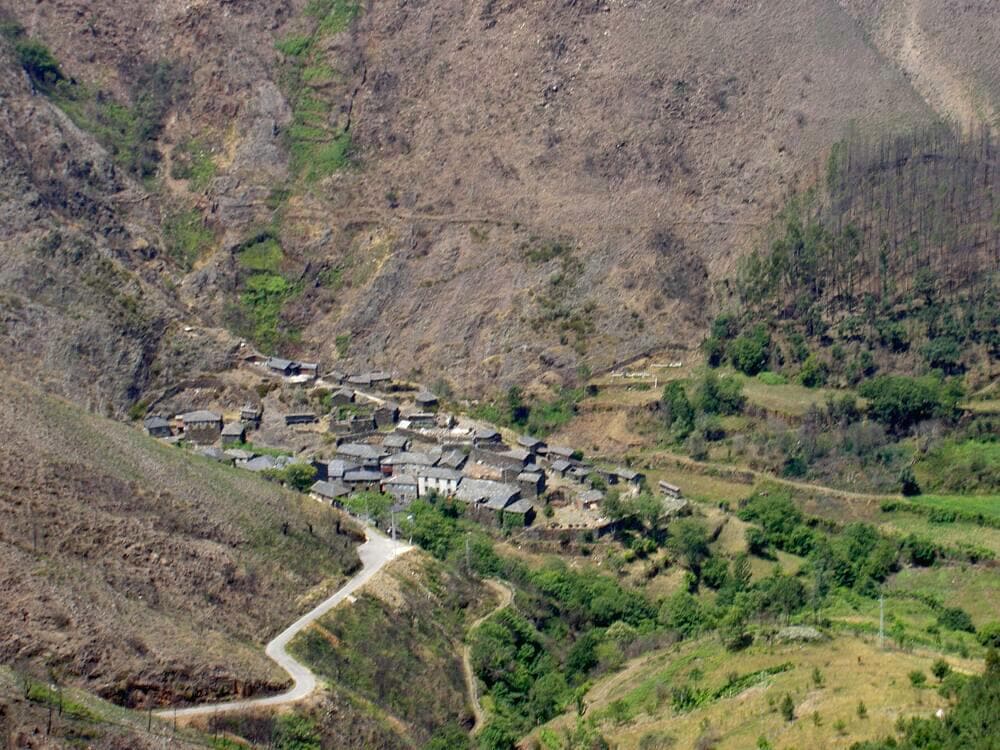
The schist houses and schist villages of Portugal's central interior, a vernacular architecture of stone in the Serra da Lousã, the Açor range and the Zêzere valley.
- Location
- Lousã, Coimbra
The schist houses constitute one of the most coherent expressions of Portuguese vernacular architecture. They rose over the centuries on the slopes of the country’s central interior, where schist — a dark, foliated and abundant metamorphic rock — provided at once the meagre soil, the rugged relief and the very building material. Born of the subsistence economy of the mountain communities, these dwellings reduced the act of building to its essentials: walls of loose or barely dressed stone, raised without mortar or with local clay, roofs of barrel tile and few openings, turned to leeward.
An architecture dictated by stone
The dominant trait of the schist houses is the wall in rough bonding, in most cases without rendering, leaving the dark, irregular texture of the stone exposed. The slabs rest one upon another with empirical mastery, adjusted by weight and form, in a knowledge handed down across generations of local masons. The dwellings are usually two storeys high: the ground floor, vaulted or with a low ceiling, served as byre and storeroom, while the upper floor, reached by an exterior stone stair, housed the family. The siting follows the gradient, fitting the volumes into the slopes and freeing for agriculture the scarce flatness of the soils, often organised into terraces.
This logic is akin to that of other regional building traditions, such as the granite houses of the Minho, in which local geology likewise determines the colour, the texture and the bonding of the walls. In both cases, vernacular architecture proves to be less a style than an intelligent response to climate, materials and ways of life.
Where the granite of the North imposes rigid angles and well-cut quoins, schist suggests winding streets and clusters of houses that seem to spring from the rock itself, indistinct from the slope of which they form part.
Villages suspended in the mountains
Gathered together, these houses form compact villages of narrow, cobbled streets, often wrapped in mist, scattered across the Serra da Lousã, the Serra do Açor and the valleys of the Zêzere and the Tejo-Ocreza. There are traces of human occupation in this territory since prehistory, but stable settlement came about chiefly in the Middle Ages, through the action of the religious orders, of pastoralism and of mountain trade. Villages such as Talasnal, Candal or Casal Novo, on the western flank of the Serra da Lousã, became emblematic images of this cultural landscape.
Throughout the twentieth century, rural exodus gradually emptied the mountains and many settlements came to the brink of abandonment. The organised response emerged in the year 2000, with a requalification programme supported by European funds through the Regional Coordination and Development Commission of the Centre, which gave rise, in 2001, to the network of the Schist Villages. Now managed by ADXTUR, this network comprises 27 villages from 16 municipalities, restoring houses, preserving the original layout and fostering tourism, crafts and local produce.
Preserving a cultural landscape
Safeguarding the schist houses goes beyond the conservation of isolated buildings: it is a matter of protecting a complete cultural landscape, in which architecture, vegetation, paths and intangible heritage are interwoven. The rehabilitation works seek to respect traditional techniques and materials, avoiding renderings and roofings foreign to the place, much like the effort applied to other recognised rural ensembles, such as the historic villages of Portugal. Alongside building, mountain crafts and know-how survive — among them the transformation of wool into burel of the Serra da Estrela — a reminder that these villages are not frozen scenery, but communities seeking to rediscover a future from their memory of stone.
Frequently asked questions
- What is a schist house?
- It is a traditional dwelling of Portugal's central interior built from slabs and blocks of schist, generally in rough bonding and without rendering, with thick walls that respond to the mountain climate and make use of the stone available on site.
- How many schist villages are there?
- The Schist Villages Network brings together 27 restored villages, spread across 16 municipalities of central Portugal, in the Lousã and Açor ranges and in the valleys of the Zêzere and the Tejo-Ocreza.
- Where are the schist villages located?
- They are concentrated in the country's central interior, above all in the Serra da Lousã, near Coimbra, but they also extend into the Açor, the Zêzere and the Tejo-Ocreza areas, covering districts such as Coimbra, Castelo Branco, Guarda and Leiria.