Archaeology
Citânia de Sanfins
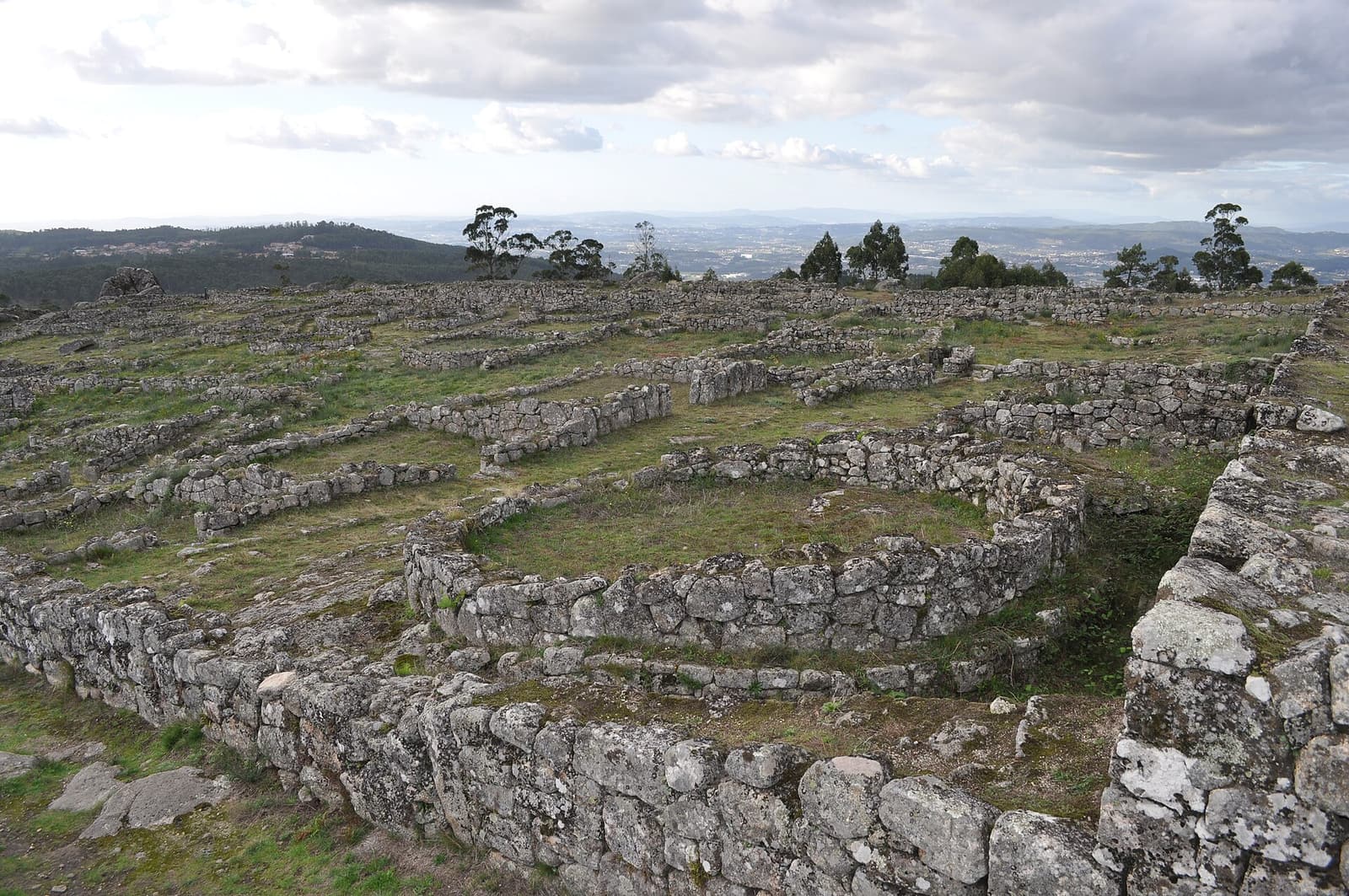
Citânia de Sanfins, the great Castro-culture oppidum of Paços de Ferreira with its triple walled enclosure, bathhouse and the Warrior of Sanfins.
- Location
- Paços de Ferreira, Porto
- Built
- Séculos III a.C. – I d.C.
- Style
- Cultura castreja
The Citânia de Sanfins is one of the largest and most thoroughly studied fortified Iron Age settlements of the north-west of the Iberian Peninsula. Set on the summit of a hill of the Serra da Lixa, in the parish of Sanfins de Ferreira (Paços de Ferreira, district of Porto), it commands a vast horizon over the Sousa valley and, at its height, was a genuine regional capital of the Castro culture. Listed as a national monument since 1946, the citânia extends over more than fifteen hectares and reveals, in its layout, the degree of complexity these communities attained in the centuries that preceded and accompanied Romanisation.
An oppidum with a triple enclosure
The most striking feature of Sanfins is its defensive system, formed by three concentric lines of granite-block walls, reinforced to the north and south by ditches cut into the rock. Within this perimeter a dense cluster developed, with some 160 identified structures — for the most part single-plan circular houses, roughly five metres in diameter, but also quadrangular buildings of later influence.
The dwellings are organised into blocks or family clusters of four to five units arranged around shared courtyards, served by an orthogonal street layout, with a main north-south artery crossed by secondary streets. This urban regularity brings Sanfins close to the great oppida of the Castro world and sets it apart from the smaller settlements with their more spontaneous organisation.
The regular design of the streets and the articulation of the quarters around courtyards show that, at Sanfins, communal life took precedence over the mere juxtaposition of houses: we are before a true proto-historic town.
The bathhouse and the Pedra Formosa
Among the singular buildings, the Castro-culture bathhouse stands out, still supplied today by a natural spring. It is a space dedicated to ritual and steam bathing, with a heating furnace, a sauna chamber, a cooling antechamber and immersion tanks. Access to the innermost compartment was made through a Pedra Formosa — a monolithic slab decorated with geometric motifs, opening a low aperture that forced the user to enter on all fours, in a gesture laden with symbolism. These basin monuments are one of the most original creations of the Castro world of the Entre-Douro-e-Minho, and their function and typology can be explored further on the page devoted to the Pedra Formosa and the Castro-culture bathhouses.
Excavations, Romanisation and the Warrior
The first archaeological work at Sanfins dates back to 1895, at the initiative of Francisco Martins Sarmento, but it was from 1944, with the campaigns led by Eugénio Jalhay and, above all, by Afonso do Paço between 1946 and 1967, that the settlement was systematically uncovered. The investigations revealed an occupation that extended over several centuries, from the pre-Roman period to full integration into the Roman world, when new building typologies were introduced without the site losing its indigenous character.
Beside one of the entrances, the marks of the feet of a warrior statue set into the rock were found — testimony to the celebrated statuary of Galaico-Lusitanian warriors. The Warrior of Sanfins, with its round shield (caetra) and dagger, became one of the icons of the Portuguese Iron Age, and a replica has been placed on site, evoking the symbolic watch over access to the settlement.
For its monumentality and state of preservation, Sanfins relates directly to other great settlements of the North, such as the Citânia de Briteiros, in Guimarães, and the Monte Mozinho, in Penafiel, forming an essential group for understanding the transition between indigenous society and the Roman order in the north-west of the Iberian Peninsula. The materials recovered — pottery, goldwork, metal tools and elements of statuary — are today gathered in the Archaeological Museum of the Citânia de Sanfins, housed in the centre of the parish.
Frequently asked questions
- Where is the Citânia de Sanfins?
- It lies in the parish of Sanfins de Ferreira, in the municipality of Paços de Ferreira, district of Porto, occupying the summit of a hill of the Serra da Lixa.
- What is the Warrior of Sanfins?
- It is a statue of a Galaico-Lusitanian warrior found at the settlement, today a symbol of Castro-culture statuary. A replica has been placed on site, beside the rocks that overlook one of the entrances.
- Can the Citânia de Sanfins be visited?
- Yes. The settlement is open to the public and the archaeological finds are displayed in the Archaeological Museum of the Citânia de Sanfins, in the centre of the parish.
Sources
Keep exploring
Heritage nearby
More places to discover from here. Approximate straight-line distances, within 50 km.