Archaeology
The Iron Age in Portugal
The Iron Age in Portugal: fortified settlements, the Castro culture, Mediterranean contacts and proto-historic peoples before Romanisation.
- Built
- c. 800 a.C. – c. 19 a.C.
The Iron Age corresponds to the last great period of the prehistory and proto-history of present-day Portuguese territory, situated, in general terms, between the end of the second millennium and the beginning of the Bronze Age and the Roman conquest, completed in the final decades of the first century BC. It is defined not only by the spread of a new metal — iron, more abundant and versatile than bronze — but by a set of social, economic and symbolic transformations: the densification of fortified settlements, the hierarchisation of the territory, the intensification of agriculture and, above all, the entry of the western peninsula into the exchange networks of the Mediterranean. This is why archaeologists prefer to speak of “proto-history”, since, for the first time, peoples without a writing of their own begin to be named in the written sources of others, Greek and Roman.
Chronology and Mediterranean influences
The period is customarily divided into two broad phases. The First Iron Age, from around the eighth century BC, is marked by the arrival of Phoenician traders on the southern peninsular coasts, who founded trading posts and introduced the potter’s wheel, iron, the vine, writing and new prestige goods. In the lower Alentejo and the Algarve a strongly Orientalising culture then developed, heir to and continuation of the Tartessian world, associated with the enigmatic “Southwest stelae” and the oldest writing of the Peninsula, still not fully deciphered today. The Second Iron Age, roughly from the fifth–fourth century BC, witnessed the consolidation of the great settlements of the interior and the north and the advance of continental influence, with Celtic elements marking the toponymy and onomastics of large areas.
The novelty of the Iron Age lies not only in the metal: it lies in the fact that, for the first time, the communities of the Atlantic west became interlocutors — commercial and, later, military — of Mediterranean powers that left a written record.
The castros and the Castro culture
In the north-west — northern Portugal and the central coastal strip, extending into Galicia — the Castro culture took hold, based on fortified hilltop settlements, the castros, defended by ramparts, ditches and embankments. The houses, generally round in plan and covered with vegetation, were organised into quarters, and some settlements grew until they became true oppida, populous and hierarchised centres. The Citânia de Briteiros, in Guimarães, and the Castro de Romariz, in Santa Maria da Feira, are among the best preserved and studied examples, with streets, cisterns and ritual baths that reveal complex communities, culturally distinct from those of the south.
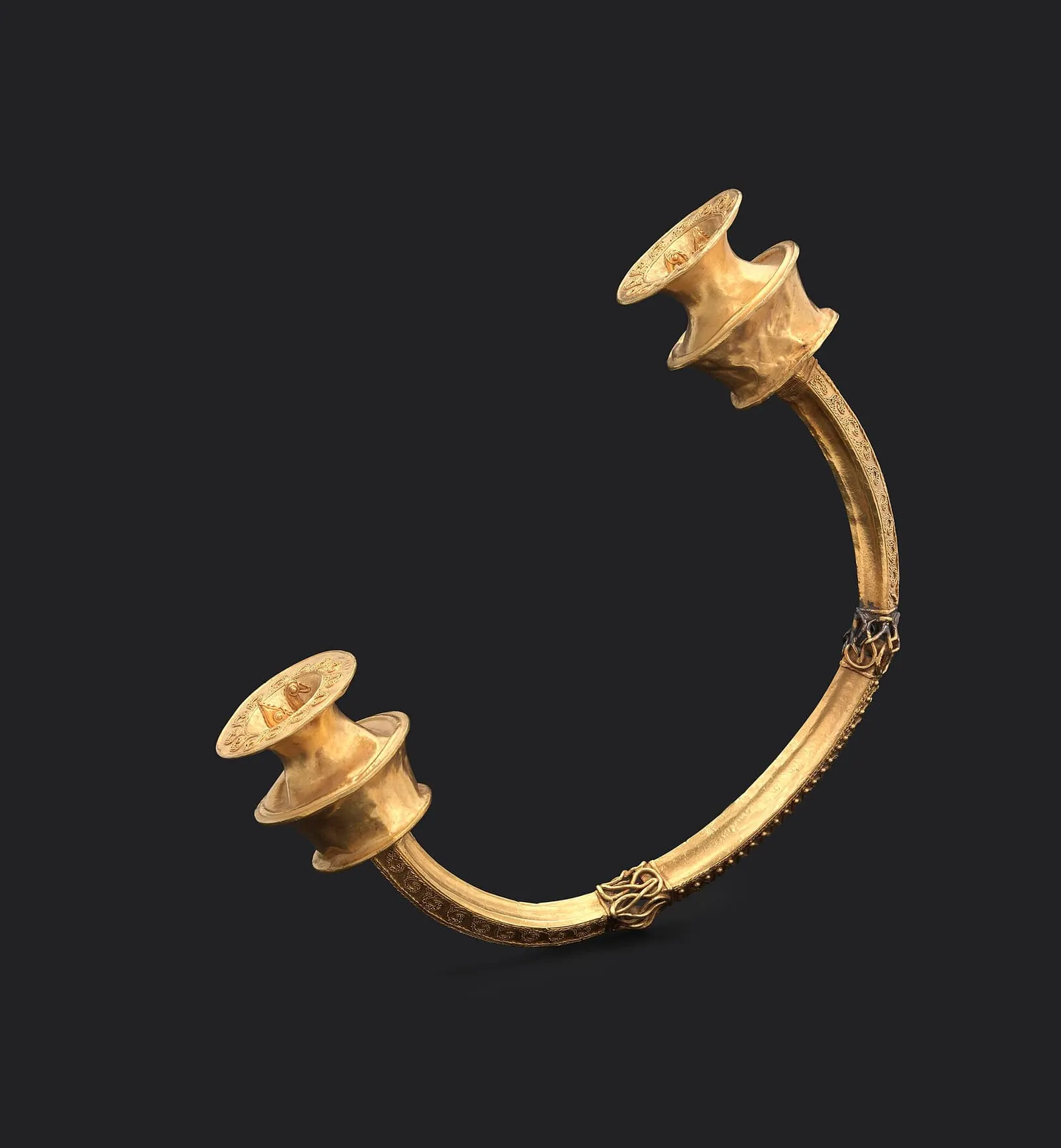
Alongside the architecture, the Castro culture left goldwork of extraordinary quality — torcs, earrings and gold pendants — and granite statuary of warriors and heads, which expresses warrior identities and local lineages. The pottery, often micaceous and decorated, and iron metallurgy complete a material picture that became more elaborate as exchanges and internal inequalities grew.
Peoples, sources and the end of the period
The classical sources populate this territory with names: the Gallaeci in the north-west, the Lusitanians in the central belt between the Douro and the Tagus, the Celtici in the Alentejo and northern Algarve, among many other groups. These designations, filtered through the Roman gaze, do not correspond to rigid frontiers, but to ethnic and political units in formation, sometimes capable of military coalitions — such as the one that, under the figure of Viriathus, resisted the expansion of Rome for years.
The end of the Iron Age coincides with Romanisation, a gradual process in which the local elites played a decisive role, integrating themselves into the new provincial order. Many castros were abandoned or repurposed, others endured, now framed within the Roman administration. The study of this period, central to Portuguese archaeology, remains in constant renewal, as radiocarbon dating and ongoing excavations refine chronologies once traced solely from the ancient texts.
Frequently asked questions
- When does the Iron Age take place in Portugal?
- Conventionally from around the eighth century BC, with the spread of iron metallurgy and Mediterranean contacts, until the Roman conquest of the territory, completed in the final decades of the first century BC with the campaigns against the Cantabri and Astures.
- What is the Castro culture?
- It is the material culture of the fortified hilltop settlements — the castros — that occupied the north-west of the Iberian Peninsula, including northern and central Portugal, during the Iron Age. It is characterised by round-plan houses, ramparts, goldwork and stone statuary.
- Which peoples inhabited the territory during the Iron Age?
- Greco-Roman sources mention, among others, the Gallaeci in the north-west, the Lusitanians in the central belt between the Douro and the Tagus, and the Celtici in the south, in the Alentejo and northern Algarve, as well as communities influenced by the Tartessian and Phoenician world to the south.