Archaeology
Citânia de Briteiros
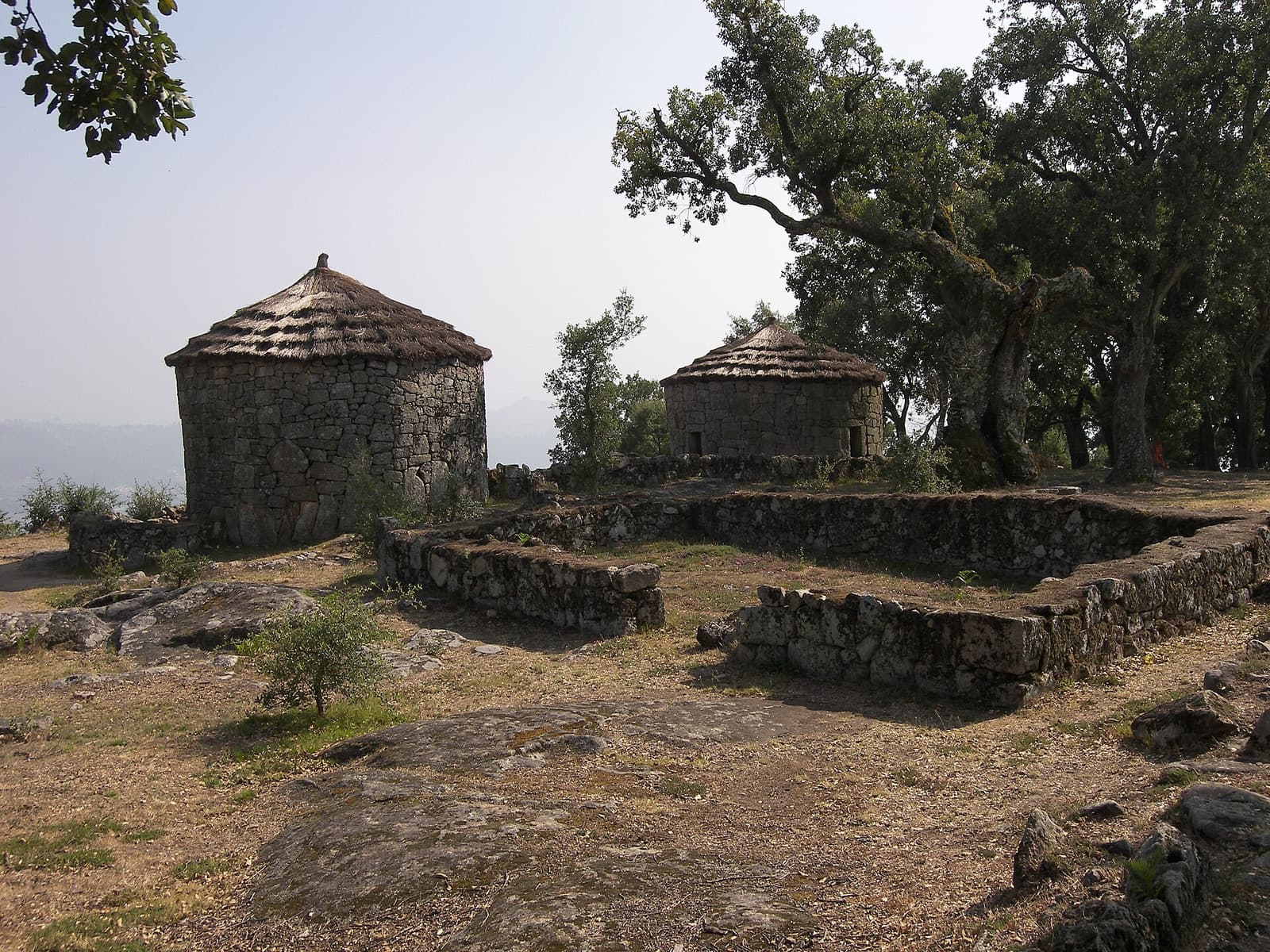
The Citânia de Briteiros, in Guimarães, is the most famous hillfort of the North-West, with hundreds of houses, paved streets and Iron Age bathhouses.
- Location
- Guimarães, Braga
- Built
- Séculos II–I a.C.
- Style
- Cultura castreja
The Citânia de Briteiros is the most celebrated fortified settlement of the Castro culture of the north-western Iberian Peninsula. Set on the summit of the Monte de São Romão, in the parish of Briteiros (São Salvador), about 15 kilometres from the centre of Guimarães, it rises on a spur commanding the valley of the river Ave. The monumental scale of the complex, the density of its houses and the organisation of its space have made it, since the nineteenth century, one of the most studied and most visited archaeological sites in Portugal.
A proto-urban Iron Age settlement
Occupation of the hill extends from the Bronze Age to the Middle Ages, but the settlement seen today corresponds above all to its apogee in the last two centuries before our era, well into the Iron Age. Defended by several lines of rampart encircling the slope, the agglomeration came to gather around a hundred dwelling units spread over an area of several hectares.
What sets Briteiros apart is its almost urban character. The houses, predominantly circular and built of granite, were grouped into family courtyards linked by a network of paved streets and alleys, often with channels for draining water. This architectural complexity, with a system of supply and drainage, reveals a populous and socially differentiated community, characteristic of the great Castro oppida that flourished on the eve of and during Romanisation.
The regularity of the streets and the presence of channelled water and buildings for collective use show that these hillforts were, already before Rome, true indigenous cities — and not mere fortified villages.
The bathhouses and the Pedra Formosa
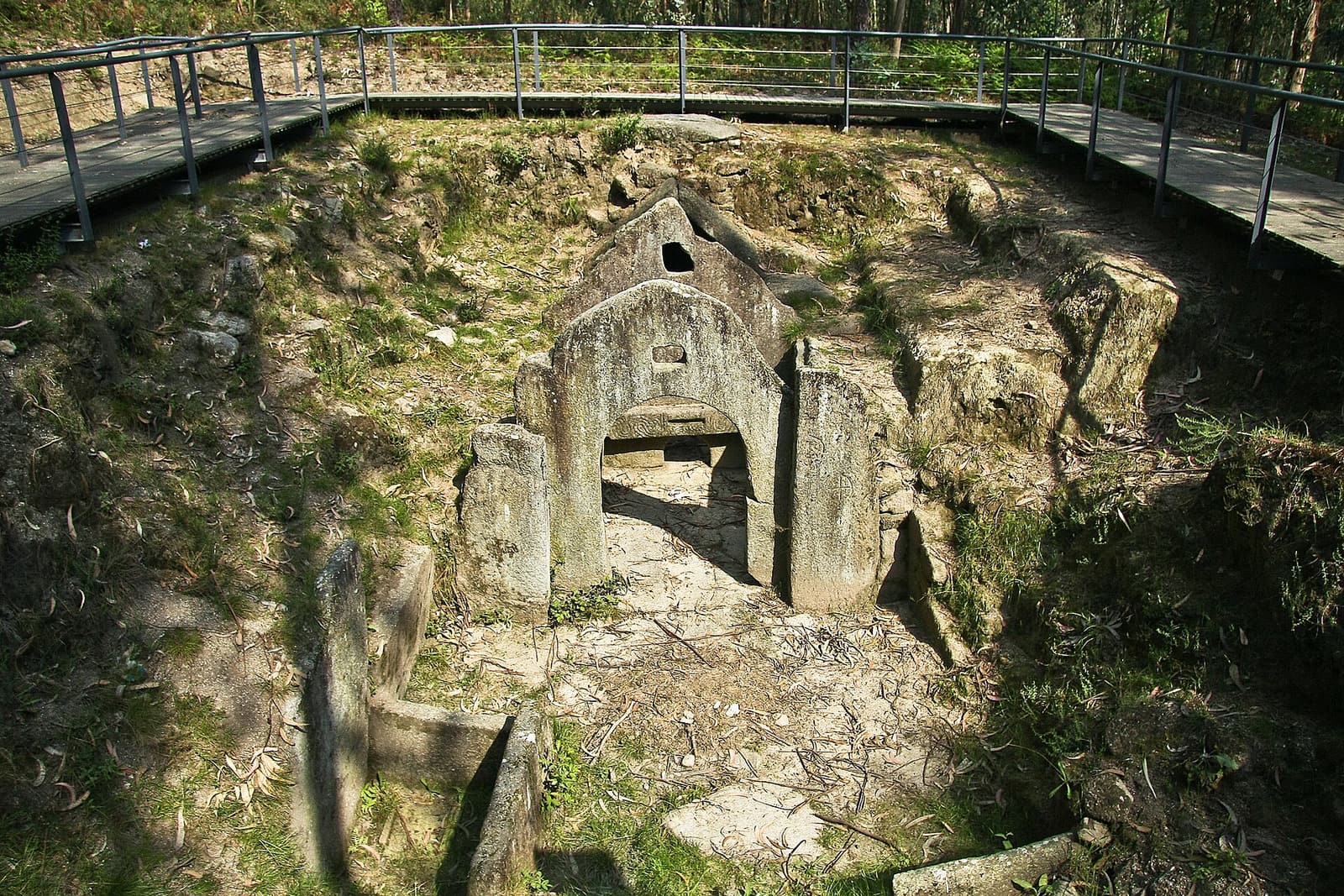
Among the most remarkable buildings are two Castro bathhouses, semi-buried structures associated with steam baths and purification rituals. Access to the furnace of these bathhouses was through a richly ornamented monolithic slab, the celebrated Pedra Formosa, carved with geometric decoration. These monuments, unique to the Castro culture of the North-West, constitute one of its most enigmatic identifying features, discussed in detail on the page devoted to the Pedra Formosa and the Castro bathhouses.
Martins Sarmento and the rediscovery of the hillfort
Briteiros owes its renown in large measure to Francisco Martins Sarmento, who in 1875 began here the systematic excavation campaigns that were pioneering in the country. His work, continued in the twentieth century by Mário Cardozo and other researchers, turned the site into an international reference for the study of the Castro culture. The collection gathered, including the Pedra Formosa and numerous works of art and epigraphy, today forms part of the Museum of the Sociedade Martins Sarmento, in Guimarães, an institution that continues to manage and study the site.
For its size and state of preservation, Briteiros is the obligatory point of comparison for the other great hillforts of the North-West, such as the neighbouring Citânia de Sanfins. Together, these settlements map out one of the most original civilisations of the European Iron Age, whose memory remains inscribed in the granite landscape of the Minho.
Frequently asked questions
- Where is the Citânia de Briteiros?
- It stands on the Monte de São Romão, in the parish of Briteiros (São Salvador), in the municipality of Guimarães, district of Braga, about 15 km north-west of the city centre.
- Who discovered and excavated the Citânia de Briteiros?
- Systematic excavations were begun in 1875 by Francisco Martins Sarmento, whose work made the settlement a benchmark of Castro-culture archaeology. The site is today managed by the Sociedade Martins Sarmento.
- From what period does the Citânia de Briteiros date?
- The settlement reached its apogee in the last two centuries BC, during the Iron Age, but occupation continued through the Roman period, with traces enduring into the Middle Ages.
Sources
Keep exploring
Heritage nearby
More places to discover from here. Approximate straight-line distances, within 50 km.